


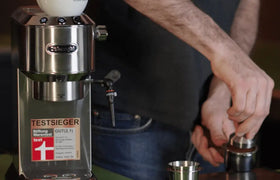
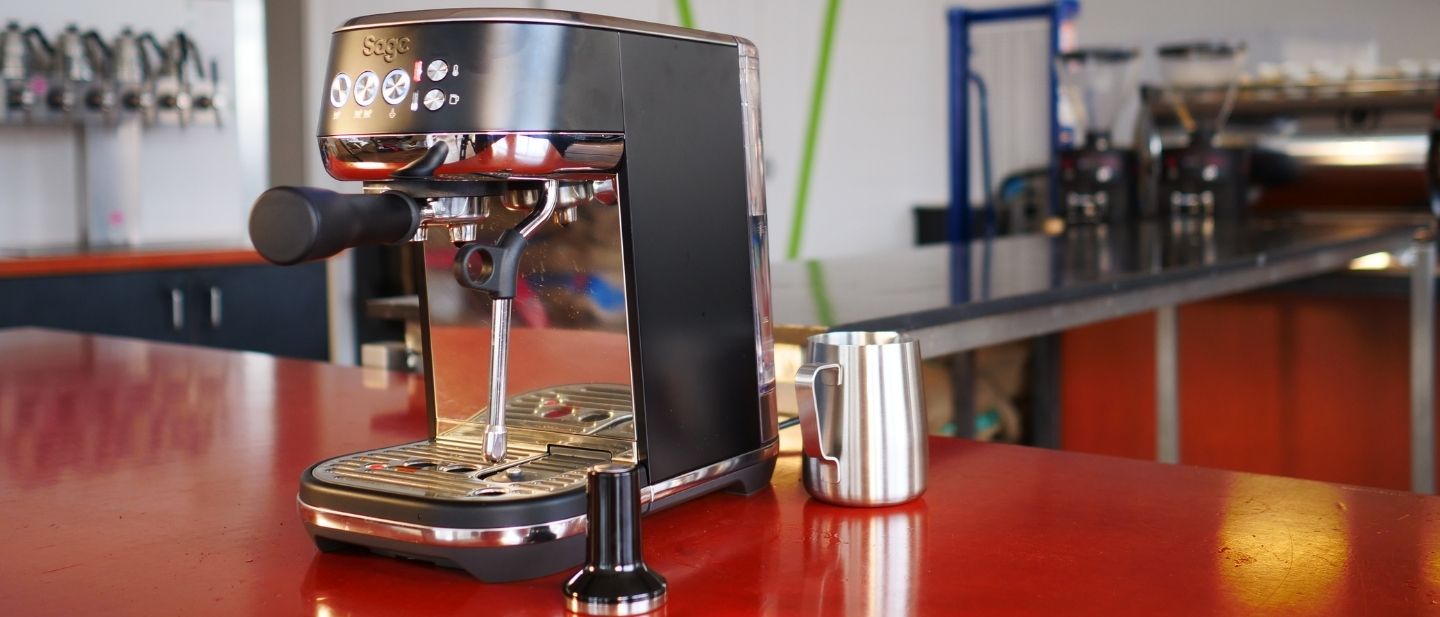

The Sage The Bambino Plus is the smallest espresso machine from Sage. Sage? Yes, the company that sells identically built machines under the name Breville in other parts of the world. The Sage Bambino Plus belongs to the class of thermoblock espresso machines. And as it should be, the Bambino Plus is also ready for use in about 3 minutes. At around 330 euros and Swiss francs, the Sage Bambino Plus is in the field of more affordable thermoblocks in our test series.
As with all thermoblocks, there are also some questions about the Sage Bambino Plus:
Energy Consumption
If you want to buy an espresso machine based on energy consumption, the Sage Bambino Plus is an excellent choice. Our approach to testing energy is always the same. We use an adapter from MyStrom.ch. After a five-minute warm-up time, we extracted 5 double espressos. After waiting a further two hours, we extracted another double espresso. The consumption at that point was 0.08 kWh. For comparison: the Ascaso Steel Duo PID, also a thermoblock, which goes into an eco mode, had a consumption of 0.28 kWh at that point.
Compared to dual boiler espresso machines, that is also minimal. The lowest consumption was recorded by the Xenia Espresso with 0.48 kWh and the Bezzera BZ10 with 0.48 kWh. The highest was the Bezzera Magica S with 0.72 kWh.
Small, Compact, Light, and Lots of Plastic
The Sage Bambino Plus is small and compact, and at 7 kg it's a real lightweight. Light doesn't have to be bad if a machine has suction cups or is fixed to the ground. Unfortunately, that's not the case with the Sage Bambino Plus. When trying to lock or unlock the portafilter, you have to hold the entire machine with your arm. Very impractical, especially since you can't use the surface on the machine that was actually intended as a cup rest. After all, you have to hold the machine somewhere when locking the portafilter in place.
At 31 cm in height, 32 cm in depth, and 19.50 cm in width, the espresso machine fits into any kitchen nook. But be careful! The machine requires an external grinder to make coffee. This should be factored into space planning.
The drip tray is also rather small. We strongly recommend rinsing with water after each espresso extraction to clean the shower screen. After two or three espresso extractions, the tray is already full. There is a small red float that indicates the water level. But if it always floats on top, that's not very helpful.
The black parts of the Sage Bambino Plus are made of plastic. The plastic itself feels "high-quality," but it's still plastic. The advantage: unlike the stainless steel powerhouses of the dual boiler class, there are no sharp edges.
First-Class Milk Foam Performance
The Sage Bambino Plus has a real strength. The milk foam performance of this machine is unmatched in this price range. With plenty of power, the small machine foams even a large 0.6-liter pitcher. Some dual boilers have failed at this!
This is a joy. Also very practical for beginners and espresso starters: the milk doesn't heat up too quickly. This gives you plenty of time to circulate (rolling phase) and to really break down even the last bubbles.
Also great: the Sage Bambino Plus has an Auto-Steam function. A temperature sensor in the drip tray not only measures the temperature but also sends control signals to the intensity of the automatic steamer. The final temperature and milk foam density can also be pre-set. We recommend the middle setting for you. What is then produced in terms of milk foam is really impressive.
Here Sage demonstrates what is possible foam-wise in a thermoblock. If only they had worked as carefully in the area of temperature consistency...

Espresso Disaster – When Brew Temperature Isn't Consistent
It's such a shame what comes out as espresso from the Sage Bambino Plus. Unfortunately, not much that's delicious. First, the supplied double-wall basket prevents careful adjustment of a grinder. A double-wall basket is designed for preparing pre-ground old coffee and not for preparing freshly ground coffee. From the inside, such a basket looks "normal." Many openings allow the coffee to flow into an intermediate chamber. However, this in turn has only a tiny outlet, a hole of about 0.3 mm. The espresso is then forced through this hole, is puffed up by the pressure (see also our blog post on the subject of crema). Precise adjustment of the grinder is impossible under these circumstances, as is even extraction.
Since we have other baskets in our coffee academy, we were able to test the extraction behavior of the machine with a single-wall basket as well. Unfortunately, this did not significantly improve the taste of the espresso. The reason for this lies primarily in the inconsistent temperature of the Sage Bambino Plus.
The average perfect brew temperature for espresso is 93 degrees. Good espresso machines maintain the brew temperature at this temperature over a long period of time. Not so the Sage Bambino Plus.

Initially, the temperature during extraction rises to at least 98 degrees. In some cases, we've also measured temperatures of 102 degrees. Then the temperature drops to below 85 degrees. That's significant and something we haven't seen very often. Sensorially, this manifests in two extremes: the high temperatures impart an unpleasantly harsh bitterness to the espresso and leave a dry mouthfeel. The low temperatures cause sharp acidity. Overall, the espresso is not extracted evenly.
Really too bad, but we can't really recommend the machine for making espresso.
Export of CSV temperature measurement
Conclusion on the Sage Bambino Plus
The Sage Bambino Plus is a good milk foam machine. Unfortunately, it doesn't convince us as an espresso machine. It's hard to understand what Sage was trying to construct there. Perhaps the focus on the truly outstanding milk foam performance is also a statement: milk on the espresso neutralizes acidity and bitterness quite well, and the milk sweetness brings a nice balance.
What we would wish for: the milk performance of the Sage Bambino Plus in the outstanding espresso machine of the Ascaso Steel Duo PID. That would be our dream thermoblock.