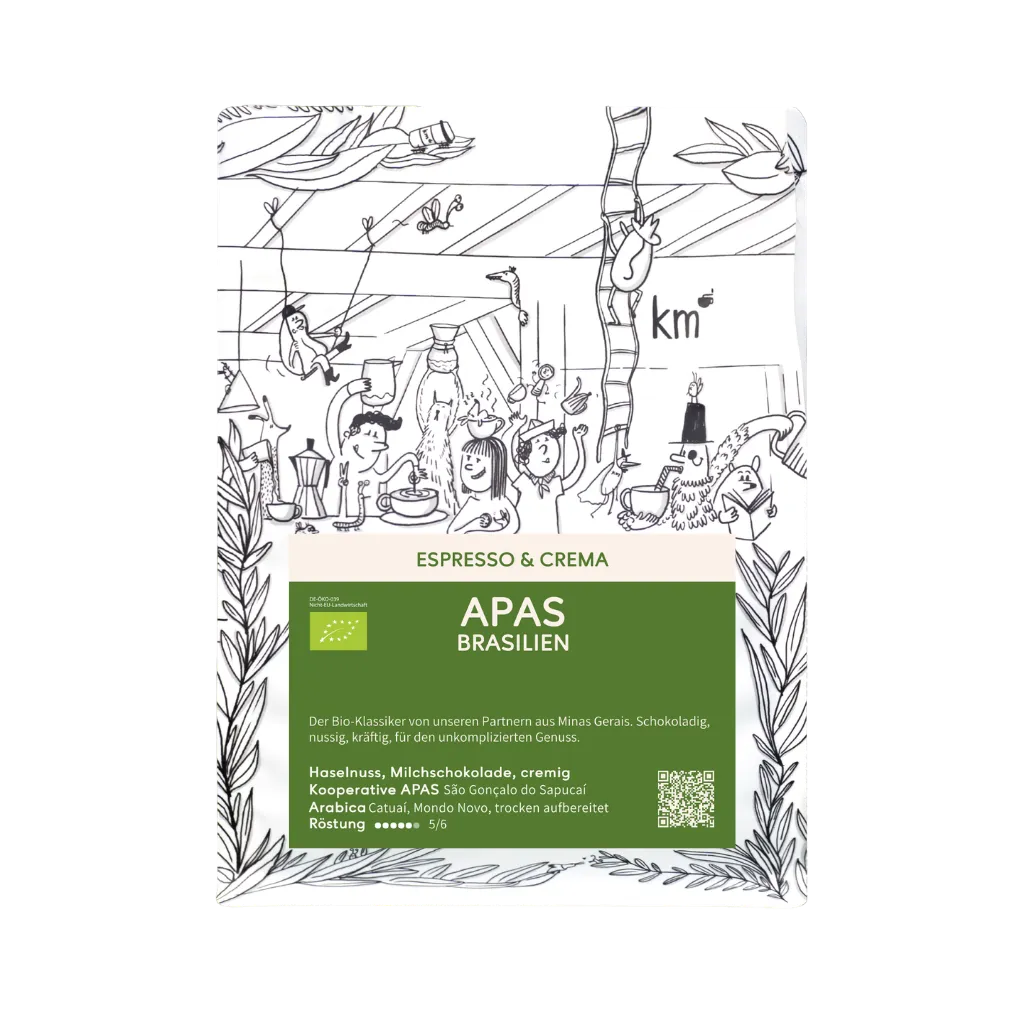

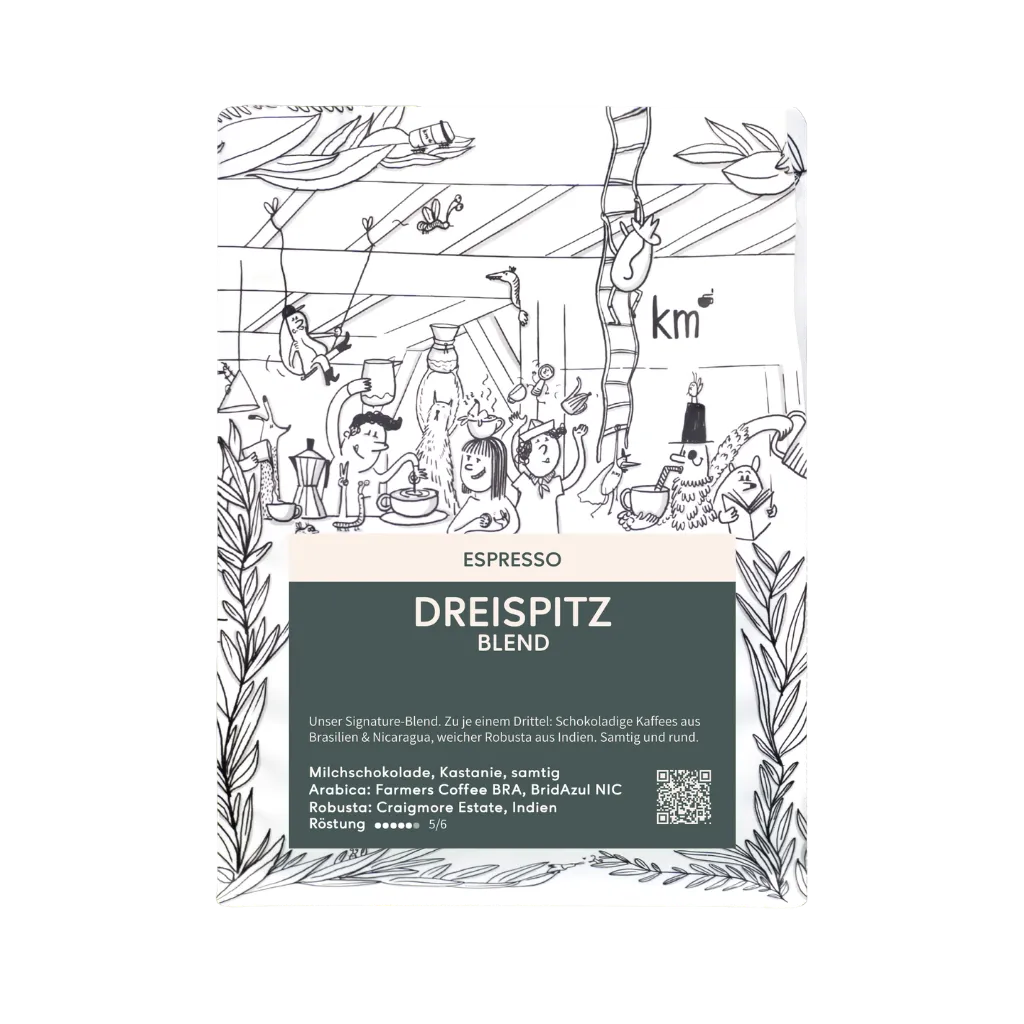
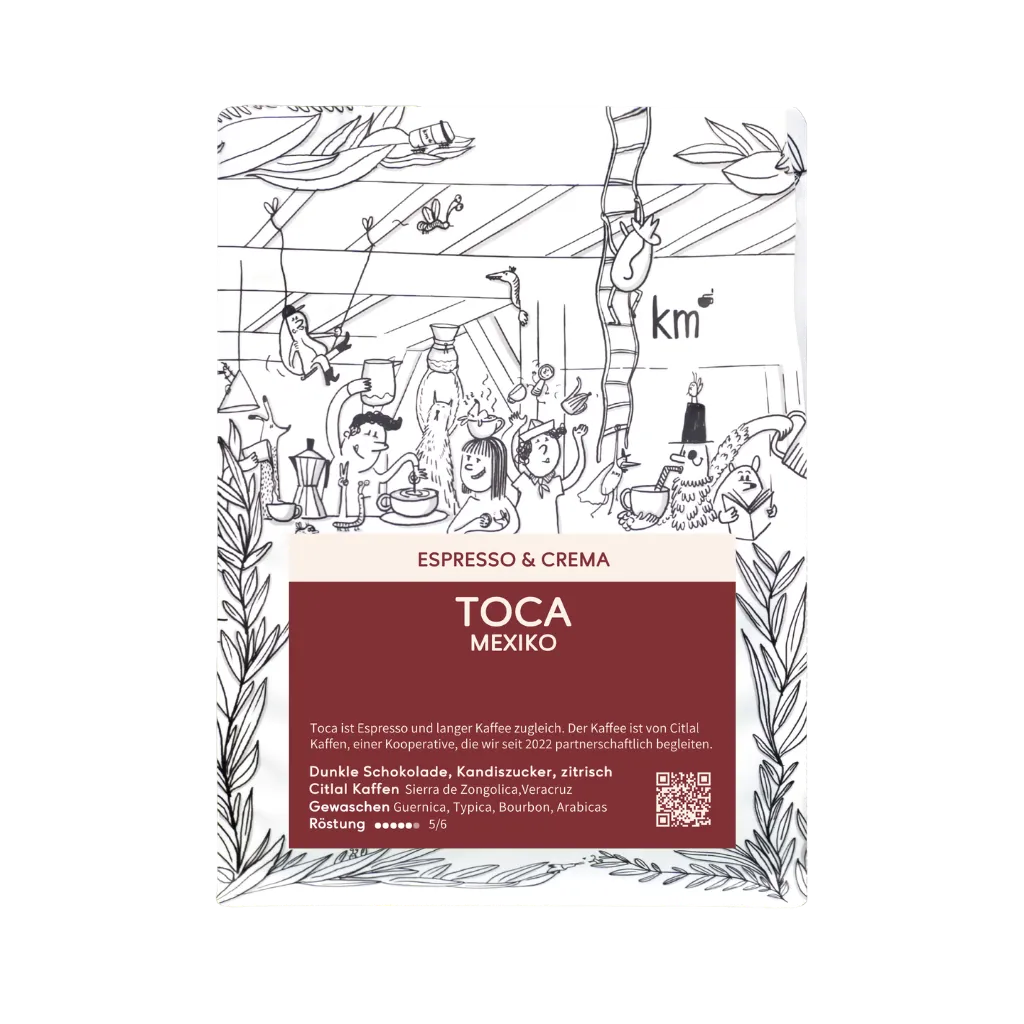

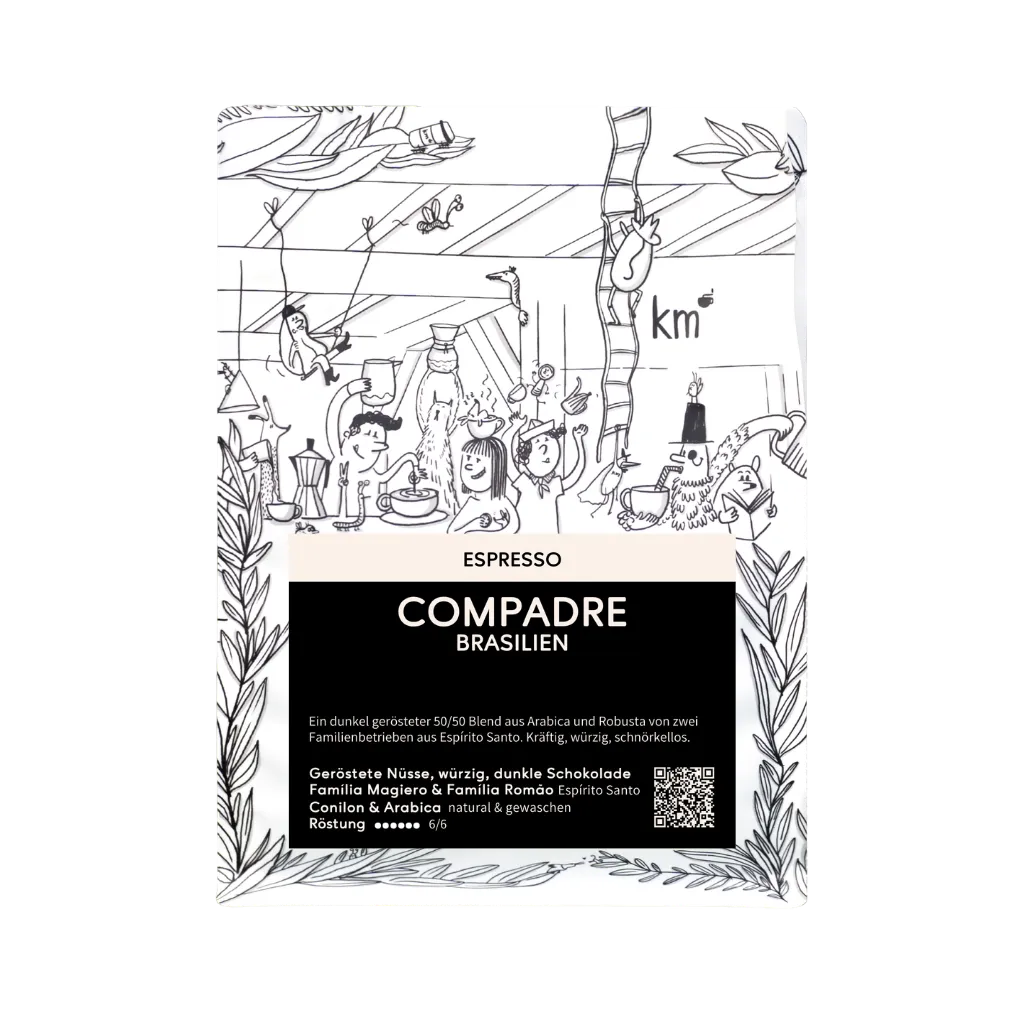









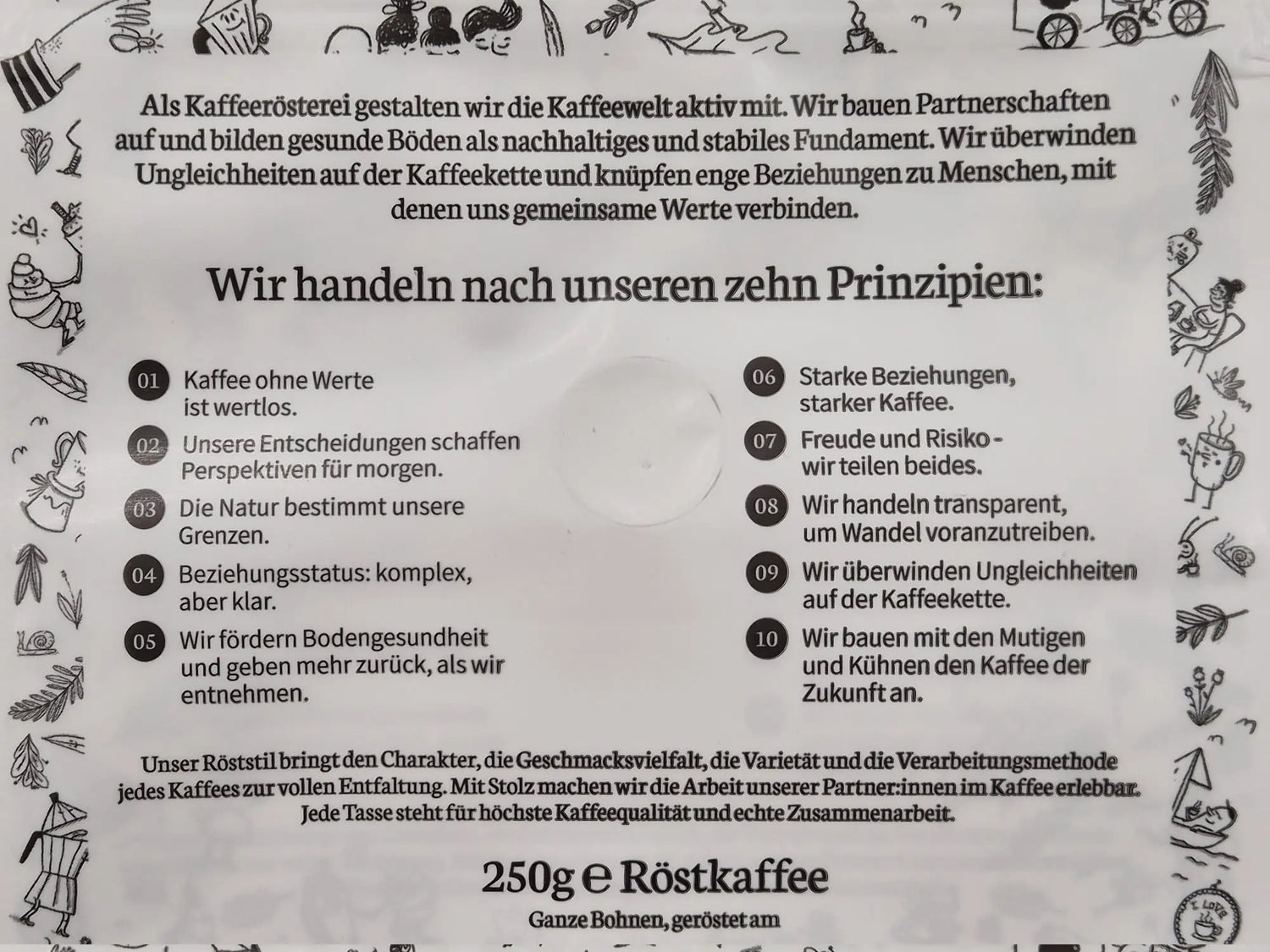

On our new coffee packaging, you will find ten punchy statements that summarize our work as a coffee roastery. We communicate daily with our production partners, who may be far away, but make it possible for us all to drink coffee in the first place. With them, we are learning what is needed today so that we can still drink coffee tomorrow.
Sometimes, clear messages are needed. We have prominently featured ten of them on our new coffee packaging.

The back of the new coffee packaging.
1. Coffee without values is worthless.
If we view the production and consumption of coffee as merely a mechanical act, we fail to attribute the value inherent in it. Countless hands have picked, processed, exported, roasted, packaged, and provided it. Coffee is a product made by people. If we value the product, we can also appreciate the work of the people behind it.
 Producers sorting coffee cherries by ripeness, Apixtepec, Mexico
2. Our decisions create prospects for tomorrow.
Coffee is a long-term project – the plant grows slowly and change takes time. Awareness of coffee is developing, but as we said: it takes time. And because we work with people, change sometimes requires patience. This makes it all the more important that we shape the future today and understand our decisions as an investment in tomorrow. This is how we create new perspectives together with producers.

Joél turning the coffee in parchment so it can dry evenly. Apixtepec, Mexico
3. Nature sets our limits.
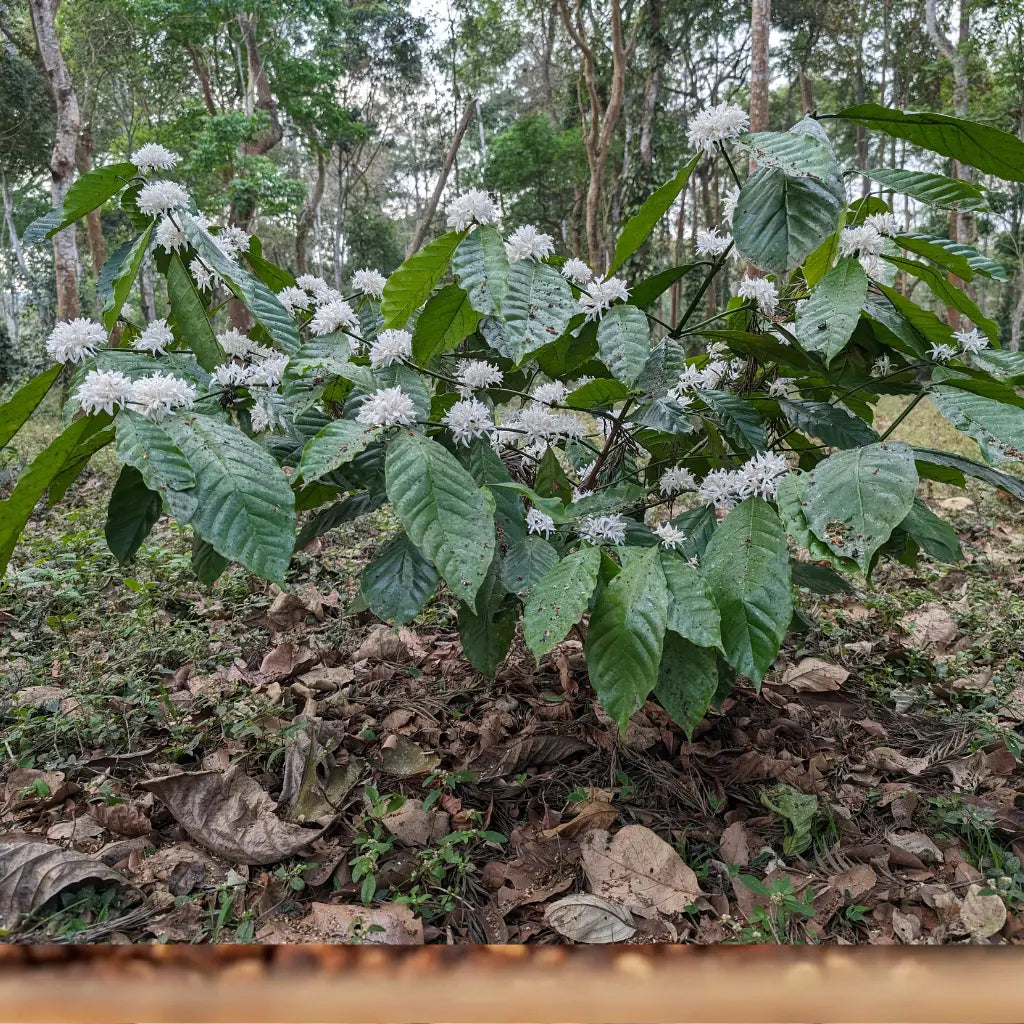
Long-term coffee production is only conceivable in conjunction with high biodiversity, plenty of shade, and intact ecosystems. Coffee cannot be produced in isolation; it must be guided by the limits set by nature. There are varieties that grow well in Brazil but not at all in Nicaragua. Certain processing methods work consistently in one place – but not in others. Understanding the environment and accepting that nature dictates what is possible and what is not gives us direction: what we can influence – and what we should leave alone.

Our partner farm El Arbol from above. The coffee trees integrate into an existing forest.
4. Relationship status: complex, but clear.
We maintain several long-distance relationships with our production partners. We always try to clarify mutual expectations early on and think ahead. The collaboration is always context-dependent and sometimes differs significantly from other relationships. Like any relationship, a partnership-based collaboration is complex and sometimes varied, but clear in its communication.

Don Roque is a founding member of the Citlal Kaffen cooperative in Mexico.
5. We promote soil health and give back more than we take.
The soil is a complex system – with many components, but above all: full of life. Microorganisms, minerals, and organic matter ensure that plants develop well and remain healthy. Coffee plants draw their energy from the soil, which in turn must be nourished. The excessive use of fertilizers and pesticides shifts the focus away from the soil, even though it is precisely what secures long-term production. We make the soil the focus of our cooperation and work to give back to it more than we take.

Célia Bühler from HAFL wrote her Master's thesis on compost production in Nicaragua
6. Strong relationships, strong coffee.
We all love coffee. The taste, the feeling when drinking it, the effect. We love coffee so much that we go to its source and build relationships with the people who grow it. If we succeed in making these relationships strong, durable, capable of mastering crises, and constantly renewing themselves – then we are not just drinking a coffee that is strong in taste, but one that carries a strong story within it. And that makes the coffee taste even better.

We have always connected all points in the coffee chain. Here: our Coffee Farm Training in Nicaragua
7. Joy and risk – we share both.
Someone once said that coffee production is very simple – it consists only of 100 lessons, and you learn one every year. Every year brings reasons for joy, and every year brings new challenges. Sometimes it rains too much, sometimes not at all. Then there are no ships available, or the price explodes. Harvesters are missing, loans are too expensive. But then a partner wins a Cup of Excellence, a natural lot blows us away, or the sorting has never been as good as this year. We listen and share the responsibility with our partners – because that is part of a relationship.

Marcia is a pioneer of organic coffee cultivation in Brazil. She is part of the Apas cooperative
8. We act transparently to drive change.
Coffee has a long history – and it is sometimes dark (Coffee & Colonialism). Today, much is better along the coffee chain, but there remains a large knowledge gap and power asymmetry. Producers often have only selective knowledge about the coffee market, while buyers have access to a wealth of information. We believe: transparency is the first step toward change.

Mauricio (left) is the managing director of the Apas cooperative. Here he discusses pricing with Philipp
9. We overcome inequalities along the coffee chain.
This knowledge gap is often also reflected in financial starting positions. We are working to bridge them – and are investing selectively in coffee-producing countries to drive change and work with our partners at eye level.

Miguel (white shirt) in conversation with Don Roque and Doña Alma from the Citlal Kaffen cooperative
10. We are building the coffee of the future with the brave and the bold.
The coffee world is sometimes sluggish. Changes take time – or are perceived as a risk. Roasteries need security, just as producers do. If both opt for caution, much remains the same. We seek partnerships with the brave and the bold – with those who think for themselves, question the status quo, and want to help write the future today.

Yazmani is the managing director of the Citlal Kaffen cooperative. He leads with great dynamism and vision