






Many espresso machines advertise pre-infusion or pre-brewing. But what is actually happening during this process, and when is this function useful? We explain why we no longer use the term "pre-infusion", why 3 seconds is always too short, and when it is better to turn the function off. (This article builds on our Espresso Preparation Guide. You can find the basics there.)
Why we no longer say "pre-infusion"
The term pre-infusion suggests a specific sequence: putting water on the coffee, pausing, then continuing the brew. We believe this pause—sometimes called "blooming"—is pointless for espresso. More on that in a moment.
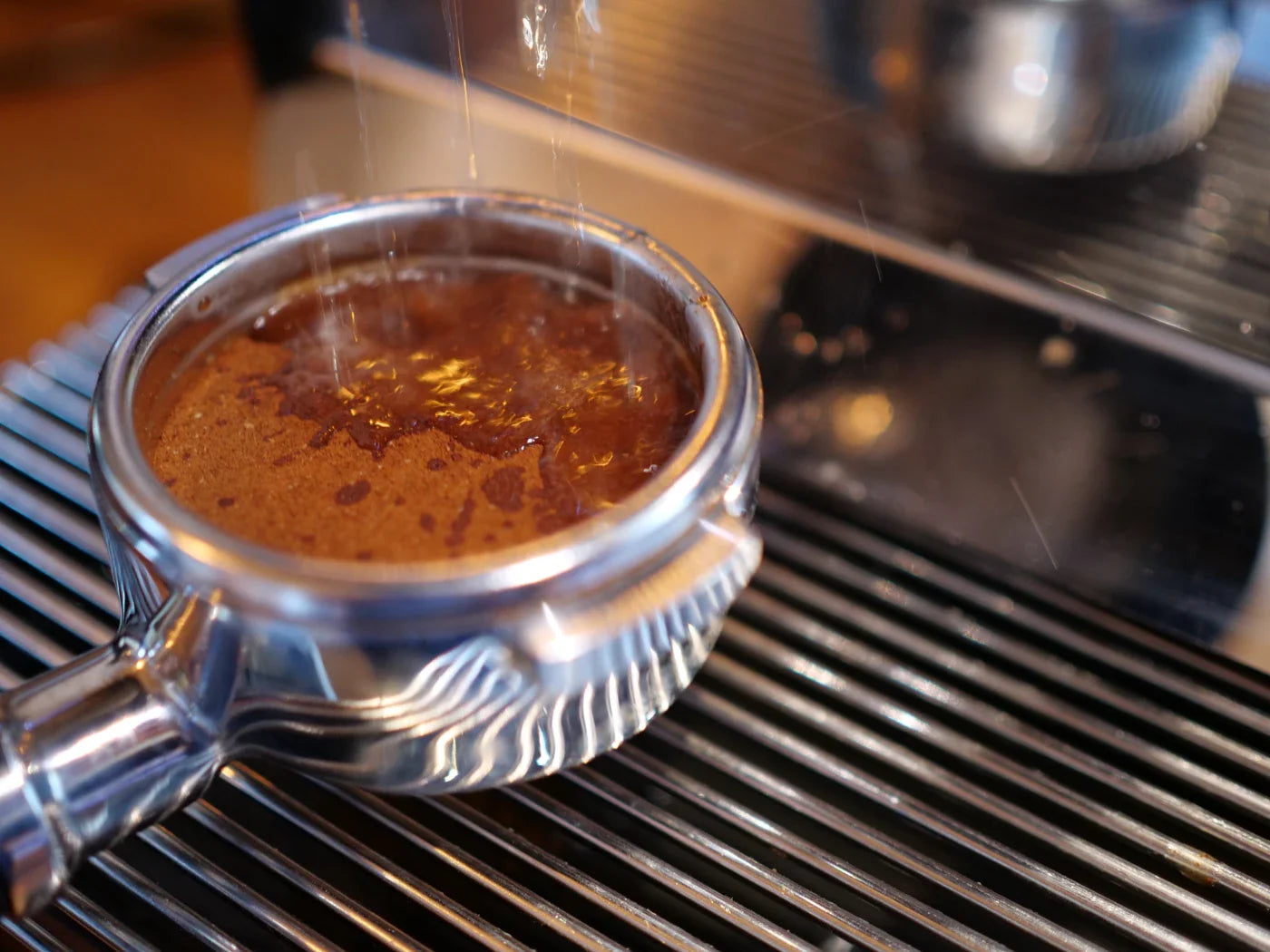
What we mean instead when we discuss this topic is a gentle pre-wetting of the coffee puck. In other words, slowly adding water to the coffee at reduced pressure or reduced flow before the full brewing pressure is applied. Without a pause. The difference might sound like splitting hairs, but it is relevant to what happens in your portafilter.
What pre-wetting achieves
Coffee is hydrophobic. It initially repels water. Dry coffee grounds do not absorb water immediately. If you hit a dry coffee puck with full pressure (8–9 bar), the water meets resistance and seeks the path of least resistance. The result: channeling, uneven extraction, and an espresso that can taste both sour and bitter at the same time.
If you pre-wet the puck slowly, something else happens. The coffee absorbs moisture and swells evenly, and when the full pressure then hits, the puck is prepared. The water distributes more evenly, and the extraction becomes more homogeneous. For many coffees, this results in a rounder, sweeter, and fuller-bodied cup. Not for all—but for many.
A side effect: with pre-wetting, you can often grind finer without the puck clogging, while still maintaining even extraction. A finer grind size means more extraction, which is often very interesting in terms of flavor, especially with complex coffees.
Filter coffee blooming and espresso pre-wetting: two different things
There is a similar-sounding technique for filter coffee: blooming. You pour a small amount of water over the coffee grounds, wait 30 to 45 seconds—and watch as the coffee swells and gas bubbles escape upward. The CO₂ stored in the coffee cells during roasting rises freely out of the open coffee bed. This isn't a ritual; it's physics. If this CO₂ were still in the coffee bed, it would block the even flow of water and additionally introduce carbonic acid into the drink. The pause solves the problem. (We explain how this works in detail in our filter coffee preparation article.)
This is physically impossible in a portafilter. When the portafilter is locked in, CO₂ has no way to go upward—the puck is sealed off by the shower screen. It can only escape downward through the basket, and that happens extremely slowly without an active flow of water. Even when the pump is running and pushing water through the puck, current findings suggest it takes longer for the CO₂ to be fully removed from the coffee puck than it takes for a shot to run. A pause without water flow certainly won't accomplish it.
The purpose for which blooming works for filter coffee therefore doesn't exist for espresso—not because a pause is poorly implemented for espresso, but because the physics of the system simply leaves no path for it. Pre-wetting for espresso therefore pursues a different goal: saturating the hydrophobic coffee puck evenly with water before full pressure begins. This is not a CO₂ problem, but a wetting problem. And completely different rules apply to that.
Why the pause doesn't make sense
Many machines implement "pre-infusion" like this: pump on, a few seconds of water, pump off, pause, then pump back on with full pressure. The problem with this is simple.
If the pump works at full pressure in the first phase and then pauses, you have already blasted water under pressure onto the puck. The puck is saturated in some areas and not in others. Then comes a pause where nothing happens except that the coffee swells unevenly. And then full pressure comes again—onto a puck that is partially swollen but not evenly wetted. This isn't gentle; it's counterproductive.
For pre-wetting to work, you need one of two things: either the pump can reduce its output for the first phase (less pressure or less flow). Or the machine has a second water path with a smaller diameter that is activated during the pre-wetting phase. Both lead to the coffee becoming wet slowly and evenly before the actual extraction at full pressure begins.
Three seconds of pre-infusion is always too little
This is where it becomes a math problem. To fully wet a coffee puck, you need approximately double the amount of water as the amount of coffee. For 18g of coffee, that is about 30–36 ml of water.
How fast does your machine deliver this water? Normally, about 4 ml per second flows through the puck. At 4 ml/s, you need at least 8–10 seconds to push 30–36 ml of water through the puck. Only then is the coffee puck fully saturated.
Three seconds gets you 12 ml. The puck is perhaps one-third wetted. Five seconds? 20 ml—still not enough. With reduced flow (about 3 ml/s), it takes even longer.

Vibration pump: Your machine is already doing it
If you have a vibration pump—and that applies to the vast majority of home machines under €2,000—then your machine is already performing a gentle pre-wetting automatically. The vibration pump builds pressure slowly; the flow starts low and increases over several seconds. That is exactly what pre-wetting is.
What does this mean? If your machine with a vibration pump additionally offers a "3-second pre-infusion", exactly what the pump does anyway happens during those three seconds. In the worst case, the existing pressure is even relieved by the water in the portafilter. Your additional pause has no positive effect. The effect is zero. You are simply extending the brewing time without changing the extraction.
For some machines—the Ascaso Steel Duo PID is a well-known example—we therefore recommend simply turning off the pre-brewing function. It doesn't make the machine better, and the 5 seconds that can be set there as a maximum are not enough for meaningful puck wetting anyway.
When pre-wetting actually makes sense
It gets really interesting with machines that have a rotary pump and can additionally reduce flow. The Lelit Bianca is a good example: using the paddle, you can throttle the flow at the beginning and wet the puck slowly—9 to 10 seconds with reduced flow, then move to full pressure. For many coffees, this results in a measurably more even extraction.
In summary, the requirements: You need a machine that can actually reduce the flow or pressure in the first phase (not just pause), and you need at least 8–10 seconds of pre-wetting time so that the coffee puck becomes fully saturated.

How pre-brewing affects total brewing time
If your machine does pre-wetting, it naturally extends the total contact time. How do you handle that if you have a recipe from a roastery?
Starting point: The recipe says 27 seconds, made with a rotary pump.
You have a vibration pump: Calculate about +3 seconds on top, so around 30 seconds. This is because the vibration pump builds pressure more slowly and the first phase extracts less intensely. (We explain this in detail in the article Espresso Extraction Time: When does the brew time actually start?)
Your machine also has pre-brewing with a pause: Then the pause time is added on top. If the machine "takes a breath" for two to three seconds after pre-wetting before full pressure builds, you add that time as well. In the example: 27 + 3 (vibration pump) + 3 (pause) = around 33 seconds.
But—and this is important—don't drive yourself crazy with second-by-second recipes. These times give you a framework, an orientation. Stick to the brew ratio (e.g., 18g in, 36g out), land roughly in your time window, and then decide based on taste. Your tongue will get better from espresso to espresso.
More on the topic of brew time and why the first drop is not the right starting point: Espresso Extraction Time: When does the brew time actually start?
This article is also available as a video on our YouTube channel.