





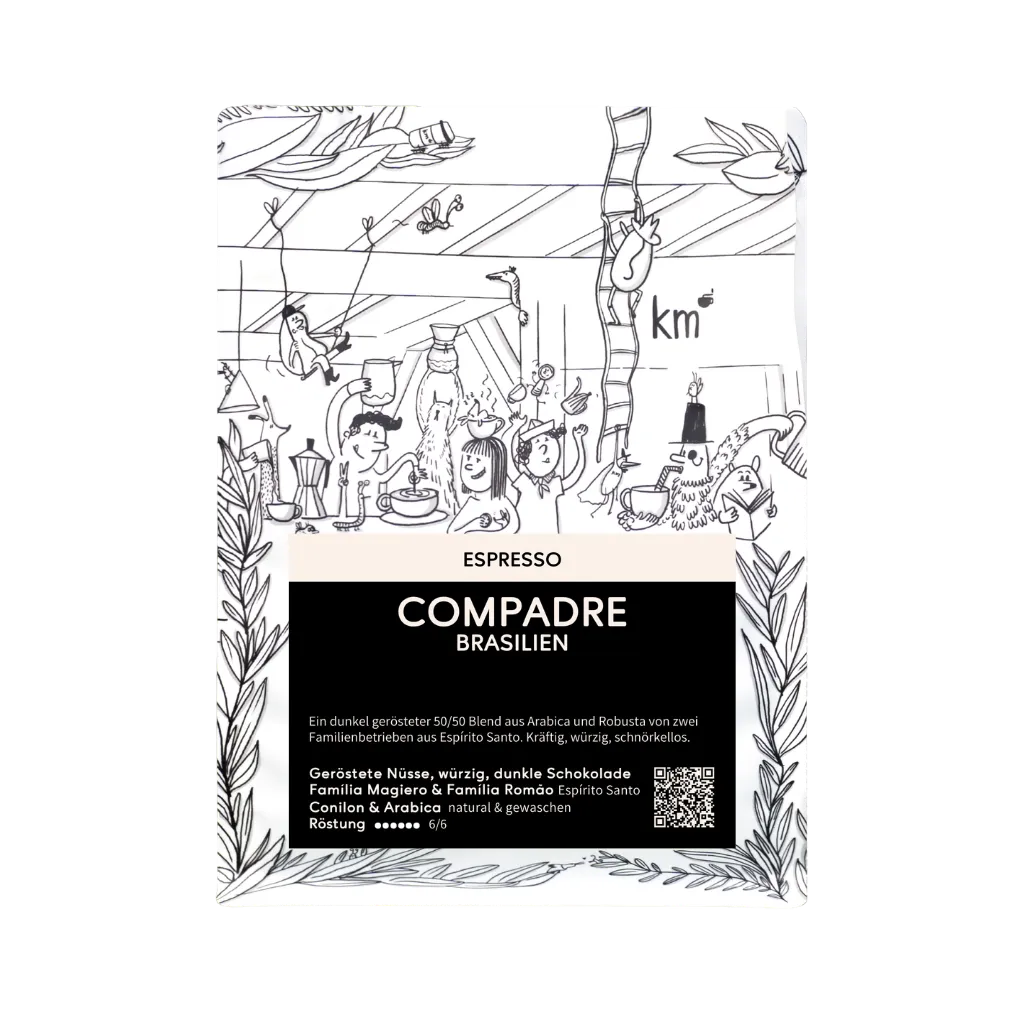
After almost ten years of roasting, we have dared to take on the holy grail of coffee. We have released our interpretation of an Italian espresso – the Compadre.
The Compadre is a 50/50 blend of Arabica and Conilon, the Brazilian Robusta. Both coffees come from family-run coffee farms in Espírito Santo, Brazil. We roast the coffee very dark, emphasizing the bold notes of the Conilon while finding spicy, tobacco-like aromas. The Arabica gives the coffee texture as well as dark chocolate and nutty tones.


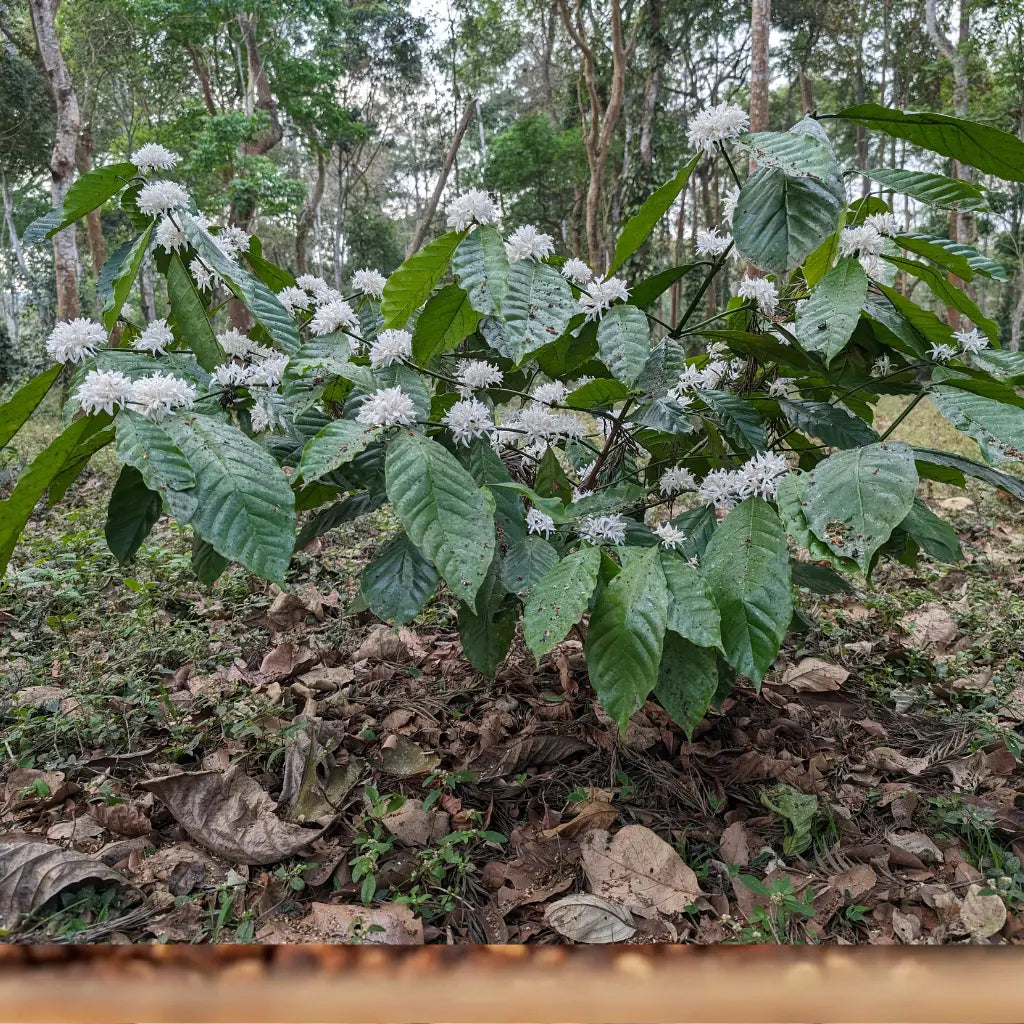
The Arabica portion comes from the Montanhas Capixabas, the mountainous region of Espírito Santo
We developed the coffee together with our partners from Farmers Coffee. I visited in the fall of 2023 and was impressed by the drive shown by these young entrepreneurs and sons of coffee farmers. They focus on high-quality Conilons and Arabicas from the mountains of Espírito Santo. We visited Arabica farms at 1200 meters and Conilon farms at 80 meters above sea level. The topography is impressive.

Visiting Farmers Coffee in Venda Nova do Imigrante, fall 2023

The Conilon portion comes from the northern part of Espírito Santo and is grown at 80 meters above sea level
Espírito Santo has a history strongly shaped by immigration. Many Italian families immigrated at the end of the 19th century, worked in coffee production, and gradually took over coffee farms.
The two families who contribute their coffee for the Compadre also have Italian roots: the Romãos produce their pulped natural Arabica in the mountainous region around Castelo, while the Magieros produce their pulped natural Conilon in the plains of São Mateus in the north of Espírito Santo.

The Romão family contributes the Arabica part of the blend
If you like, this closes a very large historical circle: the coffee from these two families with Italian roots now ends up in an espresso modeled after the Italian style.
Farmers Coffee sorts both coffees in their warehouse and blends them in a 50/50 ratio within the coffee sack. This allows the moisture of the two green coffees to equalize while still in the sack. The 30 kg sacks arrive at our roastery and are roasted as a complete, already-blended coffee.

The roast
We decided on a medium-long and hot roast. We roast the Henrique or Apas espresso a bit longer, but the Compadre reaches the highest final temperature on our roaster. With this high final temperature, we emphasize the toastier, bold notes. We finish the roast just before the second crack.
What is Italian espresso?
In the fall of 2024, we released a video and a blog about the 20 best Italian espressos. The selection of coffees to be tasted was made by our community, with over 2,000 votes cast.
In this complex and long tasting, one thing became clear to us: "Italian espresso" doesn't actually exist as a single thing. There is a tendency for more Arabica to be used in the north and more Robusta in the south. We also saw that roasteries in the north roast a bit lighter, while roasteries in the south prefer a dark roast.
The image of "classic Italian espresso" is often invoked, but consensus probably only exists when viewed from the outside. We often hear that the coffee just tastes so much better after passing through the Gotthard Tunnel or crossing the Brenner Pass.
It is possible that the anticipation, the holiday feeling, the sight of the machine, and the familiar bean brand have an influence in that moment—making the espresso perceived differently than when it is prepared at home.
But, we believe, it is primarily the ratio of the amount of ground coffee used to the extraction amount in the cup: the brew ratio. This differs significantly from what is common north of the Alps. While we prefer brew ratios of 1:2.2 to 1:2.4 in our cafes, 1:2 is already almost too long an espresso in many Italian caffè bars. 1:1.5 often serves as a reference, meaning 1 part coffee to 1.5 parts water – for example, 17g of ground coffee and 25.5g of espresso in the cup.
That is short and strong. And often also significantly cheaper—not because of the amounts served, but due to different wage and price structures.
Anyone serving an espresso at a 1:1.5 ratio north of the Alps and then charging twice or three times as much as in Italy is often met with a grim look. Yet the coffee would now be sensorially optimized. If a customer then wants "more for their money," the extraction is prolonged (more water flows through the coffee grounds) while the amount of grounds remains the same. This results in watery espressos that are far from the imagined ideal.

We met Dério Brioschi, one of the founders of Farmers Coffee, in Geneva at the World of Coffee 2025.
How would we prepare it?
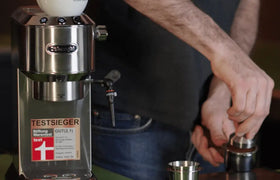
We are currently developing various recipes. Many fans of Italian espressos use manual lever machines, which is why we also want to develop a recipe for that.
For a classic 9-bar profile, we work with a brew ratio of 1:1.8 to 1:2 in at least 27 seconds. Those aiming for high intensity in taste and a heavy body should extract the coffee shorter, i.e., towards 1:1.8. Those who want to bring the coffee more into balance and highlight a few more caramelly tones can aim for 1:2.
We look forward to your recipes—please feel free to comment them here.