






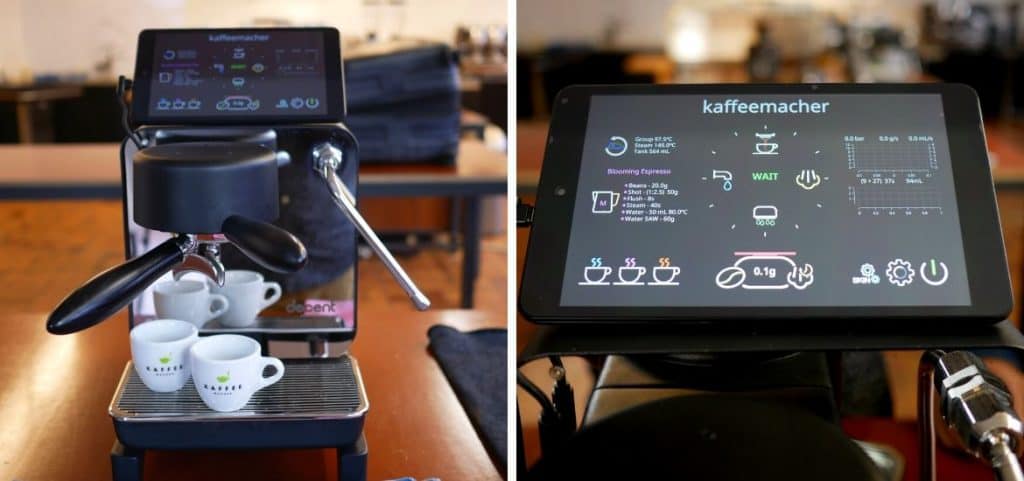
If I were to spend €2500 on an espresso machine again, it would be on a Decent Espresso machine. What you get here is a coffee playground that is second to none. The Decent Espresso machine could be as disruptive for the ambitious home market, roasteries, and even gastronomic concepts as the Ikawa turned the sample roaster market upside down.
This article came about after a 4-hour test of the Decent. Patrizio Frigeri visited us at the coffee academy and guided us through the various functions. Patrizio is a two-time Swiss Vice Barista Champion (2012, 2013) and works as an engineer and roaster. He has been using the Decent to make his espresso for half a year now.
Appearance, Basic Equipment, and Options
The Decent arrived in its own rolling case, complete with all necessary tools. Anyone who has ever loaded or unloaded a professional home machine like La Marzocco's GS3 will either miss their workout or turn green with envy. The device can be assembled in a few simple steps.
Included: an Android tablet for control, although the software can also be installed on your own hardware.
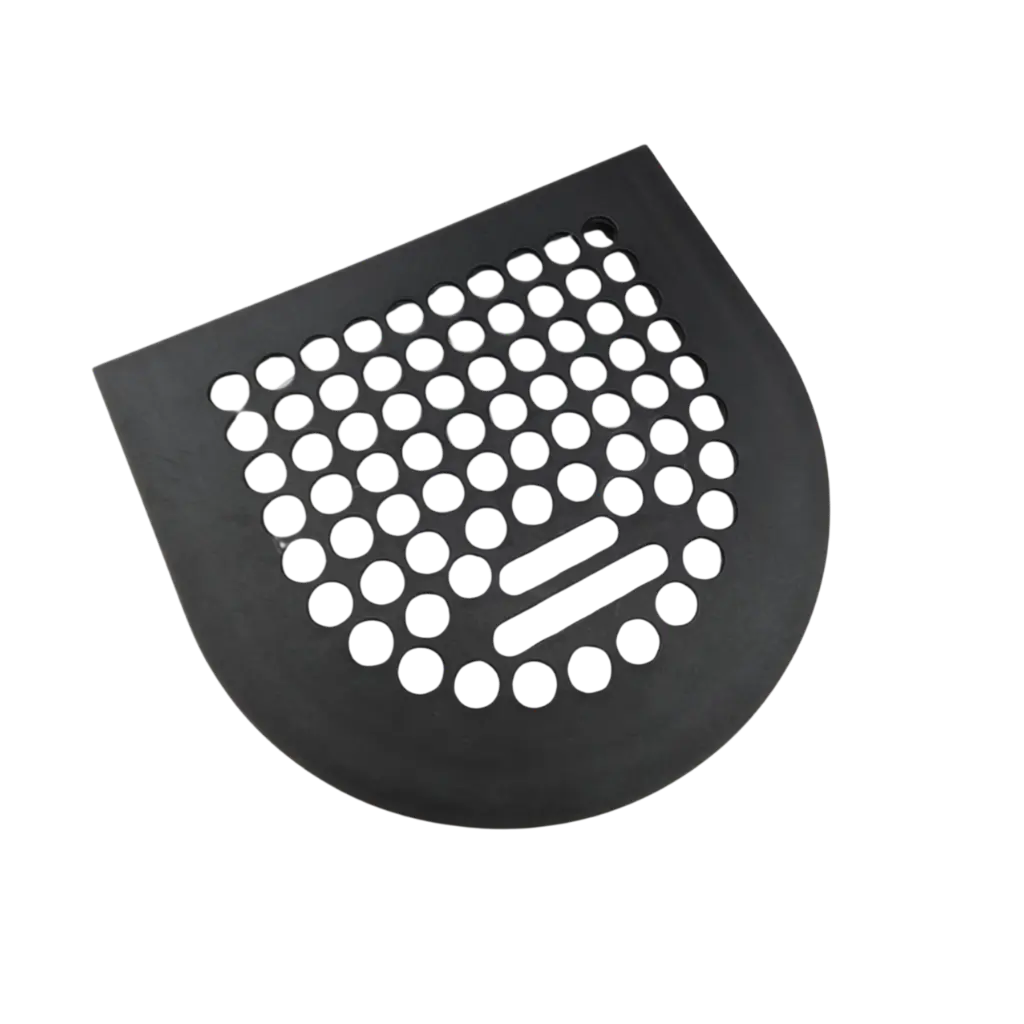
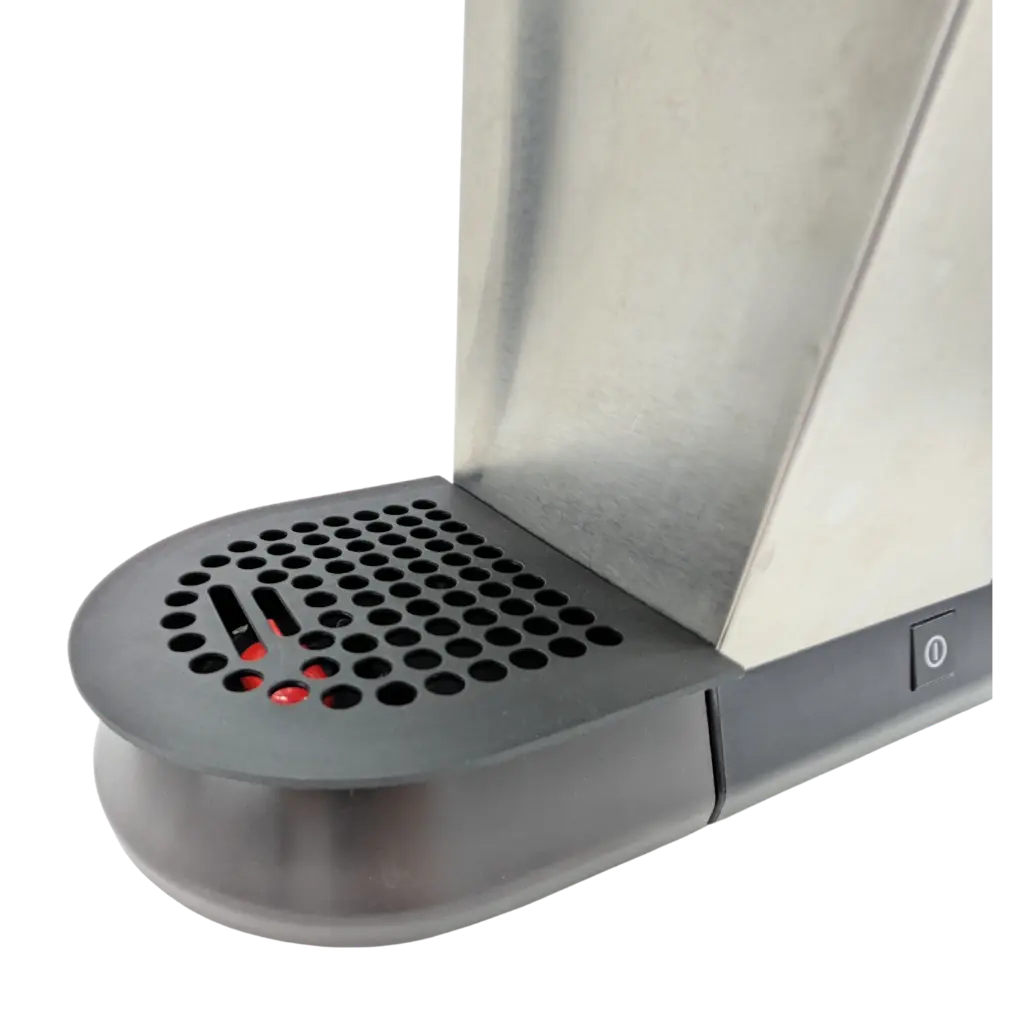
Two glazed ceramic bowls serve as a water reservoir and drip tray. One might argue that these are less stable than a plastic container. But who hasn't wondered how to clean the plastic water tank on their Dalla Corte Mini?! The ceramic bowls are open and, of course, dishwasher-safe.
A handle screwed to the front of the machine solves a problem – it compensates for the machine's low weight. Very often, lighter espresso machines twist when being clamped in.
Finally, there's a scale connected via Bluetooth to the tablet and espresso machine. We'll use it later to calibrate the milk pitchers and control the machine.
The machine is available in various versions. The DE1+ variant is intended for private households. The Decent Espresso DE1Pro targets offices, home baristas, and restaurants. With additional kits, the DE1XL model can be connected to a fixed water supply and external boilers, making it ready for more demanding gastronomic uses.
The machine measures 22.5 cm in width, 42.5 cm in height including the panel, and 48.3 cm in depth if you include the holder's and portafilter's protruding handles. The machine weighs 13 kg and comes in a suitable case.
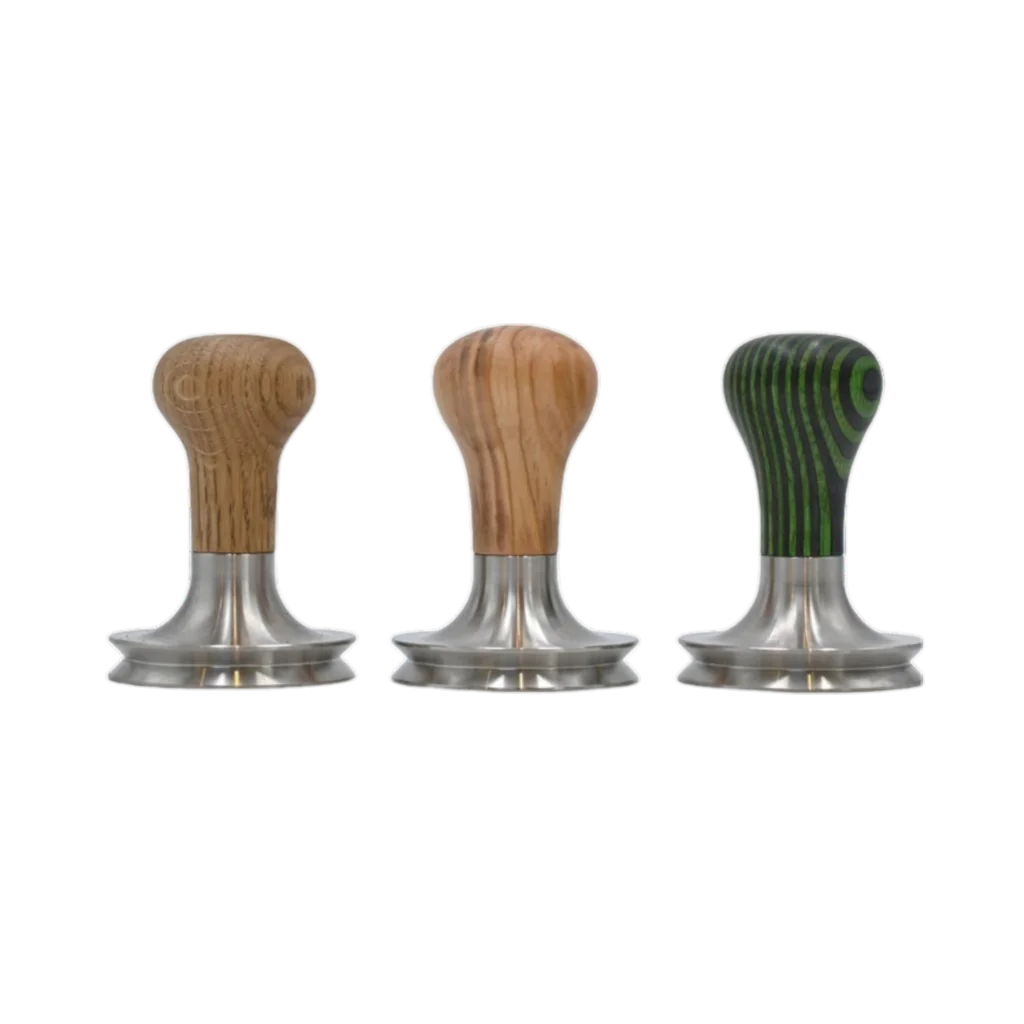
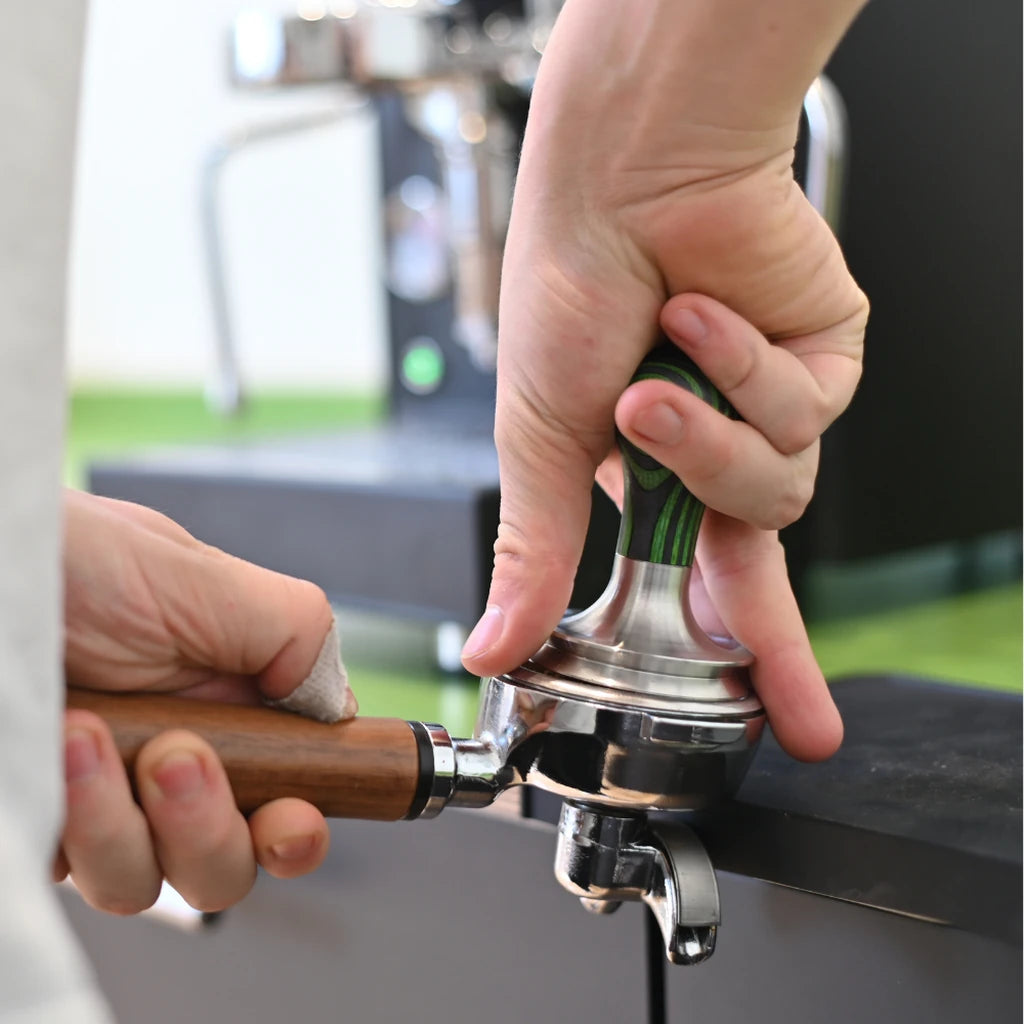
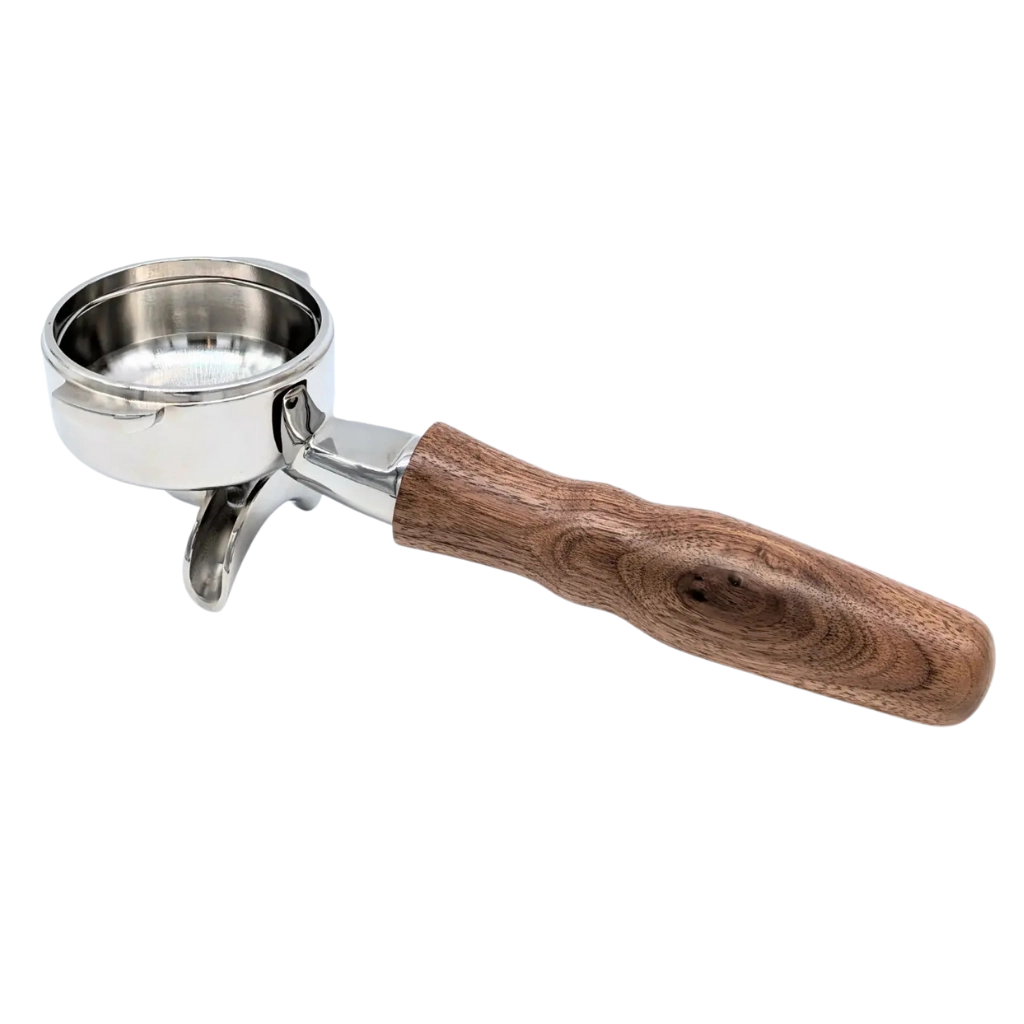
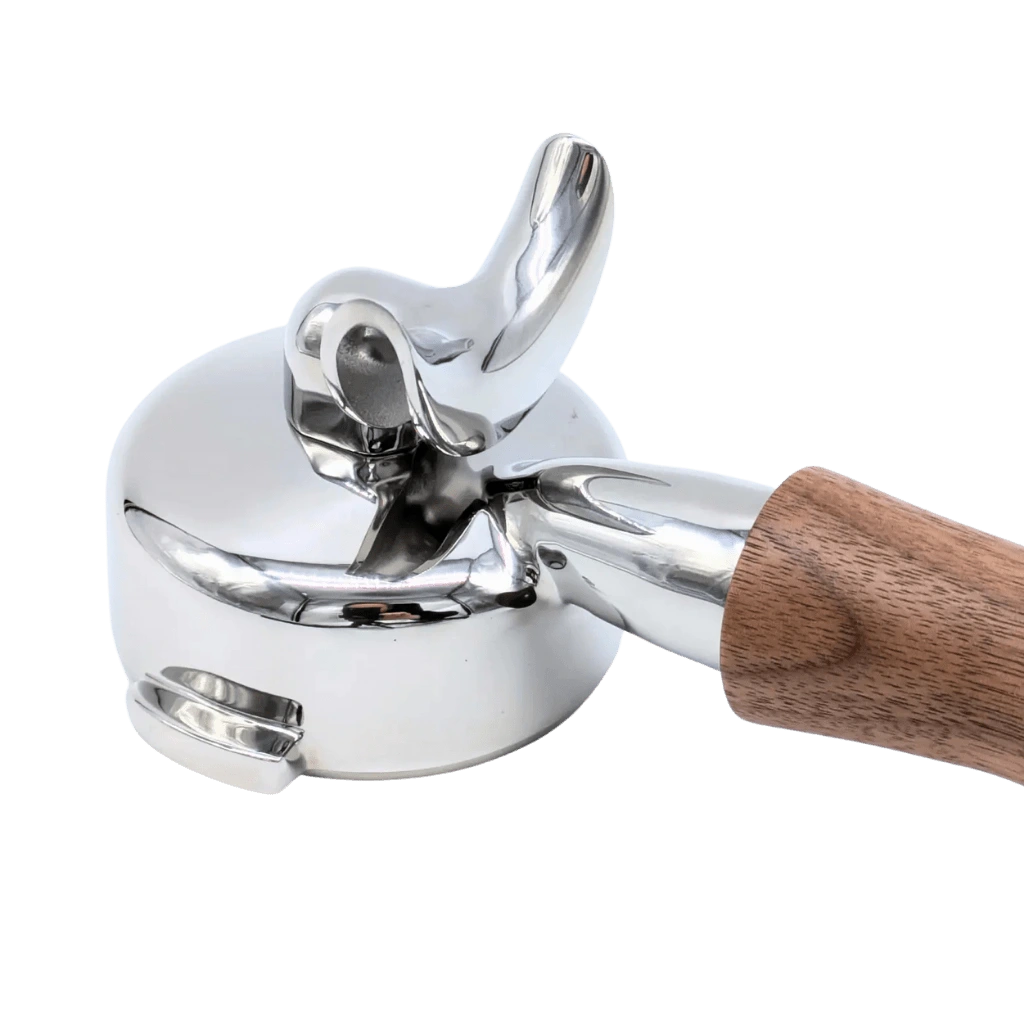
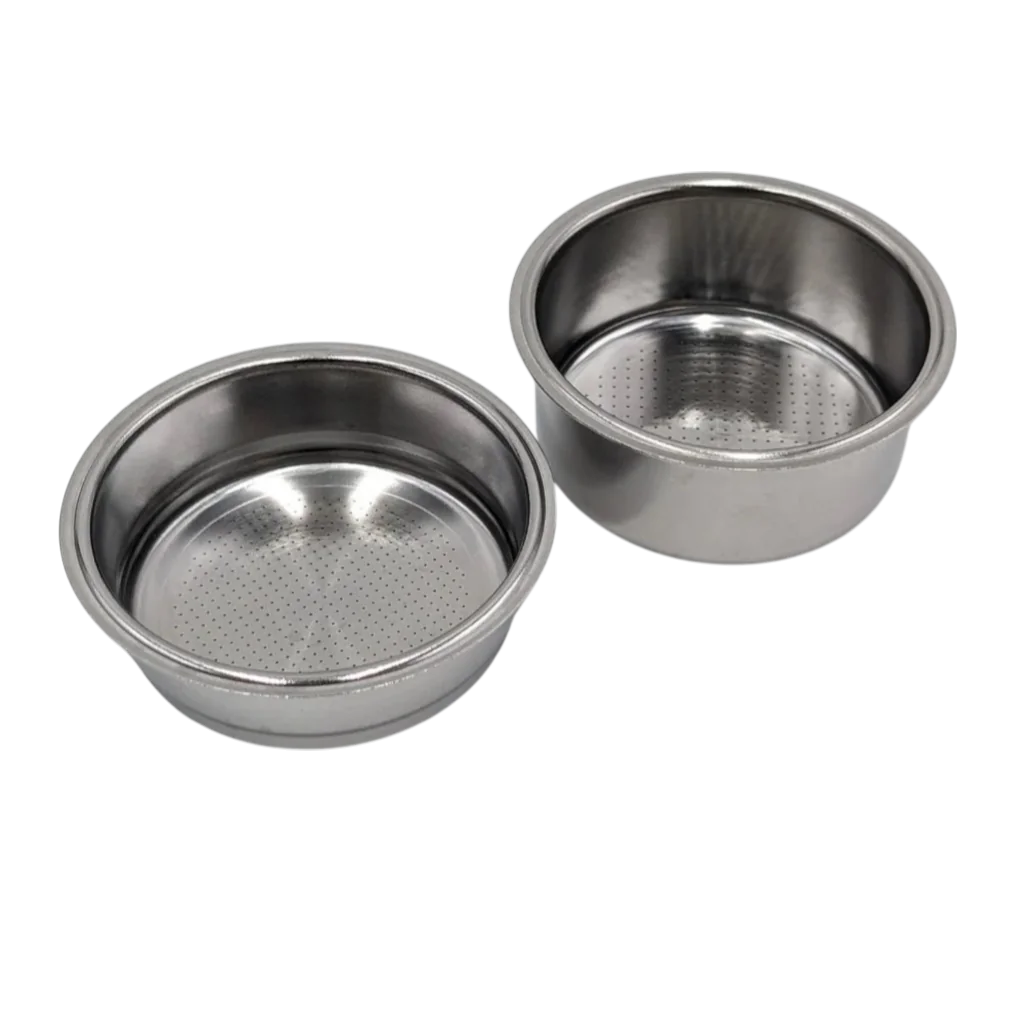
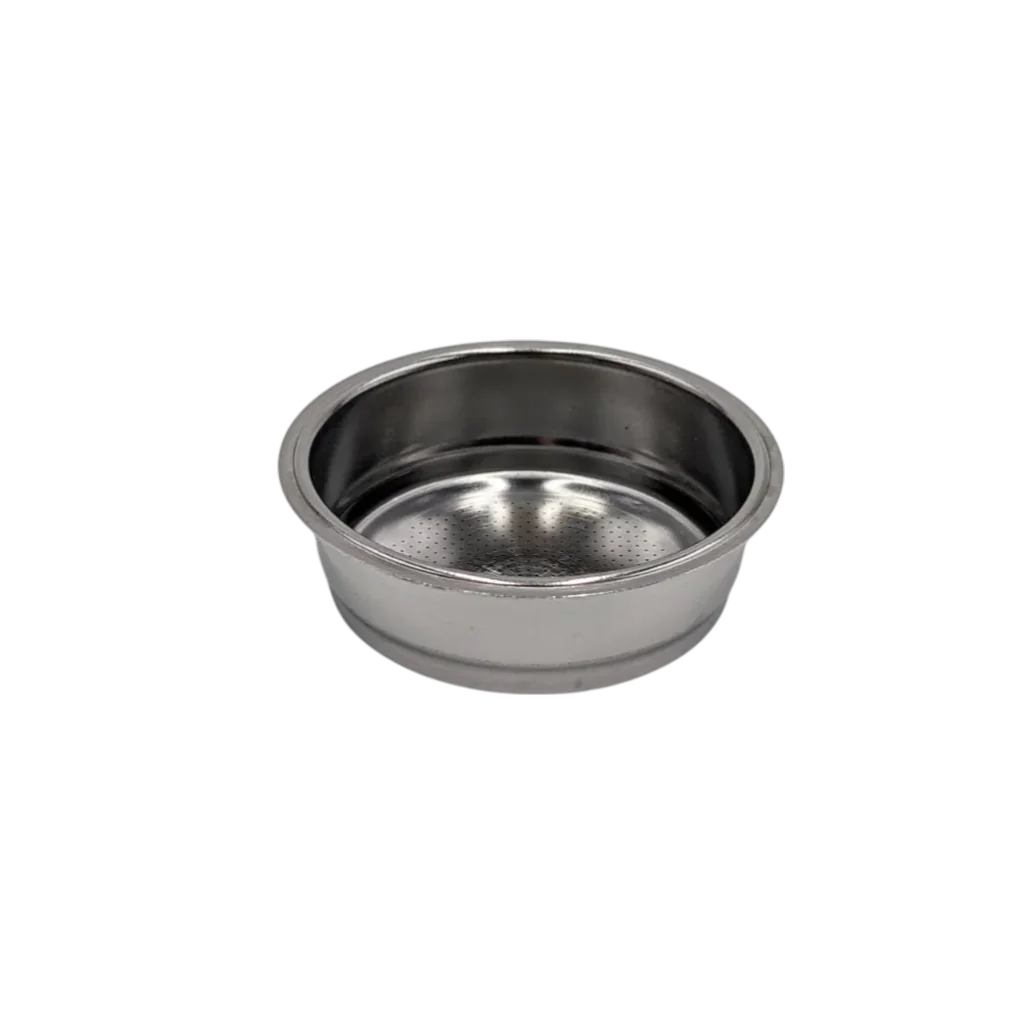
The casing is entirely made of metal and well-crafted. The portafilters and baskets, unlike many high-end dual-boiler machines in the over €2000 price range, are extremely precise and microscopically inspected. Professional 58.5mm tampers can be used.

The first espresso – what's that rattling?
Technologically, there's still a lot to mention to fully describe the machine. But before we get lost in those depths, let's pull the first espresso.
It rattles, stutters, and spits out noises we don't recognize from any other espresso machine. What is it? Every vibratory pump is loud. But the Decent's noises take some getting used to. It sounds like a specialty espresso tastes when you're used to dark, Italian espressos. But today we don't want to win an acoustic prize; we want to evaluate coffee. Incidentally, the reason is that the phase-angle control doesn't fully load the vibratory pump but engages it according to the desired pressure curve.

We're brewing a "classic Italian espresso." But we could also replicate the profile of a lever machine or completely venture off the beaten path. The control software allows you to build pretty much any pressure profile of any espresso machine.
With a few adjustments, the duration of pre-infusion can be changed or switched off. We start with a rising curve to 4 bar and then continue with a pressure of 9 bar.
For espresso, we're using our filter coffee Alessandro. It's roasted very light and tastes far too sour with this profile. Classically, with a "normal" espresso machine, we would now start adjusting the grind size, changing the brew ratio, or switching coffee. Not so with the Decent.
Switch profiles instead of grinder settings
Of course, we can also work traditionally with the Decent. If we continue with "filter coffee," we could, for example, grind coarser and change from a beverage ratio of 1:2.5 (20 grams of coffee in the portafilter, 50 grams of espresso) to 1:3 (20 G in and 60 G out). Adjusting the brewing temperature could also help, if the espresso machine allows it.
With the Decent Espresso machine, we change the approach. We switch from a pressure profile to a flow profile.
Pressure profile vs. Flow profile on an espresso machine
Most espresso machines operate with constant pressure during brewing, e.g., 8 or 9 bar. Some have a kind of pre-infusion due to their design. Pressure profile machines allow you to control the pressure during brewing. This principle exists for espresso machines for the home market, such as the La Marzocco GS3 MP, and of course for gastronomic machines.
The Decent allows for a different type of control, namely flow control or flow rate control at the output. Instead of controlling the pressure, it is adapted to the effective output speed. If the water flows too quickly through the coffee puck, either because the grind is not fine enough or channeling occurs, the machine reduces the pressure. This leads to less aggressive extraction and increases the likelihood that the espresso will be more enjoyable than it would have been with a "normal" pressure profile.
The machine, to a certain extent, corrects imperfect grind or imprecise leveling and tamping. Of course, it can only do this partially, and proper preparation of the coffee is still an essential prerequisite for truly good coffee.

Mixed water and temperature Decent
Directly above the shower screen, the Decent controls the water temperature. A built-in temperature sensor constantly communicates with the software and adjusts the mixture of hot and cold water to the desired temperature. This is the only way the Decent principle works: controlling and anticipating the presets. Other espresso machines install the control shortly after the boiler or thermo-unit and program the temperature via a standard deviation based on the expected heat loss to the water outlet.
The Decent has two thermoblocks installed, one for brewing water and one for frothing milk. By the way, this cannot be done simultaneously because the pump used is fully utilized in both cases. The thermoblock principle has advantages and disadvantages. Among the advantages is that no large water tank needs to be heated, making them more energy-efficient and ready for use faster (approx. 5 minutes for the Decent until the first espresso). The disadvantage is often temperature consistency. However, this is less due to the thermoblock itself, but rather to the fact that these are often installed in cheaper machines, and temperature control units and probes are skimped on.
Decent follows a similar approach to Sage and demonstrates what's possible when a thermoblock isn't left to heat on its own but is supported by sensible tools. Used in this way, there's a lot to suggest that the thermoblock and related systems (Thick Film Heater) will displace boiler systems as the supposed pinnacle of creation in the field of home espresso machines.

Play with me – set and save profiles
The machine's settings are almost limitless. We brewed an espresso with a brewing time of 50 seconds. It was truly delicious. Scott Rao, a virtuoso in extraction matters, writes in his blog about extensive brewing pauses that he inserts in the middle of espresso brewing. This is reminiscent of brewing filter coffee, where you also include a degassing or bloom pause.
The possibilities with the Decent in terms of flow, pressure, and temperature are so enormous that one can easily get lost. Fortunately, you can fall back on the pre-programmed profiles and also consult the community, which I will write about below.
Incidentally, the Bluetooth scale also plays an important role in controlling, as it communicates with the software and weighs and feeds the effective amount of espresso in the cup. The scale is robust and part of the machine package. The scale is similar in function to an Acaia, but its appearance looks more like a coarser tool. I accidentally dropped it on the floor, which caused no permanent damage. The scale allows for volumetric control. For example, if there are 40 grams of espresso in the cups, the scale gives the stop command to the espresso machine.

You can also froth milk
Anyone who has spent many weeks developing a new brewing profile might be less interested in the Decent Espresso's milk frothing capabilities. But even here, the machine makes a good impression. Thanks to its own heater, frothing can be done immediately after brewing (not in parallel due to pump load).
The Bluetooth scale is also used here again. The jug size for different jugs can be programmed. Afterwards, the milk quantity is entered on the scale. Based on your own preferences, a frothing duration can be programmed. Optionally, a temperature sensor can be used, which also communicates with the software.
In our case, we simply positioned the jug once and inserted the milk wand into the milk. The machine then frothed the milk into a silky and Latte Art-capable foam. This was slightly too voluminous for Philipp's liking, although we didn't make any fine adjustments.
Community and Decent Diaspora
A highlight of the Decent is certainly its community, which gathers on a Basecamp platform. Many users, as well as the founder John Buckmann, provide direct feedback to users and offer support with problems and challenges. Some users, such as Damian Brakel or Scott Rao, contribute to the sharing of knowledge, profiles, and further developments. The software has open programming interfaces, so many mods and skins are available that provide individual views and functions for the machine.
Errors and potential improvements are also collected on the platform. One consequence is that Decent itself has since developed further builds and hardware updates, such as a grinder stand that weighs the ground coffee and feeds the weight into the software.
The sharing of profiles is reminiscent of the Ikawa principle or even Artisan. In both cases, roasting profiles can be shared with a community, helping everyone progress.
Pros and Cons and Conclusion
As can be seen from the article, I was enthusiastic about the possibilities the Decent offers me. The variety of functions is gigantic and the playing field enormous. Possibilities can also be overwhelming. The machine is only suitable for you if you can also ignore options.
If you are looking for pure, simple functionality and ideally just one button, this machine is not for you. If you don't appreciate digital formats, you won't be happy with the Decent at the moment either. If you set up the machine in a museum or a noise-sensitive environment, the acoustics will probably be problematic.
Anyone who wants to learn something about espresso, challenge themselves, and perhaps discover new things will take a big step with the Decent. For coffee schools, roasteries, and coffee aficionados, I can't imagine a better espresso machine in terms of price-performance.
As coffee makers, we will place such a device in our school and integrate it into our courses. In addition, we can then write one or two more videos and one or two more tests and guides on espresso extractions for you.
To the Decent Espresso website: https://decentespresso.com/
From the failed ZPM Kickstart to Decent Espresso. Article in Barista Magazine.
We have no economic connection with Decent. As always, we write, test, and tinker freely, in this case after testing the machines of our friend Patrizio Frigeri, a passionate user of Decent Espresso.