






Grind by Weight solves a problem that hopper grinders have had for years: the coffee dosage is incorrect. With timer-based grinders, the output quantity depends on the grind size, the type of coffee beans, and even humidity. If you change the grind size, the quantity changes too – and you have to readjust the timer. Grind by Weight makes this unnecessary: an integrated scale tares the portafilter and grinds until the set weight is reached.
This sounds like the perfect solution. For many, it is. But not for everyone. We have tested seven espresso grinders with integrated scales – and learned where GbW really excels and where its limits lie.
How does Grind by Weight work?
You place the portafilter on the grinder, and the display shows the weight. You press start, the grinder tares automatically, starts grinding, and stops at the set weight – for example, 18.0 g. Most current models achieve an accuracy of ±0.1 g.
The advantage over a timer grinder: if you set the grind size finer, a timer grinder will dispense less coffee in the same amount of time. You suddenly find yourself with 16 g in the portafilter instead of 18 g. With a GbW grinder, the scale compensates automatically – the grinder simply runs a bit longer until the 18 g is reached.
This principle has existed for a few years, but it is only since 2023/2024 that enough manufacturers have offered viable models to make a real comparison possible. Prices range from €499 (Baratza Sette 270 Wi) to over €1,100 (Zuriga G2, Ligre Siji).
What GbW can do – and what it can't
The dosage problem is solved
The biggest weakness of hopper grinders with timers was the fluctuating output quantity. GbW eliminates this problem. The same amount of coffee lands in the portafilter, grind after grind. This makes the workflow easier and the espresso more reproducible.
Freshness remains an issue
You have the convenience, but not the freshness – that is the key takeaway for GbW. The beans sit in the hopper, and the retention remains. Ground coffee that has been sitting in the grinder since the last use oxidizes and loses aroma. This distinguishes GbW from single dosing: with a single-dosing grinder, every portion is completely fresh because you only add the exact amount required and the grinder clears everything out.
With GbW grinders, between 1.5 and 7 g of coffee grounds from the previous dose remain in the grinder, depending on the model. So, if you make your first espresso in the morning, you will have some old coffee in your cup. With daily use and constant throughput, this becomes less of an issue. If you only drink an espresso every other day, you will taste the difference.

Retention: The most important number for GbW
Retention is more relevant for GbW grinders than for any other category of grinder. With a single-dosing grinder, you avoid retention by grinding everything out completely. You can't do that with a GbW grinder – coffee always sits in the machine.
The differences between the models are enormous. The Zuriga G2 has 1.5 g of absolute retention, of which 1.2 g is temporary and 0.3 g is permanent – barely noticeable during daily use. The Fiorenzato Allground Sense Plus is at 7.1 g absolute, with 6.6 g being temporary. That is almost half a portion that you carry over with every grind.
For every GbW grinder, program a "purge dose" – for example, 6 g – that you grind into the trash in the morning. This clears the old coffee from the retention area before you pull your first espresso.
Speed: Not automatically faster
Intuitively, it sounds like this: set up the GbW grinder, put the portafilter in place, press the button, done. In practice, the workflow is not always faster than with single dosing. The grinder must first tare the portafilter, and then it often grinds in a controlled, slow manner to avoid overshooting the target weight.
The Eureka Libra 65 grinds at around 1 g per second – for 18 g you need 18 seconds plus taring time. The Zuriga G2 takes 16 seconds for 18 g. The Mahlkönig E64 WS (7.5 seconds), the Fiorenzato Allground Sense Plus (8 seconds), and the Ligre Siji (8 seconds) work significantly faster.
Price: GbW is a premium segment
There is only one model under 500 euros, the Baratza Sette 270 Wi – and it is not convincing in terms of taste. Viable GbW grinders with good particle distribution start at around 600 euros. However, in this price segment, you can also get very good single-dosing grinders that solve the freshness issue better.
The tested GbW grinders at a glance
We have tested seven grinders with integrated scales so far. Five of them according to our current test protocol with particle distribution analysis at the ZHAW, two older tests (Baratza Sette 270 Wi and Eureka Mignon Libra 55mm) with less comprehensive measurement data. The Mazzer Mini G is currently being tested.

Mahlkönig E64 WS €999
The most feature-rich grinder in the test. Electronic grind adjustment in micron steps, guided dial-in via algorithm, and portafilter detection – no one else offers this. 64 mm flat burrs, 27.3 g/10 sec grinding speed, 7.5 seconds for one portion. The GbW function works with a standard deviation of 0.067 g.
The weakness: The software was not fully mature at the time of testing. Boot time around 30 seconds, occasionally ignored settings, and software limitations (minimum 40 g brew weight) limit its use. 4.1 g retention (3.8 g temporary, 0.3 g permanent) is in the mid-range. The grinding temperature remains good at 32.5 °C.
In the cup: solid results across various roasts, good sweetness and body. The particle distribution (x50: 289.8 µm, fines content 32.2%) is well-suited for medium to dark roasts.
To the detailed review →
Eureka Mignon Libra 65 All Purpose €699
The only GbW grinder in the test explicitly designed for filter coffee as well. 65 mm all-purpose burrs deliver a narrow main peak (142 µm) with low fines content (27–28%) – suitable for espresso and filter. The large grind adjustment knob with turn indicator allows for very precise adjustments.
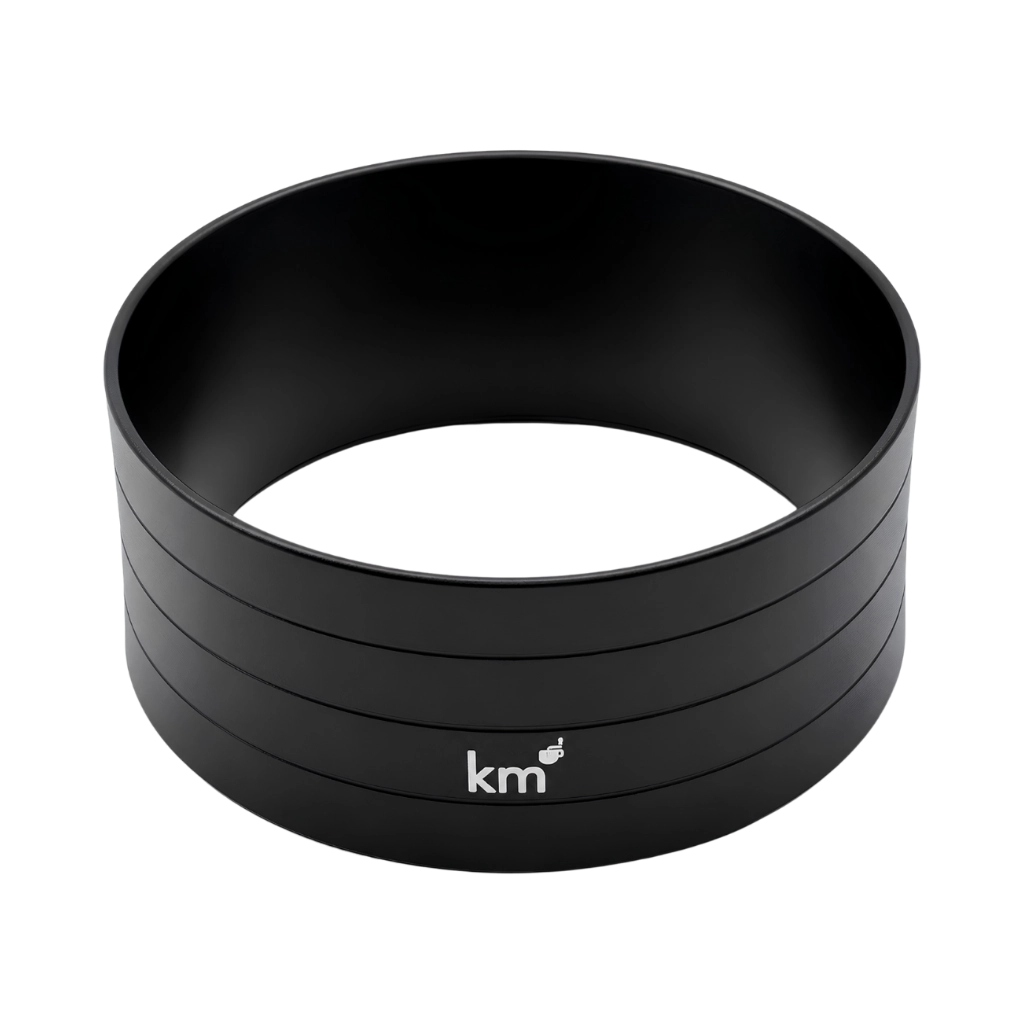
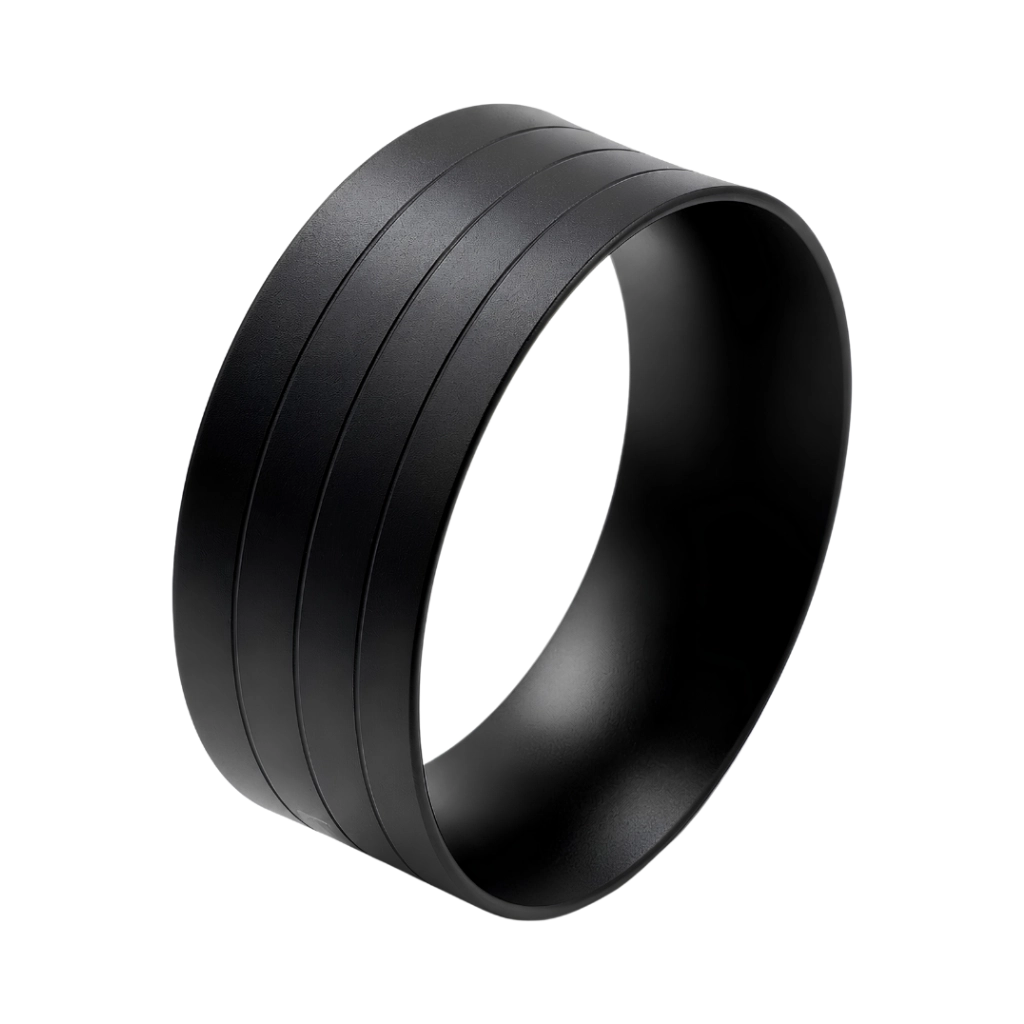
The retention is very good for a hopper grinder at 2.1 g absolute (1.5 g temporary, 0.6 g permanent). The GbW function works precisely after calibration (±0.1 g), but occasionally annoys with "FH" error messages. The magnetic dosing ring is a welcome accessory. Optionally, the burrs can be exchanged for coated Black Diamond Burrs.
Biggest weakness: The grinder is slow. About 1 g per second, so almost 18 seconds for an espresso portion. Furthermore, switching between espresso and filter in everyday use is impractical – grind size, intermediate grinding, and taring must be readjusted every time.
In the cup: Light roasts showed surprising complexity in our blind tastings, dark roasts showed powerful sweetness with a full body.
To the detailed review →
Fiorenzato Allground Sense Plus approx. €849
The most precise GbW system in the test: the same amount, grind after grind, standard deviation 0.067 g. Cleaning is exemplary – no tools required, takes seconds to access the burrs. 64 mm flat burrs, 23.8 g/10 sec, 8 seconds for 18 g. The grinding temperature remains stable at 29.6–32 °C.
The catch: 7.1 g retention. 6.6 g of that is temporary – with every grind, a good third of your coffee consists of material from the previous portion. If you don't grind several times a day, you have a freshness problem. The grind adjustment is too coarse: there is a 3–6 second difference in extraction time between two notch points. Additionally, there are no numbered markings, which makes finding a previous setting difficult. The manufacturer has not fixed these problems for years.
In the cup: lots of sweetness, soft texture, nice body with a long, cocoa-like aftertaste. The fines content of 31.8% is well-suited for medium and darker roasts.
To the detailed review →
Zuriga G2 GbW approx. €1,150
Swiss-made, quiet (79 dB), only 1.5 g total retention (1.2 g temporary, 0.3 g permanent). No other GbW grinder in the test comes close to this. The weighing function works robustly with ±0.1 g accuracy. The grind adjustment ramp offers tighter steps in the fine range than in the coarse range.
The particle distribution (x50: 286 µm, fines content 23.7%, main peak 212 µm) shows a low fines content – this results in a clear, nuanced cup that works well with light and medium roasts.
The problem: heat. After two consecutive grinds, the grinding temperature rises to an average of 40.2 °C. Especially for light roasts, which would otherwise be well suited to this particle distribution, this is a contradiction – volatile aromas escape before extraction.
On top of that: 11.1 g in 10 seconds, so you need about 16 seconds for 18 g. No problem for a single household. It gets tight for a household with guests or a shared flat.
To the detailed review →
Ligre Siji approx. €1,180
The Siji is based on the Eureka Mignon Specialità with 55 mm burrs and brings independent scale technology from Ligre. The dosing accuracy is strong: ±0.1 g, also robust against vibrations. 78 dB operating volume – the quietest grinder in the field. 22.9 g/10 sec, 8 seconds for 18 g.
Weaknesses in detail: The small dial for grind adjustment is fiddly. Cleaning requires screwdriving – not intended for regular opening. The display is on top of the grinder, which is impractical in daily use. For €1,180, you basically get a 55 mm Eureka with a scale – a high price for this base. Retention is 2.7 g total (1.6 g temporary, 1.1 g permanent), temperature is 35 °C – both within an acceptable range.
In the cup, the Siji shows the typical Eureka character: soft espresso with sweetness, medium body, and notes of cocoa and almond. The particle distribution (x50: 249.6 µm, fines content 28.6%, main peak 211 µm) is suitable for medium roasts.
To the detailed review →Eureka Mignon Libra (55mm) approx. €550 Older test
The predecessor to the Libra 65, tested according to the older protocol. The GbW function works reliably, but without a dosing ring, the grounds do not land precisely in the portafilter – a typical Eureka Mignon problem. With a dosing ring, it is a good espresso grinder for body-heavy, medium to dark roasts. 20.2 g/10 sec, 79.8 dB. Retention 2.4 g. The particle distribution (x50: 289 µm, fines content 24.2%, main peak 231 µm) is in the typical Eureka range.
The grinding temperature of 36.1 °C is noticeably warm – a disadvantage for light roasts. The grinder is being replaced by its successor but is still available online.
To the test review →Baratza Sette 270 Wi approx. €499 Older test
The cheapest GbW grinder. The scale works precisely, and the grinder is fast (29.3 g/10 sec). However: 89 dB volume, predominantly plastic construction, and a broad particle distribution (x50: 316 µm, fines content only 20.6%) result in an espresso that tastes "frayed" and lacks balance.
Known long-term issues: Defects after 6 to 24 months are frequently documented. Good availability of spare parts suggests that the manufacturer is living with this problem. A re-test would be necessary.
To the test review →GbW, single dosing, or timer – what suits you?
Grind by Weight is not automatically better than single dosing or a timer. It depends on how you drink coffee.
… drink several espressos every day, don't change beans constantly, and don't want the hassle of weighing. The constant throughput minimizes the retention problem, and the scale ensures reproducible amounts – without the need for a separate scale.
… frequently switch between coffee varieties (then single dosing is more flexible), only make an espresso every few days (then the coffee in the retention area will be old), or have a budget under €600.
Anyone who wants to combine the freshness of single dosing with the convenience of GbW currently does not have an ideal solution. The Acaia Orbit tried – and demonstrated that GbW and single dosing are difficult to combine if retention corrupts the weighing result.
Conclusion
Grind by Weight solves the dosage problem of hopper grinders – but only that. If you drink a lot of coffee, use one type of bean, and want convenience, you are well-served with a GbW grinder. Those looking for flexibility and maximum freshness should stick with a single-dosing grinder.
When choosing the right espresso grinder with Grind by Weight, it's not just about the scale, but what happens around it: retention, grinding temperature, particle distribution, adjustability. Our tests show: the one perfect GbW grinder does not exist yet. Every model has strengths and trade-offs.
The Mahlkönig E64 WS offers the most functions but struggles with software teething problems. The Fiorenzato delivers the most consistent dosing but has too much retention. The Zuriga has the best retention but gets too warm. The Eureka Libra 65 can also do filter, but it is slow. The Ligre Siji weighs precisely but is expensive for the base provided.
Which grinder suits you depends on what bothers you the most – and what you can best ignore.
Technical data at a glance
| Grinder | Price | Burrs | dB | 18g in | Temp. | Retention | Consistency | x50 | Fines content |
|---|---|---|---|---|---|---|---|---|---|
| Mahlkönig E64 WS | €999 | 64mm Flat | 85.1 | 7.5 s | 32.5 °C | 4.1 g | 0.067 g | 289.8 µm | 32.2 % |
| Eureka Libra 65 AP | €699 | 65mm Flat | 84.2 | ~18 s | ~34 °C | 2.1 g | ~0.1 g | 142 µm | 27.5 % |
| Fiorenzato Allground Sense+ | approx. €849 | 64mm Flat | 84.1 | 8 s | 32 °C | 7.1 g | 0.067 g | 262.3 µm | 31.8 % |
| Zuriga G2 GbW | approx. €1,150 | 64mm Flat | 79 | ~16 s | 40.2 °C | 1.5 g | — | 286 µm | 23.7 % |
| Ligre Siji | approx. €1,180 | 55mm Flat | 78 | 8 s | 35 °C | 2.7 g | 0.067 g | 249.6 µm | 28.6 % |
| Eureka Libra 55mm ⚠️ | approx. €550 | 55mm Flat | 79.8 | — | 36.1 °C | 2.4 g | — | 289 µm | 24.2 % |
| Baratza Sette 270 Wi ⚠️ | approx. €499 | 40mm Conical | 89 | — | — | 2.7 g | — | 316 µm | 20.6 % |
⚠️ Older test – not all values measured according to the current protocol. Retention = absolute retention.