






Defects in coffee. Where do they come from, how do they taste?
 Philipp Schallberger
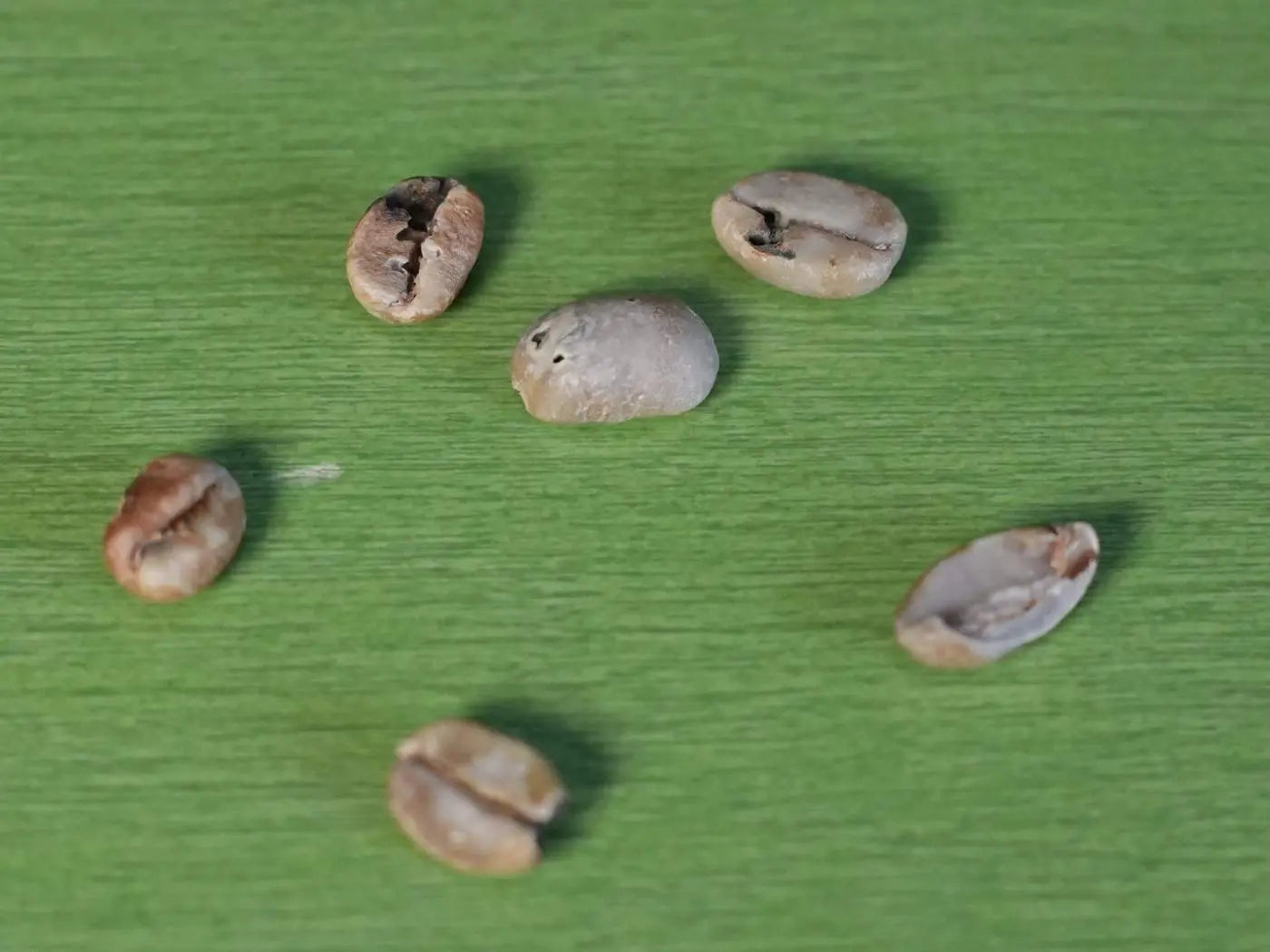
Not every coffee bean looks the same. This is normal, as coffee is a natural product. We see different sizes and shapes, and sometimes differences in color. But: there are more drastic deviations that can have a negative impact on roasting, preparation, and taste. That's when we talk about defects.
On the one hand, we distinguish between defects that can occur on the farm or during further processing and are thus inherent in the green coffee, and on the other hand, between defects that arise during roasting and can diminish the sensory quality of the coffee.
Some may categorize roasting defects as a style, but it's essentially about whether the full potential of the bean is being realized at all.
Similarly, defects are differentiated by their impact on sensory perception. Sometimes it's enough for a single coffee bean with a phenol defect to get into the grind. This single bean can then overpower the entire taste of a cup of coffee and make it unpalatable. Defects that have such a strong effect on sensory perception are assigned to the first category of defects.

Fungal infestation. These beans are sorted out before export.
Defects in the second category include beans that alone do not have a direct impact on a single cup of coffee. These are often physically damaged beans such as shells or ears, which are more strongly affected by roasting and where the roasting notes dominate.
What is not considered a defect are beans that are not visually perfect but show no other irregularities. Or as a colleague once said:
“Ugly is not a defect.”
I co-judged the World Roasting Championships for several years. One part of the competition is sorting green coffee and classifying defects, which are usually manually mixed into a sample. Many participants sorted the green coffee so precisely – or rather, over-precisely – that many green coffees looked visually flawless afterwards, but the sorted-out beans had no defect at all, they just didn't conform to the norm.
Sorting at the Dry Mill
Sorting green coffees so that they are flawless and largely uniform is the job of the dry mill – the place where coffee is prepared for export. Traders and roasteries can then choose from different qualities: roasteries that prioritize taste generally purchase coffees without defects of the first category. Brands that primarily aim for low prices buy cheaper coffee – and thus coffees with defects.

Here, coffee in parchment is hand-sorted on the farm.
Some of these defects can still be recognized in roasted coffee. Let's take a look at the defects of the first and second categories and discuss how significant their influence on taste is.
Coffee Defects and their Influence on Taste
In the following, we differentiate where defects can occur and how great their influence on taste can be. Since some defects are recognizable in both green and roasted coffee, you can check this at home and examine a bag of coffee for defects.
Phenol
You can recognize phenol by a sharp, medicinal smell, often reminiscent of leather, bandages, or rubber. It primarily arises from uncontrolled fermentation or the penetration of unwanted microorganisms during processing. Traditionally, numerous roasteries in the Balkans and Eastern Europe use coffee beans with low to sometimes strong phenol content.
In many classic "Turkish coffees," phenol is part of the flavor profile. So what is professionally classified as a defect is a flaw for some, and part of the overall impression for others. Coffees with various phenol intensities can be purchased from Brazil: from a gentle, slightly unclean phenol cup to a strongly noticeable phenol defect that dominates the cup.
- Origin: uncontrolled fermentation, poor storage
- visually recognizable: no
- roasts differently: no
- negative sensory impact: slight to very strong
Quaker

An immature bean that appears as a Quaker, a light bean, when roasted.
Quakers are often lighter beans with low density or those that, despite having high density, haven't received all nutrients. Quakers appear faded in green coffee, and then yellowish to light brown in roasted coffee. They are caused by a lack of nutrients. In washing channels, they can be separated on the farm as these floaters float to the surface.
Later, shortly before export, the green coffee is hulled and classified in the dry mill. On vibrating tables, the coffee is sorted again by density. Floaters, or Quakers, can be separated from denser beans here. And yet, a few Quakers always make it into the final product.
Quakers are easily recognizable visually because they are significantly lighter than intact roasted coffee beans. Sensorially, the impact on cup quality can vary: They can dilute the coffee flavor, making it undefinedly nutty – often peanut-like. In addition, a high number of Quakers can cause a dry mouthfeel.
- Origin: nutrient deficiency
- visually recognizable: yes
- roasts differently: yes
- negative sensory impact: slight to medium
Insect Infestation / Broca

Broca - from two punctures to total infestation
The coffee berry borer (Broca beetle) infests the cherries while they are still on the tree. It burrows into the cherry; the entry point is usually the end opposite the stem. With its ovipositor, the insect lays up to three eggs per day for over 20 days. After a resting period, the process restarts. Up to 120 eggs are laid in this way by a female coffee borer.
Infested beans are riddled with tunnels, become susceptible to uncontrolled fermentation, spore infestation, and lose density. These beans are sorted out before export. The holes are visually recognizable in the bean and indicate infestation. A few holes have no major taste impact as long as the bean has not been infested by other microorganisms. From four holes per bean, it is considered a severe infestation, and according to the former Q-Grade standard, a serious defect that could be tasted.
- Origin: coffee berry borer beetle
- visually recognizable: yes
- roasts differently: slightly
- negative sensory impact: slight to strong
Shells, Ears, Crushed Beans

The shells, ears, crushed or split beans originate during the pulping of coffee cherries. If the machine's calibration is poorly set, the discs can crush or squeeze apart the still very moist bean. These "split" beans are sorted out before export but still occasionally make it into the final product.
Since these beans are no longer intact and have a significantly lower density, they roast very differently. They burn faster and become charred to ashy.
- Origin: pulping of coffee cherries
- visually recognizable: yes
- roasts differently: yes
- negative sensory impact: medium to strong
Low Uniformity
Coffee beans don't all look the same – because they are coffee beans. What helps with roasting is having as uniform screen sizes as possible, meaning bean sizes.
If you roast very small and very large beans together, the heat transfer occurs extremely differently: In a small bean, heat penetrates to the core faster, while a large bean is still barely heated internally.
As uniform bean sizes as possible result in a uniform flavor profile because they behave more consistently in the roaster.
Broken Beans
Already dried green coffee beans can also break during transport – usually into smaller pieces, because they are already dry and do not contain moisture like shells. The broken fragments roast quickly and become charred and ashy.
Defects arising in the roastery
Officially, the following "defects" are considered flaws, though some may categorize them as a style. In any case, they can have a slight to strong influence on taste. Whether this positively contributes to the coffee's character or not remains an individual decision.
Oily Beans

Very high final temperatures cause coffee to become progressively darker. The cells burst, and the coffee bean becomes more porous. The oil contained within the bean encounters less resistance during outgassing and is pushed to the surface, forming an oily film.
The problem with oil is that it eventually becomes rancid – the same applies to coffee oil. We avoid heavily oily coffees because they also unnecessarily contaminate grinders and automatic machines.
Tipping and Scorching
Two further consequences of roasting at very high temperatures – but in different ways:
Tipping:
Especially in industrial hot-air roasters, where beans virtually shoot through the hot air stream, a tip burn, known as tipping, often results. This occurs where the bean is weakest – at both ends, because the heated water is displaced and escapes there. This is clearly visible as a small black spot: the embryo. Fast, hot roasts can lead to tipping. In very light roasts, tipping can be sensorially detected – perhaps less because of the burnt embryo, but more because of the very rapid temperature increase that prevents the development of other aromatics.
Scorching:

Scorching occurs when a bean lies against a very hot drum wall for too long. This can happen with slow drum speeds or full batches. Intense scorching results in a roasted, ashy shimmer in the coffee cup.
Contextualization: are we all too meticulous?
Coffee is a natural product, and therefore visual differences in beans are a fact. There are coffees that are not uniform in appearance but are convincing in taste. There are also coffees that are uniform but fall short in quality. The visual assessment of defects primarily helps to gain an understanding of the coffee's production method:
- Where could improvements be made?
- Which pest is currently spreading on the farm?
- And are the pulper and vibrating table precisely calibrated?
One defect that will become even more pronounced in the future due to changing weather patterns is the Quaker bean: the light bean that often smells like peanuts. If it is not sorted out in the green coffee, it can be separated after roasting, where it becomes much more visually apparent. In recent years, roasteries have upgraded for this purpose and installed so-called color sorters – sorting machines that selectively sort out beans by color or shape using an air blast.
These color sorters are helpful, reducing inequalities, but also volume. If I set the machine to remove three percent of all beans, and I roast, for example, 100 tons of coffee annually, that would be three tons of waste per year.
At a green coffee price of 10 CHF per kilogram, that would be 30,000 CHF paid for coffee that is then not used. So, it's also an economic factor whether and how much is sorted out.
And then I see a tendency for things to be examined a bit too closely sometimes: There are roasteries that sort out every minor color change. This is interesting in a boutique market, and those who want to pay more for flawless beans can do so. However, this should not lead to exaggerated expectations. Just because a bean doesn't look "perfect" doesn't mean it's bad. This reminds me of the time when I tasted coffees with seasoned Q-graders who then picked apart a 79-point coffee because it wasn't top-notch.
But there's a big world between rejects and boutique coffees. Sometimes it helps to use common sense – or even more importantly: to trust your palate.
Reality Check on the Coffee Farm
Finally, there is the reality on the coffee farm. In the Adventure Filter Coffee Subscription, we present special, rare coffees monthly – often the smallest lots from individual producers. These coffees are generally never "perfectly" sorted, because there simply isn't more coffee. If a producer produces 500 kg of coffee, they will hardly divide it into five different sizes and then sell five individual mini-lots of 100 kg each. There simply isn't a market for that. So they mix all their coffee and perhaps remove the smallest and largest five percent, which already provides a bit more uniformity.
And then it also depends on how a roastery handles these beans. I love roasting super sorted beans. But if they're not available, we adjust the roast profile a bit, roast a little longer – and achieve the desired results.
So, it's worth taking a second look at all defects in coffee.