









When we describe coffees, it's about more than just identifying aromas and flavor notes. The two categories of body and texture in particular, where we feel rather than taste, help us understand coffee even better and recognize truly good quality.
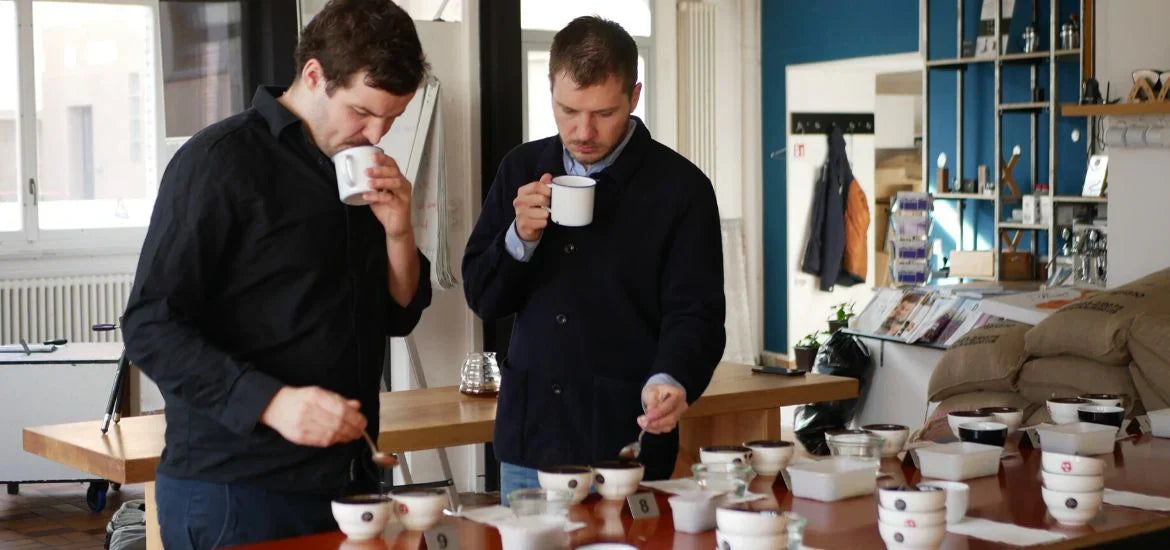
Describing coffee sensorially has something sensuous about it. It's fun to identify aromas, categorize them, and immerse yourself in the coffee. It's a multifaceted, partly creative process. When you taste coffees with others, it becomes even richer - people with very different backgrounds who also bring different vocabularies to describe the coffees exchange views about the same coffee.
This creates a catalog of descriptions from which we can take and store the most useful ones for us. In the next tasting, we can recall these descriptions and continuously expand our catalog. Various protocols allow us to document this in writing as well.
About smelling, tasting, and feeling
Especially in tastings with others, it often becomes apparent how differently coffees can be described in terms of aromas and flavor notes. When there's talk of green apple acidity, salted caramel, and ripe red grapes, most consumers might shake their heads and describe the same coffee more as "different, special, and unfamiliar." But for coffee enthusiasts, that's exactly where the incentive lies to describe a coffee's aromatics more precisely.
However, precise descriptions of aromatics are always associations with things we already know. We can only recognize smells and flavor notes in coffee that we already know.
We have to first know caramel, and then try to find the similarities of caramel in a coffee. That takes some practice, but it's even easier when someone gives you guidance. For example, coffee descriptions from roasteries help. When coffees are precisely described by a fruit or sweetness, we can try to taste out the attribute. It would be ideal if the description always matched the sensation.
Smelling and tasting is highly individual and depends largely on what we already know. In that respect, it's worth describing coffees not just by their aromatics, but also by how they feel. Because that's where the strength of all of us comes through: we usually feel better than we smell and taste. But we're not really aware of this because we don't concentrate on it all the time. However: feeling is something that's innate to us. We can feel what's soft or rough without knowing it beforehand. But we can't recognize green apple acidity if we've never eaten a green apple.

Feeling the coffee
The texture of the coffee significantly influences our perception. If a coffee has a syrupy consistency and lingers longer on the tongue, we also have more time to analyze the coffee. The flavor notes (flavours) seem more intense to us.
If, on the other hand, a watery coffee quickly disappears from the tongue, there are fewer dissolved solids in it. The low intensity and its short dwell time mean that the flavor notes are barely perceptible. The element that is decisive for a coffee's quality and readability is the body and the mouthfeel/texture.
The mouthfeel
The quality of mouthfeel plays an important role in the sensory evaluation of a coffee. Even if the coffee has great aromas and complex acids – if the mouthfeel isn't good, the coffee remains less enjoyable and the flavor notes are less readable.
The "mouthfeel" is the multifaceted, haptic sensory impression of a food. With the tongue, and less with the palate, we explore the texture of food or liquids. The term "mouthfeel" is a somewhat unfortunate loan translation from the English word mouthfeel. The texture often used in wine sensory analysis describes the same effect as mouthfeel and can easily be substituted for it.
The differences in haptic sensory impressions between crispbread, oysters, and dough are enormous. The vocabulary to describe these differences is equally broad: crispy, slippery, chewy, etc.
With coffee it's different. Coffee as a beverage is liquid and thus the wide spectrum of intensity is limited: thin – liquid – thick. Instead of going broad, we need to go deep here and describe the quality of intensity to communicate coffee. From tea-like, silky, velvety, juicy, to round, creamy, syrupy, etc., we have a large palette of descriptions at our disposal.
For example, on the Flavor Wheel from Counter Culture Coffee:

The body, the weight
The body of a coffee gives us an impression of how heavy or light a coffee can be. Especially in sensory courses, I've repeatedly noticed how difficult it can be to describe the "body" of a liquid substance. It's somewhat abstract to bring together different, seemingly unrelated concepts, and then to do that with coffee, which we want to drink, not just look at.
But if we translate body as weight, that helps many people grasp the concept more easily. This way we can use words we've been familiar with for a long time, like light or heavy, to help describe the haptics of the coffee.
On the Flavor Wheel from Counter Culture Coffee, the weight of the coffee is broken down into three levels. That's simplified and sufficient for analyzing coffees.
The weight x the mouthfeel
Now when we combine both concepts, it enables us to make a precise, yet simple and understandable description of coffees.
- We can have a light (weight) coffee in front of us that is round and silky (mouthfeel).
- Or we drink a heavy (weight) coffee that is syrupy and creamy (mouthfeel).
We combine two different categories, use words we know, and describe simply but precisely how a coffee can feel. What exactly is light, medium, and heavy, and what distinguishes a silky texture from a velvety one, requires practice - and you get that especially in exchange with others who drink and evaluate the same coffee.
Why is mouthfeel a quality indicator?
The mouthfeel of good coffee differs significantly from mediocre, and even more from coffee of lower quality. Several factors are responsible for this, but mainly one: the ripeness and uniformity of the coffee cherries. Riper coffee cherries indicate by their color that the seed (the future coffee bean) is fully ripe, has received the necessary nutrients, and is ready for harvest. The color of the cherry is comparable to a traffic light system - except here the red color is extremely positive.

Seeds from riper cherries are softer in texture because they're fully ripe. Seeds from unripe cherries are harsher because they lack the necessary sweetness.
The type of roasting can use this starting point positively, or render it useless. Shorter roasts retain the texture that's already present and can even emphasize it somewhat with an extended Maillard phase. In contrast, longer roasts, which often have a baked character, reduce texture more and more and essentially hollow it out. We often describe the mouthfeel as empty and hollow - although the weight can still feel heavy due to the high solubility of the roast.