


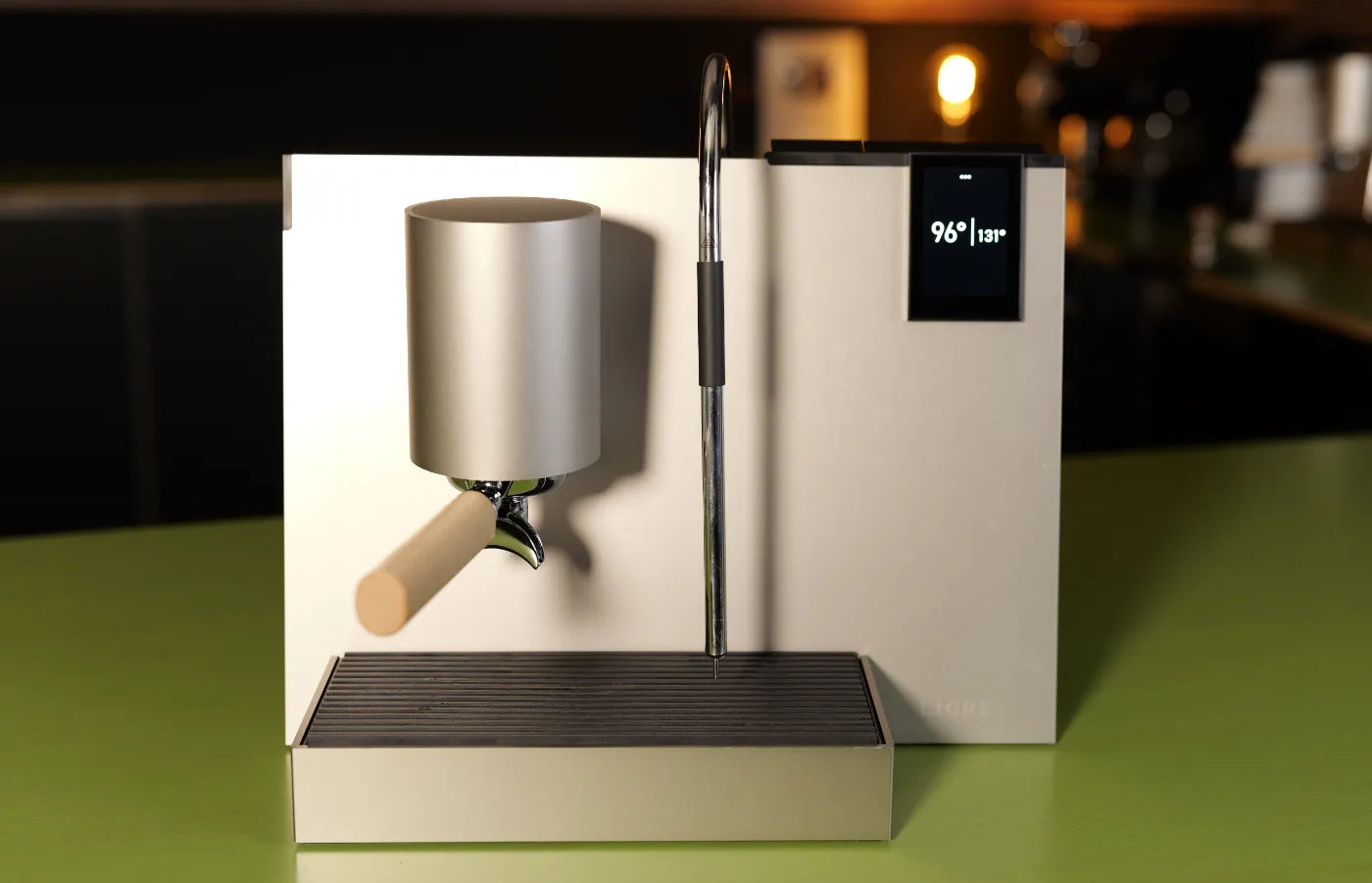

Between us stands the Ligre Youn – an espresso machine that looks more like a design furniture piece than a classic Kaffeemacher. In fact, the Youn positions itself as a true design statement and has already won prestigious awards for it (including Gold at the German Design Award and an iF Design Award).
Our curiosity was correspondingly high: An espresso machine in the ~4,000-€ league that appears radically minimalist in design and advertises innovative technology. Our initial assessment after a few days in the test lab was mixed. On one hand, enthusiasm – the engineering and technical ideas behind the Youn impress us.
On the other hand, we also felt some frustration: As advanced as the hardware is, we initially felt limited in controlling the machine. In the following experience report, we examine the Ligre Youn in detail – factually based, but also with a personal touch from the perspective of two experienced espresso machine testers.
For a test of the matching Ligre Siji espresso grinder with weighing function.
Ligre Youn in a nutshell
The Ligre youn is equipped with a thermoblock for heating the brew water, heating cartridges in the group for faster heating, and an 0.8 l stainless steel boiler for milk frothing. Two vibration pumps allow parallel frothing and brewing.
The Ligre youn is technically capable of controlling itself with flow and pressure targets. There are three preset brew profiles, but they cannot be overridden or edited. The Easy Mode brews one of the three preset brew profiles with exact volumetrics at the push of a button. A smart Guided Mode makes brewing very easy and accessible for all espresso beginners.
This accessibility and simplicity is the best feature of the Ligre youn for us. The second best is the excellent automatically frothing steam wand, which can also be controlled manually. It froths automatically and manually very well - that's a pleasure! Less pleasure comes from the temperature offset of 3 to 4 degrees. The programmed brew profiles also don't convince us.
Origin and manufacturer
Ligre is a new name in the espresso market, but not an unknown manufacturer. Behind the machine is the renowned supplier Gronbach. Gronbach, a German-Austrian family business, has decades of experience in manufacturing high-quality household appliances for renowned manufacturers. With the Ligre brand, they are now taking the step to operate under their own name and put their accumulated know-how into their own product. The Youn is manufactured entirely in Germany and Austria.
The local manufacturing approach (short transport routes, high quality controls) also fits the company's sustainability philosophy. It's nice to see that an espresso machine "Made in DACH" is back on the market. Ligre positions the Youn as the first strike of a new product line – accompanied by the matching Grind by Weight espresso grinder "Siji" – and targets both design-conscious coffee lovers and ambitious home baristas. "Siji" means "one" in Javanese and "youn" is derived from the Haitian Creole word "yon", which also means "one". We can probably expect more machines from the house. A test of the Siji will follow. We have postponed this as important updates are yet to be made.
Technical specifications
The Ligre Youn goes all-in technically. The heart is a hybrid heating system: For espresso extraction, a thermoblock is used, while a classic boiler is responsible for steam. This combination is intended to combine the best of two worlds – fast heat-up time and temperature stability during extraction thanks to the thermoblock, while also providing sufficient power and reserves for consistent steam when frothing milk through the boiler. In fact, the machine is very quickly ready for operation after switching on. Officially, Ligre speaks of only 4 minutes until it's ready to brew. In our test, it was actually about 5–6 minutes until everything was really heated through – still an excellent value compared to the 15+ minutes of many classic heat exchanger or dual boiler machines.
For parallel operation of the brew group and steam wand, two vibration pumps are installed. One pump supplies the thermoblock and delivers water to the brew head, the second maintains pressure in the steam boiler or delivers hot water for Americano etc. Both pumps are electronically controlled (keyword pressure profile), so the Youn is capable of pressure and flow profiling. In other words: In theory, pump pressure and flow can be precisely controlled to create different pressure profiles during espresso pulling. This is supported by two flow meters in the cold water inlet, which also enable volumetrics . In practice, this means: The Youn can dose a previously defined amount of water extremely precisely and automatically stop the extraction. We actually experienced this precise volumetrics as exemplary in the test – we could rely on the programmed amount landing in the cup without having to constantly check with a scale. For consistency fans and those who like reproducible results at the push of a button, that's a big plus.
Volumetrics rating: 9 out of 10 points. Only a fully integrated scale can do better.

Temperature of the Ligre youn
What about the temperature? The brew group (58 mm E61-compatible, made of solid brass) has a controlled heating system that should maintain the target temperature at the brew head. In our test, however, a temperature offset problem was revealed: The brew temperature set on the display doesn't match the actual water temperature in the portafilter. Specifically, we found that the actual brew temperature was about 3–4 °C below the displayed value. For example, 96 °C on the display only resulted in about 92–93 °C in the coffee puck. This offset was reproducible on two test devices, so we assume all currently shipped Youns exhibit this behavior. Ligre apparently measures at the top of the brew head; by the time the water reaches the bottom, it cools slightly – which explains the difference.
For practical purposes, this means: Set the temperature higher! We recommend, depending on the situation, programming 2–3 °C above your actual desired temperature. If you want about 93 °C in the puck, for example, you should set 96 °C. If you're in a hurry and brew 5–6 minutes after startup, prefer 97 °C; if the machine has been warming for a while, 95–96 °C is sufficient. This way you compensate for the offset and get the right temperature in your cup – even though it's somewhat confusing to temporarily see significantly higher values on the display. We very much hope that Ligre will address this issue via software update, as the hardware would have the potential for precise temperature control. The fact that apparently the brew temperature was never properly checked in the portafilter during development according to the industry standard using a Scace measurement basket leaves us with some question marks.
Additionally, the Ligre Youn delivers water very slowly due to the pre-infusion, brew pause, and sluggish vibration pump. This means the measuring probe doesn't provide accurate readings until about 10 seconds in. Once the Ligre is up to flow and pressure, it delivers good values. The standard deviation between extractions is also under 1 degree variation. However, it should be noted that this uses a smaller dataset compared to our classical calculation of standard deviation from second 4 to 25.
Temperature rating: 9.5 out of 15 points.
Size and accessories
The Youn is unusually wide at 45 cm, but quite slim at about 30 cm deep. The height is about 40 cm, including the raised housing area on the right where the boiler sits and the display is housed. At around 18 kg, the machine sits stably on the counter – moving it definitely requires some force. The housing is made of anodized aluminum in a noble silver-beige tone (there's also a black version), and the workmanship looks high-quality.

The removable water tank holds 1.6 liters and hides on the back of the housing. Clever: It has an integrated handle and can be pulled out for refilling. Less clever: Space gets tight under hanging cabinets – if you don't have much space above, you'll have a hard time getting the tank out, especially since it needs to be removed from the front of the control buttons. In that case, you may need to refill from the front with a pitcher.
It's somewhat amusing that Ligre itself positions the machine under hanging cabinets in some promotional images, where removing the water tank would be at least difficult.
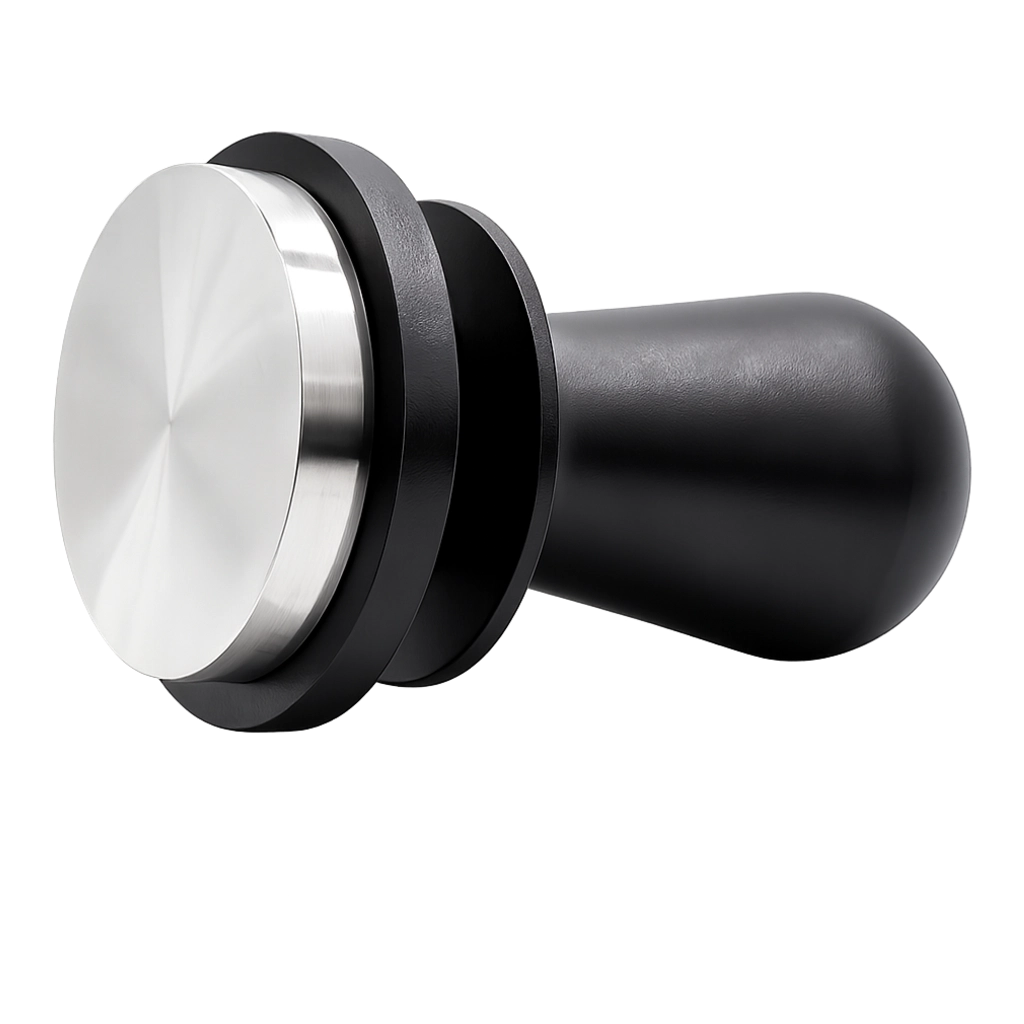
The Youn's scope of delivery includes, among other things, a 58 mm portafilter (double spout), a matching tamper made of stainless steel, as well as single, double, and blind baskets – solid standard accessories without special extras.
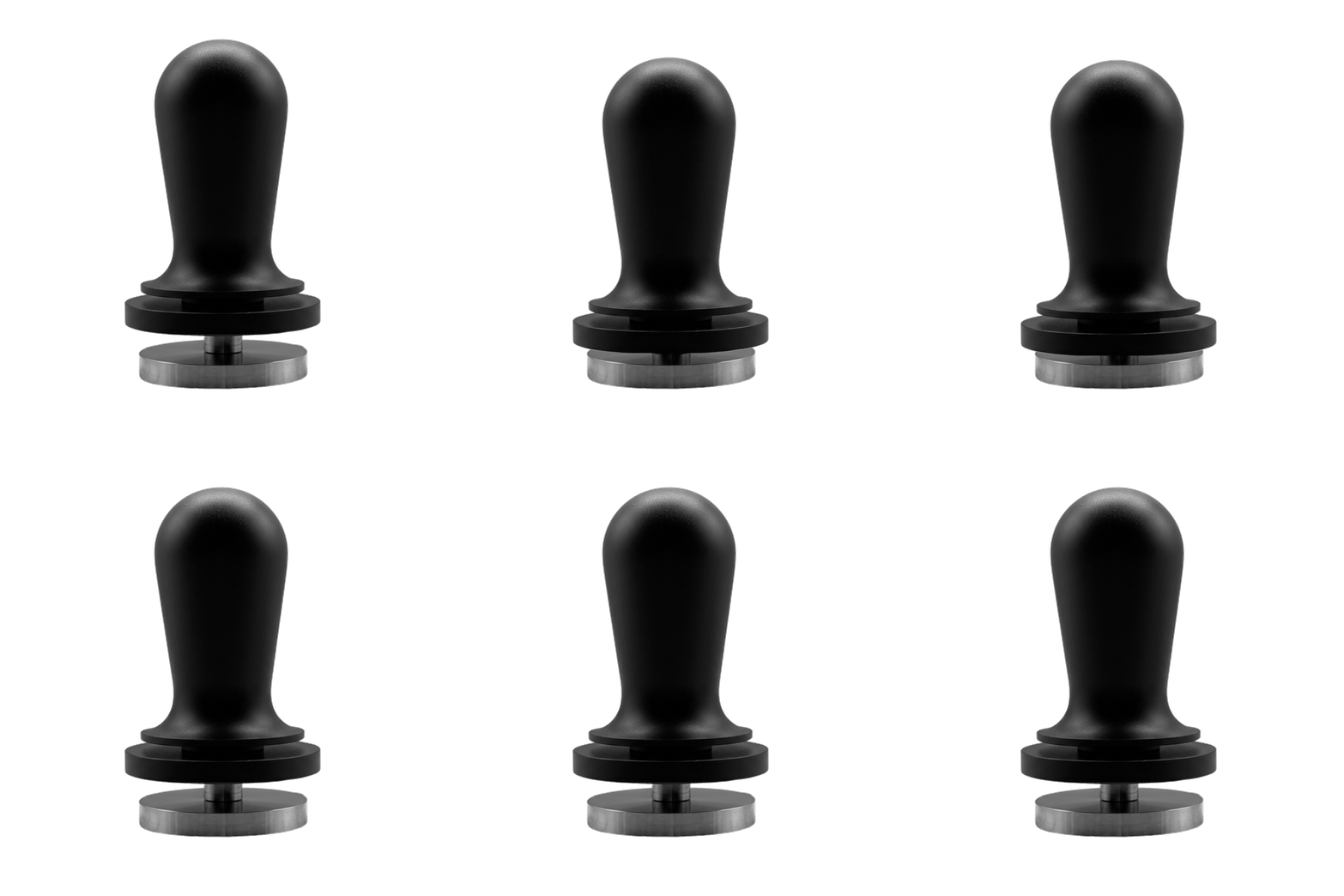
The tamper has a clearance of 0.65 millimeters to the edge in the basket. That's a good value. Haptically, the tamper is less impressive. It doesn't seem to be designed as a tamper to be pressed from above, but rather as one to be held by the handle like a hammer. A questionable design decision, especially if someone seriously presses with 15 kg of force, as Ligre recommends in its Guided Mode.
Classic baskets are found in the scope of delivery of inexpensive espresso machines several price categories below the Ligre. They are not cylindrical and the holes don't reach to the edge. A meaningful upgrade for the machine would be to replace the baskets with precision baskets from VST or our KM professional baskets. The portafilter is brass-plated and well-balanced.
Accessories rating: 3.5 out of 5 points
Hybrid machine in terms of convenience and heating
The Ligre youn is a hybrid machine in two ways. On one hand, it's technically a hybrid machine, on the other hand because of how it tries to position itself in the segment between the portafilter espresso machine and the fully automatic coffee machine (piston machine).
Halfway between portafilter and fully automatic
Fully automatic machines offer convenience and yet freshly ground coffee. A big difference from, for example, a capsule machine. Making coffee succeeds at the push of a button and demands nothing from the user. The result in the cup with household fully automatic machines is 50 - 70% of the possible quality of the coffee.
The portafilter, on the other hand, is initially complicated. You have to grind separately and adjust the grinder. Tamping, water amount, and possibly temperature are parameters you can influence. The flavor potential is 100% depending on the machine, but the margin for error is also 50% of the possible quality of the coffee. If you don't engage with a classic espresso machine, you'll drink decent coffee but still won't be satisfied. The feeling then says: you didn't get everything out of it because you didn't know better.

Operation and user experience
The Ligre Youn wants to make both beginners and advanced users happy – a balancing act that's evident in the operation. There are essentially three modes: Easy Mode, Guided, and Nerd Mode.
The different modes are all not far from each other and access to control options is limited everywhere.
The Guided Mode takes you as a user by the hand and explains more or less accurately and more or less precisely which steps you should take on your way to preparing the espresso. It asks whether you want to grind the coffee yourself, suggests an amount based on the basket, and ultimately begins brewing after you've clicked through the text passages. While the instructions are practical and somewhat improvable, the strength of the mode and one of the machine's greatest strengths begins with the brewing. If the Ligre youn encounters coarsely ground coffee or actually pre-ground coffee, then the Youn regulates its flow downward. This prevents the water from rushing through the grounds at full speed and the coffee tastes significantly better than with a "runaway over-extraction". To return to the image above: The espresso will qualitatively achieve about the 70% quality that's possible with a well-adjusted and functioning fully automatic coffee machine. The Ligre can do this due to sensitive sensors that detect when the coffee is running too fast. This function in this quality is almost unique on the market. Few other machines can do this. The fact that the Ligre falls back on one of the brew profiles to be discussed is suboptimal.
In Easy Mode, we skip the introductory text, select a Sensory Profile, and start brewing. The Sensory Profile is one of three selectable brew profiles, all of which begin with a pre-infusion, do a selectable-length brew pause, and then continue the profile. In Easy Mode, the machine stops when the programmed volume is reached.
The Nerd Mode allows the same settings that can be made in Easy Mode. And honestly, nothing more. The only additional function in Nerd Mode is that you have to end the brewing yourself and have a more detailed display. The display now shows you the amount of coffee already brewed, the current pressure, as well as the milliliters per second being brewed. The Nerd Mode is more precisely formulated – to be exact, a Nerd-Display Mode. I don't have access to the flow or other parameters – certainly not during brewing. The mode is activated when you pull rather than press the button.
So far so good, you might think. We don't necessarily need to control everything if what's set in place is convincing. But what we already saw with the poor temperature setting repeats itself with the brew profiles that we MUST select from.
Volumetrics rating: In the volume-controlled modes, the Ligre's precision is excellent. Despite different flows, we measure only deviations of a maximum of one gram from the programmed target amount. This is only better possible with an integrated scale and results in 9 out of 10 possible points in our rating.

Brew profiles and pre-infusion – missed potential
Here's the crux: The Ligre Youn offers three pre-programmed brew profiles, "Mellow Morning", "Vibrant Vigor", and "Brilliant Bolt", which promise different pre-infusions and pressure curves. In practice, however, these presets prove to be underdeveloped from a coffee perspective.
Mellow Morning works with only 2 ml pre-infusion, Vibrant Vigor with about 8 ml, and Brilliant Bolt with around 16 ml. When we first heard this, we thought: 2 ml pre-infusion per second - great! 8 ml per second - oh, interesting. 16 ml per second - somewhat crazy. When we then started working with the machine, we discovered: no – this is the total amount of pre-infusion water…
In our view, these amounts are far too small to properly saturate the coffee puck evenly. An effective pre-infusion should contain approximately 1.5 to 2 grams of water per gram of coffee so the coffee grounds are completely saturated. With a typical double shot of, say, 16 g of coffee grounds, about 24–32 ml of water would be needed to saturate the puck completely – values that the Ligre profiles fall far short of.
The consequence: Already during pre-infusion, a large part of the coffee grounds remains dry. The subsequent extraction then hits unevenly saturated coffee, which can lead to channeling and uneven extraction. In short, the machine limits itself here and doesn't unlock the full flavor potential of the coffee.
In addition, all three profiles use a brew pause that, in our opinion, is unnecessary in this form. We can hardly think of a reason why a brew pause would be meaningful when preparing espresso. With a machine that builds pressure and flow so slowly at the start of brewing, a brew pause seems even more out of place. Especially when not all the coffee is saturated. Then the already saturated coffee works during the brew pause, while most of the coffee in the portafilter hasn't even come into contact with water yet. We set the brew pause to the lowest possible time to do as little damage as possible to the extractions.
When brewing filter coffee, we often brew with a brew pause. This gives the CO2 produced by the roasting a chance to escape. But in a closed system like the portafilter, that's not possible and would especially not please crema aficionados.
Speaking of pre-infusion. Vibration pumps already have a much slower pressure build-up than rotary pumps by default. We at least question the necessity of a pre-infusion. If it is performed, it should saturate the entire coffee relatively quickly and without pressure during the pre-infusion time.
What do the profiles do after pre-infusion and brew pause?
Brilliant Bolt initially even goes above the set brew pressure, according to the manufacturer, to 9 bar and then reduces the pressure by 1 bar after a few seconds. We initially measured pressure between 9.5 and 10 bar, then a reduction to 8.5 to 9 bar.

This behavior led in our tests to the coffee puck being literally "blown apart" in some cases – the result was often severe channeling and an unbalanced taste. For this reason, we mostly used Mellow Morning, since this profile with the smallest pre-brew water amount and shortest pause, while also not ideal, disturbs the coffee puck the least.
In the final analysis, the pre-programmed brew profiles of the Youn are disappointing and waste much of the machine's technical potential. Here we would very much like to see more generous and adjustable pre-infusion options – such as a profile with ~24 - 32 ml pre-infusion, moderate pressure build-up (e.g., up to 8 bar), and subsequent reduced flow. The machine's hardware could do all of this, but the software doesn't (yet) allow it.

Espresso quality: Good, but not very good
So how do the Ligre Youn's espresso results perform in the cup? In our tastings, the machine consistently produced solid to good espressos. The extractions were reproducible and balanced thanks to temperature and volume control (offset-corrected temperature). Taste-wise, many shots pleased us – especially when we used the least invasive Mellow Morning profile.
However, there was no espresso that really stood out or unlocked the full aroma potential we know from the beans used. This is where the restrictive brew profiles become apparent in limiting possibilities. The Youn shows hints of its potential but can't fully unlock it in its current programming. Experienced users who like to play with pre-infusion, pressure profiling, and flow rate would likely be frustrated since they can't set these parameters freely. Instead, you have to work with the preset (suboptimal) profiles, which prevents top results. In short: The Ligre Youn does deliver tasty espresso in daily use – it's just not the kind you remember or that extracts the maximum from a specialty roast.
Rating: 9 out of 15
Brewing tips for the Ligre Youn
Because of the sluggish temperature development and slow start, you should aim for longer extractions with all brews. Many coffees worked best for us with extractions of 32 to 35 seconds. We recommend rather medium roasts, which have a solid base of their own and forgive a lot. From our assortment, you could try the Apas or Boton.
Milk frothing function
A highlight of the Youn – and clear indication of which target audience was also in mind – is the automatic steam wand with integrated frothing system. Ligre advertises ten different milk foam textures at the push of a button, and you can indeed set via the menu how much foam you want (from rather liquid "Flat White" consistency to firm foam) as well as the target milk temperature. In Easy Mode, a press of the milk button is all that's needed, and the machine froths itself until the programmed level is reached. How does it work? The Youn has a temperature sensor and steam function. You place the milk pitcher with cold milk under the wand, press Start – and can essentially watch as air is first blown in and then the milk is brought up to temperature.
We were initially skeptical but were pleasantly surprised: The milk automation delivers excellent results. The microfoam is fine-pored and glossy, exactly as you'd want it for Latte Art
The consistency can be selected in advance, as mentioned; we usually used level 5 or 6 (of 10) for cappuccino and achieved almost perfect results. Of course, you still have to practice pouring yourself, but the machine takes 90% of the work off your hands with this function. Especially for beginners or households where not everyone is a barista, this is wonderful comfort. However, the test showed that really cold milk is a prerequisite – in Easy Mode the machine also points this out, prompting you to use chilled milk and doesn't start otherwise. If the milk is already hand-warm, the automatic program doesn't work. In Easy Mode, frothing takes about 60 seconds.
We were impressed and can praise: "Very, very good milk foam quality – there's really nothing we'd want to improve.
Of course, the Youn also offers the option to froth manually, and that was important to us personally. If you were locked into the automation, we would have seen that critically – because even though it works well, advanced users might occasionally want to take control themselves.
If you don't press the milk button but pull it, you froth manually. In manual mode, the machine behaves like a compact dual boiler: You turn the steam lever on and froth to taste. The steam power of the 1300-W boiler is good, but not brutal. The Youn froths 200 ml of milk in maybe 40 seconds – that's noticeably slower than some dual boilers in the same price class, but still sufficient for home use.
Compared to other machines of this size, the Youn ranks in the lower middle for manual frothing. We really like the "Cool-Touch" property of the wand – it doesn't get hot on the outside, so you can touch it safely. Overall, we can say: Whether cappuccino or flat white, the Youn delivers the milk performance you'd expect from a high-end machine – with the bonus that it can almost do it on its own if you want. It's somewhat slow when frothing - at home quality seems more important to us than speed.
Rating: 9 out of 10

Energy consumption and sustainability
In times of rising electricity costs and sustainability awareness, the energy consumption of a portafilter machine is certainly a factor. Ligre claims the Youn is particularly efficient and saves up to 50% energy compared to conventional machines.
We measured: In espresso mode – i.e., when only the thermoblock is active – the Youn actually consumes pleasingly little. An espresso extraction including heat-up phase was roughly 0.052 kWh for us. As a comparison value, we look at 5 double extractions including heat-up: Here we end up at 0.088 kWh. Both values were measured with the steam boiler turned off.
That's a very good value, roughly the level of an efficient thermoblock machine. The fast heat-up time naturally plays into this positively: Since nothing needs to heat up for long, energy is saved. However, if you add the steam boiler (for milk drinks), consumption increases significantly. With the boiler in mixed mode, we were still in the green, but no longer record-breaking – other (smaller) dual boilers in our tests achieved similar values.
Pure thermoblock systems or thin-film heaters are even more economical during longer operation. According to our measurements, the Youn requires about three times as much electricity in combination mode as a machine that operates entirely without a boiler. Why? A boiler must be kept at temperature constantly to be able to access steam at any time. Thermoblocks or instantaneous heaters only heat as needed and are therefore more efficient on average. This shows a target conflict: If you want maximum steam power without wait time, you couldn't get around a boiler for a long time – that costs energy. Modern thin-film heaters can certainly achieve this without further ado and equally in seconds.
Ligre has chosen this classic compromise: Performance over efficiency, at least as far as the milk system is concerned. To be fair, in typical home use the steam boiler isn't constantly needed, and you can turn the machine off or put it into Eco mode between uses (the Youn has a standby function). Still, the point remains that a hybrid system here doesn't quite match the most economical solutions. For example, we would have found it interesting if Ligre had used a second thermoblock or thin-film heater for steam instead of a classic boiler. That would have further reduced power consumption.
In any case: The Youn is manufactured in Europe under strict environmental regulations regarding materials and manufacturing. Durability was also on the specification sheet – according to the manufacturer, every machine undergoes extensive longevity tests.
This puts the point in perspective somewhat, because what's the benefit of the most efficient machine if it needs to be replaced after a few years. With the robust Ligre, we certainly have confidence that it's built for many years of coffee enjoyment.
Rating: 8 out of 10

Design and workmanship
Let's return to the external appearance of the Ligre Youn – because this machine draws attention. As mentioned at the outset, some visitors to our academy initially didn't even recognize it as an espresso machine. The Youn looks futuristic and minimalist: a flat, slightly angled front without visible brew group housing, a small monochrome display, and otherwise just a slim cylinder (the brew head) and a linear steam arm protruding from the housing. No conspicuous rotary valves, no nostalgic pressure gauges – "away with the many levers and chrome bling of traditional machines", the design seems to say.
Instead, the Youn looks like an aluminum monolith that radiates timeless elegance. We were immediately drawn to this look. It's boldly different and yet high-quality.
You can tell that industrial designers were at work here who wanted to make a statement – and they succeeded. The material feel is also top-notch: The anodized aluminum feels good, nothing wobbles or rattles – except for one small thing, more on that shortly. Overall, we can confirm what design juries have honored: The Youn is a feast for the eyes in any modern kitchen.
Where there's light, however, there's also some shadow. In daily use, a few ergonomic and design flaws emerged that stood out despite all love for the look. First: The machine has no adjustable feet. Since the front panel of our machine and grinder don't stand at the same angle, they don't form a seamless unit.
That's a shame, because especially when two such design-strong devices stand next to each other, you want them at exactly the same angle. We helped ourselves with shims.
Second: The placement of the grinder – or rather, the required space – is impractical. Machine and grinder side by side require about 60 cm width. While the slim depth makes them look sleek, you just need a wide counter. In small kitchens, that will be difficult. And as much as the machine's small depth seems to call for standing under hanging cabinets, it's still quite tall, and this means that with cabinets hanging too low, the water tank can't be removed.
Honestly, we notice that in some of Ligre's promotional images too. That doesn't really look like the water tank could be removed there.
Third: a small quality dampener – the machine has its strengths on the front, not on the back. Not really problematic, but we noticed that the side and rear walls rattle a bit when tapped and don't match the valuable front.
Design- and operation-wise, we notice the high temperature of the massive brass portafilter holder. It doesn't seem to be insulated well or at all. We measure more than 70 degrees and find that especially problematic because the machine is otherwise so elegant and beautiful that you want to touch it. You should definitely not do that with the portafilter holder and brew head.
Otherwise, there's little to fault in the workmanship: The portafilter clicks securely (standard E61 bayonet with good resistance), the levers and buttons have a clear click point, and the drip tray is generously sized.

Conclusion and rating of the Ligre Youn
The Ligre Youn is undoubtedly one of the most exciting new entrants in the espresso machine market in recent years. It combines technical progress with aesthetic boldness – and the result is a device that is both an eye-catcher and a capable coffee tool. In our test, the Youn impressed us with its quick operational readiness, precise volumetric dosing, and clever features like the Guide Mode and automatic milk frothing. A real highlight is the powerful milk frothing function, both automatic and semi-automatic.
As much as we were impressed by the machine's technical potential, we are equally frustrated by its control. The temperature offset that the machine has been shipped with from the start prevents market orientation and has certainly led to many sour espressos at home.
The fixed programmed brew profiles diminish the result in the cup. Despite high-quality hardware and precise control options, the Youn can't show its full capabilities as long as pre-infusion and pressure profiles are so restrictively preset and can't be adjusted by the user.
The programmed brew profiles make no sense to us from a brewing perspective. After measuring and recording the profiles, we contacted numerous colleagues from the coffee community and asked for support in interpreting them. These certainly included users of Decent espresso machines and Unicas. No one could understand the profiles and, when trying to reproduce the curves with their machine, came up with satisfactory results.
So we conclude the test with very mixed feelings, and we want to summarize it in one sentence: technically, the Ligre Youn is potentially as good as the design is a statement - in programming and execution it frustrates us very much in some places.
Can you make good espresso with the Ligre? Of course! Is the milk foam excellent? Absolutely! But the Ligre doesn't live up to its own technical potential to be one of the best espresso machines. And that's tragic!

Aside: Ligre Siji Grind By Weight
Our test of the Ligre Siji is already complete. However, since the manufacturer has announced major updates coming soon, we're holding back on publication and will test the new Siji version. Some information for those considering buying the grinder.
The Ligre Siji is internally an Eureka Specialità, equipped with sophisticated weighing technology developed by Ligre. When the portafilter is inserted, the grinder first weighs or tares the portafilter and then quickly begins the grinding process.
It's very accurate in terms of grinding results. If you define a target amount of 16 grams, those 16 grams are reliably ground. Some coffees create high static charge. The problem in the current version is that the grinder can barely fill the portafilter with more than 16 grams without losing some of the coffee when the portafilter is removed. For the coffee to fall cleanly into the portafilter, many coffees require using a dosing ring. The grinder's control is intuitive and good.
Many other parameters of the grinder are determined by the Eureka Specialità grinder body.
Transparency notice
We purchased the Ligre Youn and Siji with a dealer discount and received a second Youn on loan to rule out an obvious defect in the second model (leaky water tank in our first Youn) and to verify our offset measurements on a second machine.
When we encounter test results that we see as problematic for a machine, we give manufacturers the opportunity to comment. This also happened with Ligre. However, something new was that we explained some of our findings in more detail and engaged in discussion with the manufacturer. Our willingness to do this was certainly due to both good conversations with Ligre representatives at trade shows and transparent initial conversations where the machine's quirks were openly explained to us. We were also open to providing feedback because we rate Ligre's potential higher than the machine currently sitting on our test bench.
However, the follow-up conversations didn't tend to change our impression of the machine and its potential – if anything, the opposite. A change to the temperature setting was announced to us. We hope to be able to tell you soon from which serial number this will be implemented.
The published video was not influenced by the conversations with Ligre, as it was recorded beforehand. Based on insights gained through the exchange, Ligre began to change some aspects of its online presentation of the machine, which confused us.
As a consequence of this exchange process, we will no longer discuss with manufacturers in the future and will no longer share detailed findings and parts of our test results. We will of course continue to allow space for statements without disclosing details of the results on our part.
Our goal remains to create real added value for the coffee community through transparent and comprehensible tests and to support product development through fair, well-founded criticism. We look forward to future machines that demonstrate how technology and user needs can be even better aligned.