





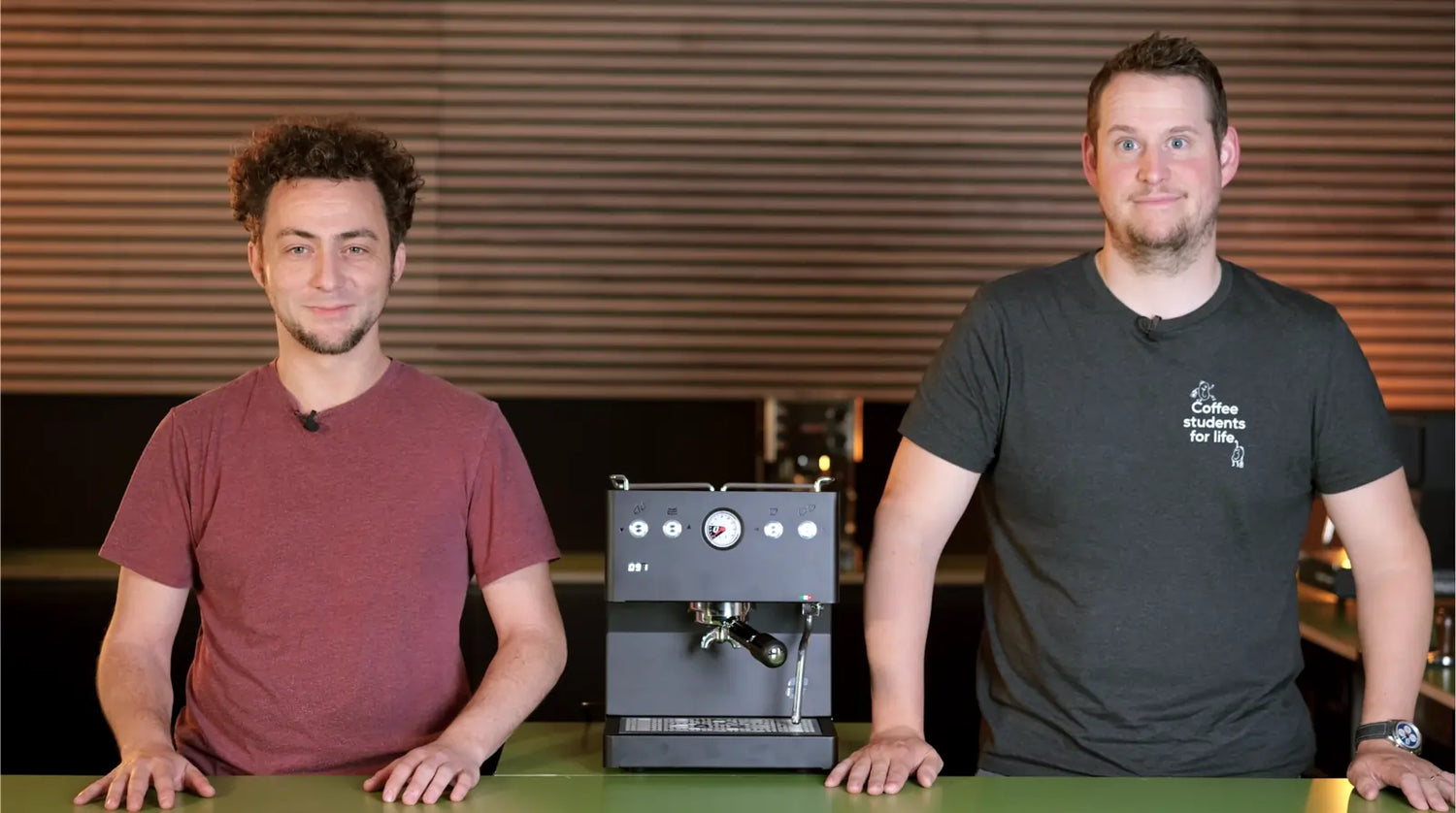

Good thermoblocks are rightfully the rising stars in the espresso machine sky. And the Quick Mill Luna is moving into the fast lane in the slipstream of another popular dual-thermoblock machine. Aside from the high build quality of Quick Mill machines, the relatively affordable purchase price is responsible for this: we can find the machine in Germany starting from 1200 euros and in Switzerland it is available from 1400 francs.
The elephant in the room is the Ascaso Steel Duo PID, which costs 1900 euros in Germany and about the same in Swiss francs. Can the Quick Mill Luna keep up at a significantly lower price? In this review, we take a look at the Luna's performance. In a future one, we will compare the machines directly (Q4 2024).
Overview of the Quick Mill Luna
It is a pleasure to start with the positive aspects, of which there are quite a few. The Quick Mill Luna is a thermoblock from Quick Mill. The family-run company, founded in 1945, manufactures its machines in Senago, near Milan. The manufacturing quality of the Luna leaves nothing to be desired in our test. The curved stainless steel housing feels premium and we find no sharp edges, not even on the drip tray.
The espresso machine is equipped with two thermoblock elements, with a power rating of 600 and 1000 watts, respectively. Simultaneous steaming and espresso brewing is possible, as both units operate independently of each other.
Weighing 12 kilograms, the Quick Mill Luna stands firmly on the table. It has a height of 35.7 cm and a width of 28.8 cm, with a depth that varies as follows due to the protruding plug and portafilter:
- The base depth is 32.3 cm,
- with the plug, the machine reaches 33.2 cm,
- and with the portafilter, we measure 39.7 cm.
The distance between the portafilter spout and the drip tray is 9.3 cm. This is practical for larger cups or for anyone who likes to use a scale under the cup to control the output volume. (This is something that makes absolute sense with the Luna, despite its volumetrics.)
The Quick Mill Luna is equipped with programmable volumetrics, which we will discuss in more detail below. The steaming time and hot water output time can also be programmed. The hot water output is more accurately described as a hot water drip, which is dispensed via the steam wand. Not much comes out!
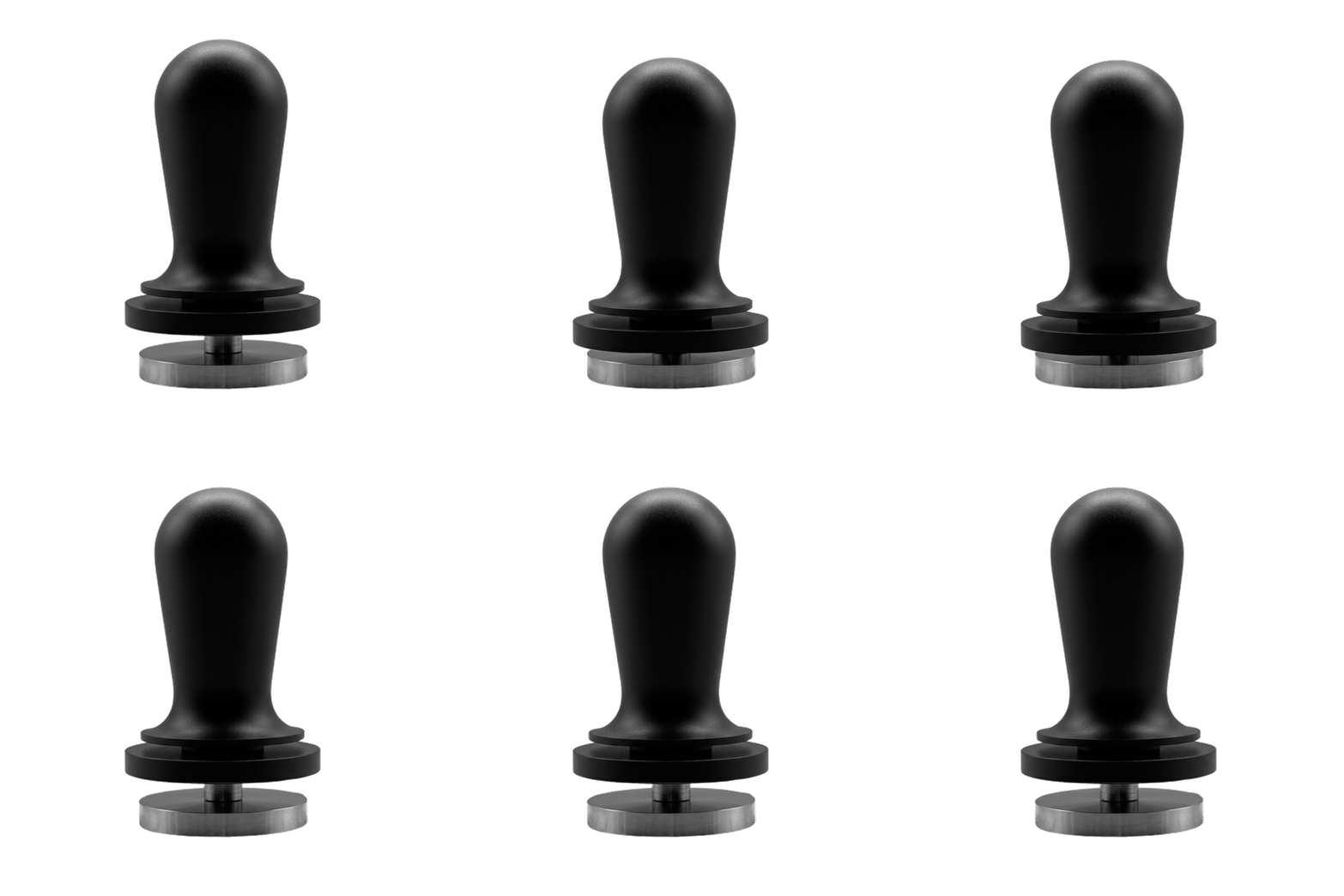
The Luna comes with the typical Quick Mill tamper, which fits neatly against the rim. While this tamper fits, non-Quick Mill equipment is once again at a disadvantage. Both the 3-lug bayonet of the portafilter and the flat support of the filter baskets are not compatible with other espresso machines. That is typical for Quick Mill. Tampers larger than 58.2 mm do not fit well, let alone filter baskets from other manufacturers. No question: the Quick Mill technology works for itself. However, the vendor lock-in effect is particularly unfortunate, given the numerous tools available in the 58mm portafilter sector.

Heat-up time and temperature performance
Those who want to enjoy espresso quickly in the morning or throughout the day will appreciate a fast heat-up time. Because of the high thermal conductivity of the aluminum block and the immediate heat transfer to the brew water, thermoblocks usually have the edge here compared to espresso machines with boilers. For the Quick Mill Luna, we measure a heat-up time of 8 minutes to reach a temperature of 92 degrees during the first extraction. However, the machine benefits from an extra minute or two. Incidentally, this is a statement we can confirm based on our logs. The longer the machine is on, the more stable it becomes, especially with a higher frequency of extractions.
With only a few extractions after an 8 or 20-minute warm-up, the machine is not stable! The extraction temperatures fluctuate significantly. While we measure an average temperature of 92.8 degrees during the first extraction, the third extraction only averages 89.23 degrees — and we are talking about seconds 5 to 25 of the extraction here. All extractions have a tendency to overshoot at the beginning and then fall during the extraction, only to stabilize again towards the end. Across the 5 extractions in our Kaffeemacher temperature protocol, we measure a maximum temperature difference of 7.63 degrees! The standard deviation (STDEV) is 2.77. This is the worst value we have ever measured using this protocol.

Interestingly, the Quick Mill Luna improves with frequency and longer idle times. In the WBC protocol, we perform 14 extractions with a final frequency of 35 seconds between extractions. The goal here is to test performance under load, e.g., for commercial use. The value of 1.18 standard deviation over 14 extractions can certainly keep up with many dual boilers, even if the difference between minimum and maximum temperature, at 5.74 degrees over all extractions, is still quite high. However, these values are partly due to the fact that the Luna is not quite up to temperature during the first few extractions of the series. Only from the 5th extraction does the Luna reach a stable 92.7 degrees, and it then maintains this well with only one outlier upwards over the subsequent 9 extractions.
In this context, another phenomenon should be mentioned. Time and again, the PID control, which can be easily adjusted via the display, shows an inconsistent temperature. This can also be seen in our video, where in the middle of the recording, the temperature in the display drops to 89 degrees for no apparent reason, and we have to wait for it to stabilize again.
Impact of temperature on espresso flavor
What impact does all this have on espresso extraction? A difficult point. Ideally, fluctuating temperature has no impact if you hit the right target window. However, our measurements show that the Luna does not demonstrate reliable temperature performance. You sometimes get the temperature you want. At times, however, it fluctuates significantly — especially during the first and second extractions. And these are the ones that are relevant to us in everyday life.
Therefore: if precise temperature is important to you, the Quick Mill Luna is not a good choice!
This does not mean that you cannot pull a very good espresso with the thermoblock. And in the end, the taste in the cup is what matters.
By the way: the offset of our machine was well set from the factory. It is set to 9 and we only had a 1-degree deviation from the display. (Depending, of course, on how the respective extraction went. Difficult. 😟)

Strong energy performance
In terms of power consumption and energy efficiency, the Luna is among the best machines on the market. 5 double shots, including heat-up time, draw only 0.08 kWh with the steam boiler switched off. An espresso with heat-up is brewed at 0.038 kWh. If we add the steam boiler, we reach a value of 0.11 kWh for extractions. A cappuccino then requires 0.092 kWh.
Those are good values!
Steaming in the slowest gear
In terms of steaming speed, the Quick Mill Luna takes last place in our test series. The thermoblock takes 80 seconds to bring the milk to temperature. That is really slow. The power of the machine is sufficient to get the milk rolling. But it takes a lot of time. It is better to steam only the small pitcher directly. Anyone who takes the time can produce good foam with the Luna. That is not the issue. And anyone who has gotten used to the machine will probably have little to complain about regarding the slow steaming. Compared to other machines on the market, however, it is very, very slow.
When steaming, it makes sense not to make a clear distinction between the stretching and rolling phases. It is better to continuously roll a little air under the milk while the entire volume of milk circulates. If bubbles that are too large are created, there is a high risk that they cannot be broken down anymore due to the low rolling power.
Volumetrics, pressure relief, and the puddle
The Quick Mill Luna has programmable volumetrics. That would be a strong argument for the machine if it worked precisely. Unfortunately, the output volume fluctuates with the resistance of the coffee puck, and therefore the volumetrics are not really usable, or only so if the grind size is already perfectly adjusted and no other factors change. Anyone returning to the machine after a day, for example, will almost certainly have fluctuating coffee amounts in the cup. A scale helps to manually control the output volume of the espresso. This is incidentally the procedure for all espresso machines with a Faema E61 brew group — so nothing special. But the programmable buttons promised us more.
What is unfortunately missing is a pressure relief valve, which is why the pressure remains on the puck after extraction. That is why we often find a puddle here, and if we detach the portafilter too quickly, there is a risk that the coffee sludge will splash out. Less than ideal for an espresso machine that costs over 1000 euros. Others in this price class do this much better.
At least it has the side effect that we only have to clean the shower screen but do not need to backflush to clean the machine.
Conclusion on the Quick Mill Luna
The Quick Mill Luna leaves me at a loss, primarily because of its poor temperature performance. It is usually roughly at temperature, but it is not a reliable partner when it comes to accuracy. I find it problematic that the first extractions in particular are not constant, as I actually see the machine being used primarily for that. One solution is probably to pull several shots of hot water through the portafilter to stabilize the machine. The WBC protocol shows that the Luna gets better and better as it goes.
In terms of build quality, the machine is exemplary, especially for the price. We have seen quite a few things that cost 1000 euros more and featured much more plastic or sharp edges.
The steam performance of the machine is sluggish. The circulation is sufficient, but the heating process takes place very slowly.
Compared to other dual-thermoblocks, the Quick Mill Luna is significantly cheaper. However, several entry-level dual boilers also populate the same price class. These have all the arguments on their side, especially in terms of consistency and steaming performance, but they are more sluggish in terms of heat-up time. But are a fast heat-up time, good build quality, and low energy consumption enough as primary arguments to buy the Luna? I have my doubts.
What do you think? Do you perhaps have the machine at home and are very satisfied? Did we overlook something important? We look forward to your notes and comments.