






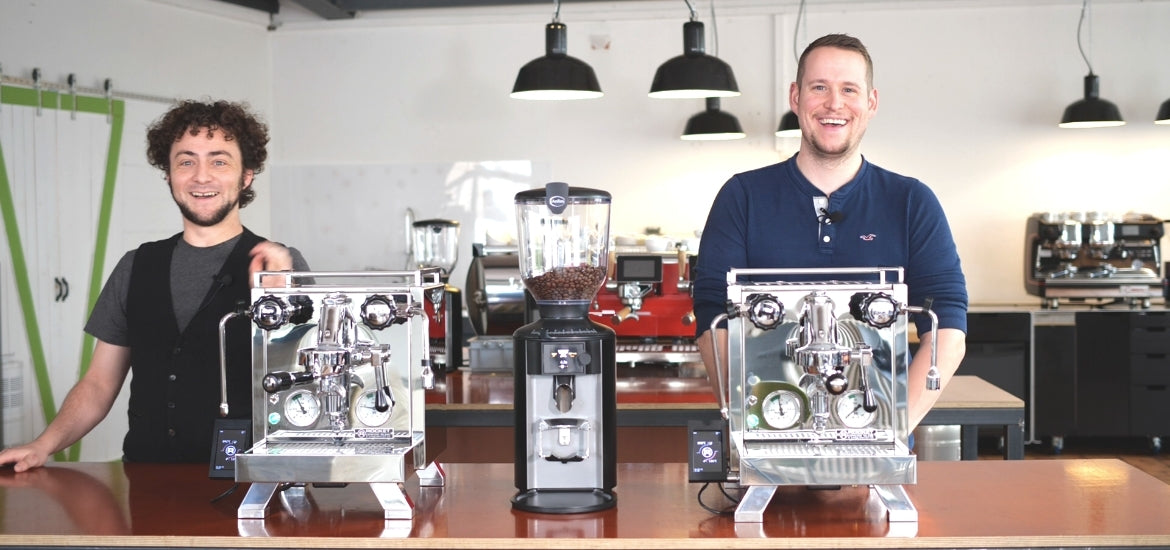

The Rocket R Cinquantotto is the successor to the R58 dual boiler espresso machine. We are taking a look under the hood of the Rocket Cinquantotto and, in doing so, cannot help but evaluate the machine in the context of other espresso machines as well. For whom does investing in a dual boiler make sense? What is the added value of such an espresso machine, and how is the result reflected in the espresso cup?
An investment for life and in plenty of material
The Rocket R Cinquantotto weighs in at a full 29 kg, making it one of the heavyweights among home espresso machines. A lot of stainless steel, two boilers, and dimensions of 46 cm in depth, 31 cm in width, and 42 cm in height all contribute to this. When measuring the width, Rocket excludes the display mounted on the left side of the machine, which takes up a good 5 cm. Although the display can be detached, it is a significant visual upgrade compared to the display design of the predecessor, the R58. And since it also includes practical functions such as temperature control and the setting of the eco-mode, it will usually be hidden on the machine. The long cable, however, also allows the display to be tucked away behind the machine.
The Rocket R Cinquantotto costs CHF 2990 in Switzerland. In Europe, we have seen the machine for 2499 euros, for example at Stoll Espresso. For the sake of completeness, it should be mentioned here that we also sell the machine in Switzerland upon request. However, we conduct our test reports as a coffee school and academy and feel free to point out both the strengths and weaknesses of every machine. In Switzerland, besides us, the Rocket R Cinquantotto is also available, for example, from Philippe at the Home Barista Shop in Aarau, from Flo at the Kaffeewerkstatt in Zurich, or from Lukas in Märstetten at Kaffee-Erlebnis.ch
The Rocket Cinquantotto with a rotary pump can be connected to the mains water supply and can also be operated with a tank. The respective connections are already in place and can be used without further ado, and a corresponding flexible hose is included in the scope of delivery.
The dual boiler principle using the Rocket R Cinquantotto as an example
Dual boiler espresso machines are a separate category of machine. They differ from heat exchanger and single boiler machines in particular by having an additional boiler, as the name suggests. A generally smaller boiler is reserved for the precise temperature of about 93 degrees for brewing water. Another, larger boiler provides the steam pressure used for frothing milk. The temperature of the larger boiler reaches between 120 and 130 degrees Celsius.
The brew boiler of the Rocket R Cinquantotto holds 0.58 l and the steam boiler 1.75 l. In the case of the R Cinquantotto, both boilers are made of copper. The big advantage of a dual boiler is the ability to control the temperature of the boilers independently of each other. This allows for the perfect brewing temperature to be achieved on the one hand, without compromising on steam power.
For this reason, dual boiler espresso machines have, in principle, been the best espresso machines for years for the precise preparation of espresso. In the commercial machine sector, this technology was taken to the extreme by Dalla Corte in 2001 with the multi-boiler approach. A separate boiler was installed above each group with a portafilter, which could be individually regulated in temperature.
The Rocket R Cinquantotto does a good job when it comes to individual temperature settings and group implementation. One downside, however, is that a potential offset cannot be adjusted.
But how does it fare with temperature consistency, and is the Cinquantotto a machine with which different temperatures can be quickly tested and different espressos brewed precisely?

6 consecutive espresso shots with the Rocket R Cinquantotto.
Pros and cons of inertia – temperature consistency
Perhaps I should start with this: we drank magnificent espressos. The Rocket R Cinquantotto can be set exactly to the point and then performs temperature-wise like a charm. The average perfect espresso brewing temperature is about 92 – 94 degrees Celsius, and our model hit that mark. The machine was not only very precise during the extraction, but it also increased by only 1.2 degrees in total over five consecutive shots. This is a top-tier value and allows for many good consecutive shots, even when guests are over or in a small catering environment.
However, the espresso machine is very sluggish. It shares this with all espresso machines featuring a Faema E61 brew group and the principle of a relatively large boiler. It takes 25 minutes before the first shot for everything to be fully heated. This inertia is evident in the consistency from shot to shot. If we compare the Rocket R Cinquantotto with an inexpensive thermoblock espresso machine, the latter looks like a fluttering heart ECG. The dual boiler, on the other hand, is a smooth line at temperature.

Temperature curves Sage Barista Touch with cold portafilter on low, Prima from Victoria Arduino, and Cinquantotto.
However, the inertia has another disadvantage. Although the temperature of the Cinquantotto can be easily adjusted via the display, the implementation of the new target value takes time. An upward adjustment is reached relatively quickly with one or two blank shots, while a downward adjustment requires significantly more patience.
Here, the Rocket R Cinquantotto illustrates the limitations of the classic dual boiler. The immense amount of heated material is not flexible and is not ready at a different temperature from one shot to the next. Its quality lies in its static nature and consistency. For this reason, a dual boiler can reach different temperature ranges. In any case, the Rocket R Cinquantotto is only recommended to a limited extent as a machine for playing, experimenting, and as a partner alongside a single dosing grinder, with the goal of experimenting and trying out different recipes and temperatures.
The independence of the flexible steam boiler and latte art
My barista colleague Michel Aeschbacher raves about the steam performance of the Cinquantotto in our detailed video. A lot of power is blown into the pitcher, and yet the milk does not heat up too quickly. This makes frothing for latte art and preparing cappuccinos and latte macchiatos a joy. The slower heating allows for long frothing in the rolling phase and thus the creation of delicate milk foam.
If the pressure is too high or too low, the individual control of the steam boiler can provide a remedy. It is a slight pity, however, that there is an upper limit of 126 degrees Celsius. This is less of a pity for home use than for the previously mentioned use in a small catering setting.
There, a bit more pressure would be synonymous with more speed. This would speed up the preparation and get the drink to the guest faster. The milk performance of the Rocket R Cinquantotto is therefore only recommended to a limited extent for the catering industry. Here one notices clearly: machines like the GS3 from La Marzocco or the Victoria Arduino Prima are much better suited with their gastro components.
High power consumption but a good ECO mode substitute
During the warm-up hour with five espresso shots, the Cinquantotto consumes 0.38 kW/h. That is quite a lot. An Ascaso Steel Duo PID consumes a quarter of that at 0.09 kW/h. After 90 minutes of no use, the Cinquantotto then jumps into an automatic ECO mode and shuts off.
A test on the subject of power consumption and Eco mode, which will be published shortly, will give the tip to turn off a machine immediately after brewing if it is expected that no more espresso will be brewed for the next two hours. The Rocket R Cinquantotto allows for additional possibilities through the control via the display. For example, two time windows can be programmed per day when the machine should turn on and off again. Very practical and, above all, purposeful for an espresso machine that takes a good 25 minutes to heat up. This way, it is already ready when the daily morning espresso is to be brewed.
Conclusion and for whom the Rocket R Cinquantotto is the right machine
An investment in the Cinquantotto is a long-term investment that will amortize over many years. The manufacturer Rocket builds solid machines meant to last for nearly an eternity. In some cases, other manufacturers who build cheaper machines with equivalent espresso performance still have to prove this.
Nevertheless, the question remains as to what justifies an investment in a Cinquantotto, especially when looking at their own house with the Mozzafiato and Appartamento.
The temperature consistency of the Appartamento is almost equivalent. The Mozzafiato is also similar and can still be controlled in the temperature range via PID, although the warm-up time was longer in our test. The significant difference of the temperature individuality of the Cinquantotto comes into play mainly when the temperature is to be used for brewing. Here, however, the inertia is an obstacle, even if the display suggests flexibility. In practice, the temperature will probably be adjusted slightly for a bag of espresso, and thus an even better result can be achieved in the cup. But we are operating at heights of sensory assessment capability that we as coffee sensory experts rarely visit in everyday life.
In my view, the R Cinquantotto is rather not suitable for baristas who want to have different espressos open at the same time and want to serve one profile to one guest and another to another. There are much better espresso machines for this, which, like the Decent Espresso, also allow for different pressure and flow profiles in addition to the temperature setting.