







In almost every testing category, the Varia VS3 performs exceptionally well. This elevates it to our top recommendation in the entry-level espresso grinder segment. We tested the Varia VS3 over many months in both our Coffee Academy and home kitchens. We evaluated both the Gen 2 and Gen 3 iterations of this grinder.
Our goal as coffee grinder testers and roasters is to find the best equipment for your home, ensuring you get the absolute most out of your coffee beans. With the Varia VS3, we stumbled upon something truly exciting.
In the meantime, we have also tested its bigger sister, which entered the market under the name Varia VS6.
Small Price, Compact Size — Great Performance?
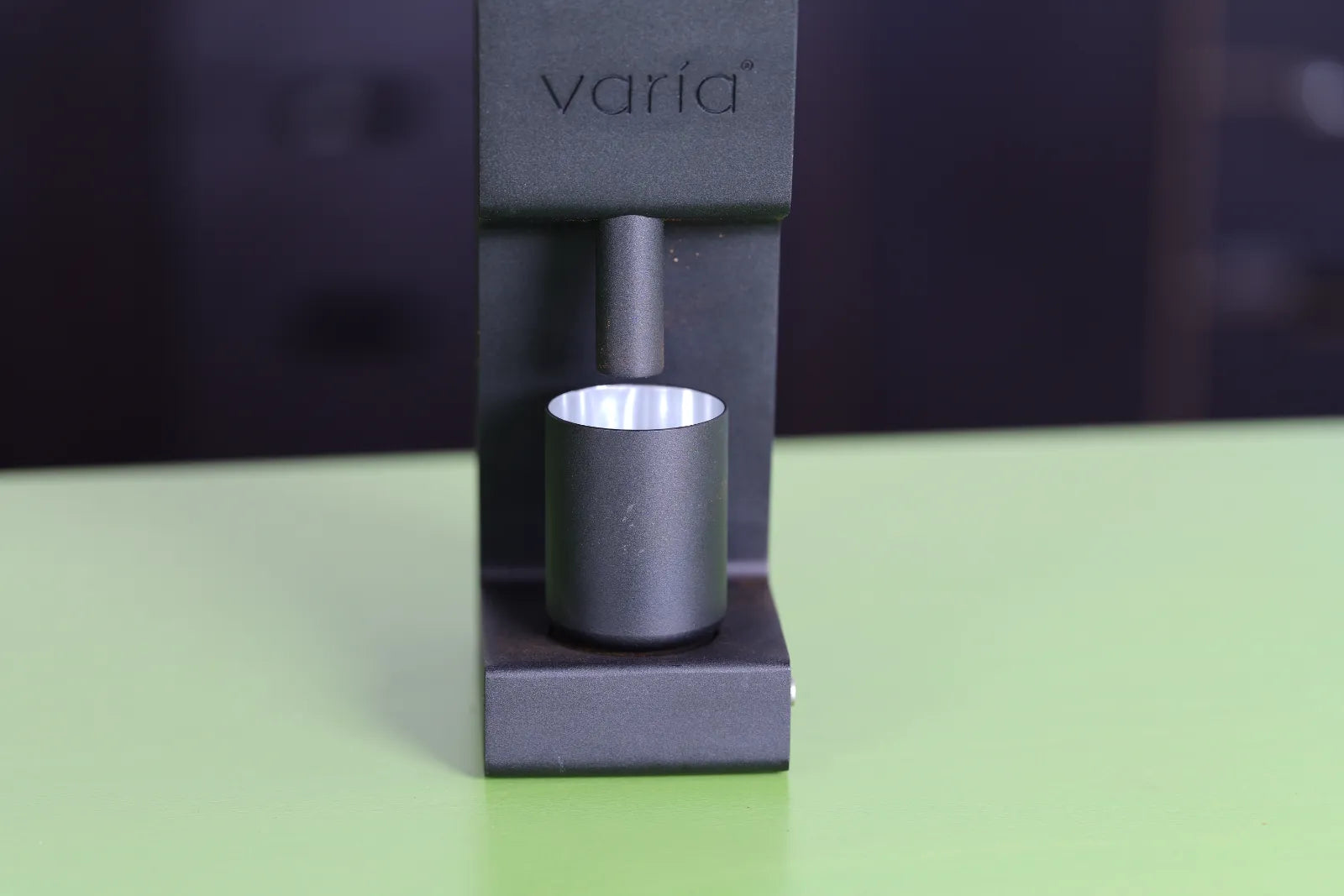
Measuring just 9 cm wide, 31 cm high, and 14.8 cm deep (16.3 cm including the rear plug), the Varia VS3 is one of the narrowest grinders on the market. The black or white painted stainless steel body looks sleek and elegant, especially alongside matching espresso machines. Despite its light weight of just 3.7 kg, the grinder sits rock-solid on the counter.
The overall build quality exceeds expectations given its entry-level price point of around €370. During our test period, we saw it on offer in Switzerland for a low CHF 270, though that appeared to be a special promotional price.
The grinder features a 48 mm conical burr set with a 38 mm inner cone diameter. The burrs are manufactured from high-nitrogen 420 stainless steel. Varia rates the burr lifespan at 150 kg of coffee. That is lower than what commercial manufacturers target, but assuming 80 espressos per kilogram, that translates to 12,000 espresso extractions. Replacing the burr set down the road is straightforward, especially since Varia offers alternative burr profiles with different flavor characteristics.
Espresso In-Cup Quality
The Varia VS3 equipped with the stock burr set delivers solid, body-forward espresso. The shot profile tastes rich, rounded, and sweet. Delicate nuances of highly complex coffees are less pronounced than a sweet, approachable body. The shots we pulled were consistently balanced and sweet.
We wouldn't name the Varia VS3 as the first choice for ultra-complex light roasts. Instead, it strikes us as a fantastic grinder for medium espresso roasts, reliably extracting the inherent sweet flavor potential from those beans.
Particle size distribution measured in our lab is good. The primary peak width sits in a solid middle range at 259 microns, with fines (<100 µm) measuring 24.6%.

Accessories and Scope of Delivery
The included dosing cup doesn't fit 58 mm portafilters cleanly because its diameter is too small. An upgraded cup that fits 58 mm portafilters is now available separately. Unfortunately, that incurs an extra cost, as the stock cup is somewhat clunky in daily workflow. The smaller cup diameter wouldn't be a problem if it had side lips like our KM Dosing Cup to catch on 58 mm basket rims.
Also included is a small spray bottle for RDT (Ross Droplet Technique), allowing you to spritz water onto the beans prior to grinding. A published scientific study confirms that RDT positively impacts extraction uniformity and static reduction.
One drawback: while the grinder body itself is remarkably compact, it relies on a massive external power supply brick. It is as large as a typical laptop charger block. If you can't tuck it away under your kitchen counter, it can get annoying. A community member actually designed and shared a 3D-printed power brick holder that clips to the back of the grinder.
Newer Revisions of the Varia VS3
We tested both Generation 2 and Generation 3 units of the Varia VS3. The latest model features a slightly upgraded motor and removes the coating inside the hopper entry chute. Some users with early Gen 1 units experienced motor stalls when grinding ultra-light roasts. That issue has been completely resolved on current models.
Removing the coating in the entry chute was a smart fix: the old coated chute generated heavy static charge, causing grounds to cling to the walls. While static is still present due to the compact design, it is significantly reduced. Static remains a factor with the VS3, making RDT (spritzing water) highly recommended.
Speed and Noise Level
The Varia VS3 is one of the slowest espresso grinders we have ever measured. It grinds just 6.7 grams of coffee in 10 seconds. In that time, you can practically wipe down half your espresso machine. The slow grinding speed takes some getting used to and alters your workflow if you are accustomed to faster grinders. However, unless you're coming from commercial speed demons, the grind duration is rarely a dealbreaker in daily home use.
Sound-wise, the grinder produces a distinct, high-pitched humming tone during operation. Measuring 73 decibels at 20 cm, it sits on the quieter side compared to competitor grinders, though the sound frequency isn't the deepest. It gets the job done without waking the house.
Otherwise, operation is pleasantly minimalist: a single button starts and stops the grinding process.
Single-Dosing Performance
The Varia VS3 is built ground-up as a single-dosing grinder. To excel in this category, a grinder must satisfy two main criteria:
Without assistance, temporary retention measures 1.1 grams. When using the included silicone bellows, retention drops to an outstanding 0.05 grams. That is exemplary.
You can remove the bellows and place the magnetic lid directly on the hopper, though it fits quite snugly. Pro tip: twist the lid rather than pulling straight up to remove it easily. But since using the bellows is so effective at clearing grounds, most users will leave it installed permanently.
On the second criterion—dial-in repeatability after drastic adjustment sweeps—ZHAW particle analysis showed minor shifts when jumping from fine ristretto settings to coarse lungo settings. However, for everyday micro-adjustments within the espresso range, repeatability proved reliable in practice.
Workflow with the Varia VS3
Due to static electricity, using RDT (the water spray technique) is almost essential. First, it prevents grounds from clinging to the dosing cup walls; second, it produces more uniform extractions. With a spritz of water, the Varia VS3 becomes an extremely functional single-doser!
Burr Upgrades: Worth It or Unnecessary Luxuries?
Varia offers several optional burr sets for the VS3—ranging from the stock steel burrs to titanium-coated options. Our testing showed that burr swaps can be worthwhile depending on taste preferences:

Verdict: Varia VS3
Despite minor criticisms, the Varia VS3 offers unmatched value for money in its price bracket. Solid espresso quality, near-zero retention (with bellows), excellent consistency, and clean usability inside a sleek metal chassis—all for around €360 / CHF 270–350.
Pros
Cons
The Varia VS3 clearly outperforms the cheaper Sage Smart Grinder Pro, holds its ground well against a DF64, and doesn't need to hide behind a Eureka Magnifico. All in all, a fantastic entry into the world of single-dosing espresso grinders!