






It stands between Michel and me: quite possibly the best entry-level single-dosing grinder currently on the market. The G-Iota DF54 (also known as the DF54) costs around 250 euros. For an electric grinder with this range of features, that is a statement that sounds almost too good to be true.
We wanted to know: what is the little brother of the well-known DF64 really capable of? Is it cheap junk or the new standard for beginners? We bought the grinder, ran it through our testing lab, and naturally drank plenty of espresso made with it.
Anyone looking to enter the world of home barista life has long faced a problem: good grinders were expensive, and cheap grinders were often frustrating. The DF54 bridges this gap perfectly. It is a classic single-dosing grinder. This means: you weigh out every portion of beans individually – ideally using a precise digital scale – throw them in the top, and (ideally) get exactly that same amount out as grounds at the bottom. This allows you to drink a strong espresso in the morning and a decaf espresso in the afternoon without having to swap beans in the hopper.
[Partner link]: Bohnendealer
We also ordered our grinder from Bohnendealer. We look for specialist partners for you whom we know provide good work and good service. We are in close contact with the retailers. These are affiliate links. If you order via this link, it costs you nothing extra, but we receive a small commission that we put into new test equipment.
Design & Build Quality
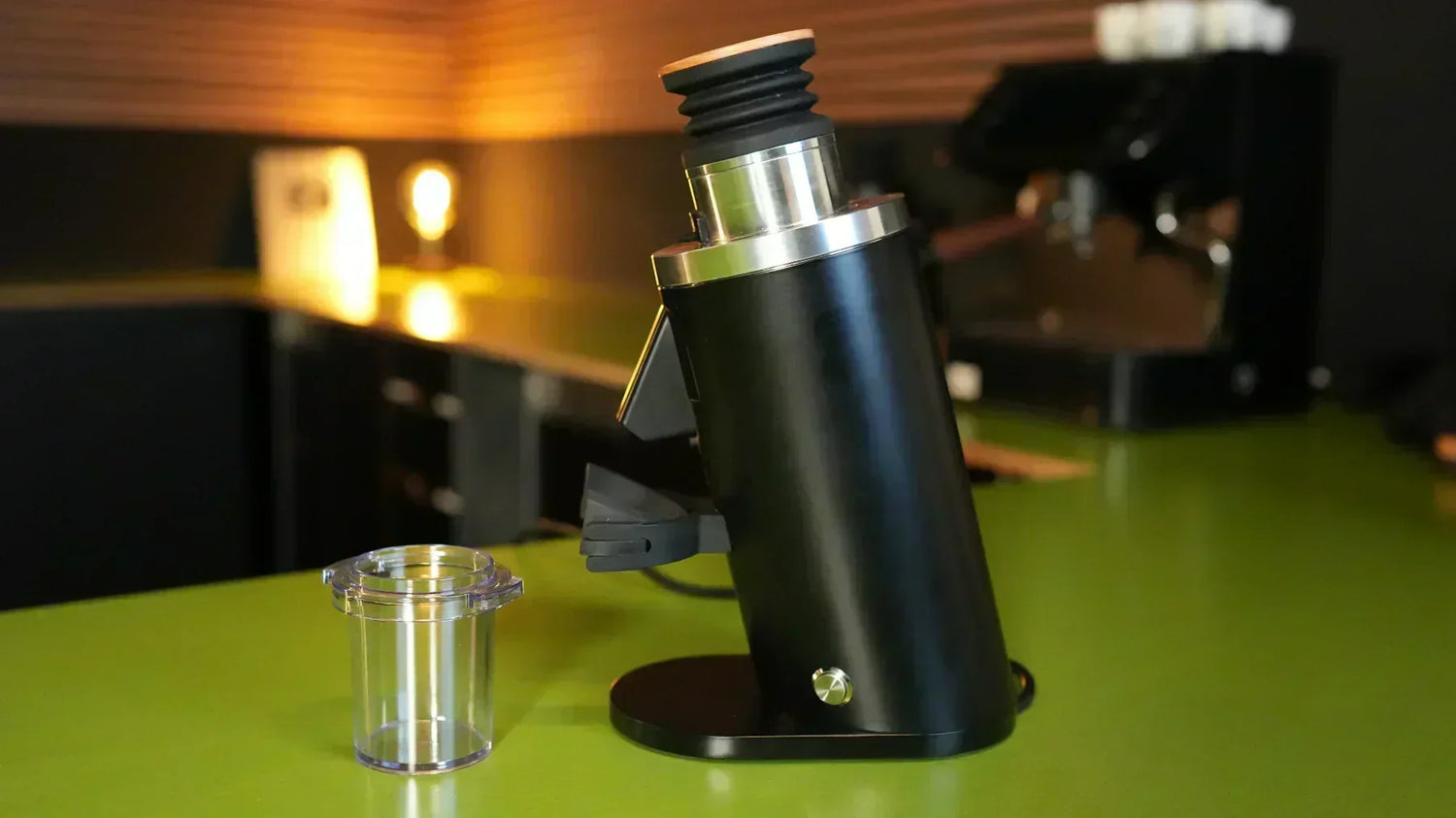
When we unpacked the grinder, we were surprised. With its dimensions (11 cm wide, 18 cm deep, 30 cm high), it is truly compact – yet it feels like a little powerhouse. It weighs 6 kilograms. The housing is made of metal, features a matte finish, and feels higher quality than many plastic-heavy alternatives in this price segment. Inside, it runs on 54 mm flat stainless steel burrs.
Is there anything to criticize? Yes. The wooden lid on the bellows feels cheap – Michel affectionately called it "poplar wood." Haptically, it doesn't match the otherwise solid build of the rest of the grinder. On the plus side, the dosing cup is now made of transparent plastic, which helps to see the distribution of the grounds. Thanks to a silicone ring and an adjusted angle, it sits much better in the holder than in the first DF64 models.

The speed comparison shows: the DF54 is not a race car. At 1 gram per second, it grinds more leisurely than its 64mm competitors, but still outperforms the Varia VS3.
Operation & Practicality
Operation is minimalist: one switch on the side, on or off. The grind size adjustment is done via the huge dial on top, which also serves as the lid base. It moves smoothly and allows for fine adjustments.
But how does it perform in everyday use?
- Noise level: We measured 86 decibels. That is not quiet, but the sound is a pleasant grinding noise, not a shrill screech. It’s not one for the bedroom, but it won't bother anyone in the kitchen.
- Speed: This is where the small motor and smaller burrs become apparent. The grinder is slow. It takes about 20 seconds for 18 grams of espresso (approx. 1 g per second). If you're in a hurry, you might get impatient. For the home coffee enthusiast, however, it is acceptable.
- Safety: One point that we noted negatively: you can unscrew the grind adjustment collar completely and the grinder keeps running. There is no safety stop. So, watch your fingers when cleaning the grinder – a good brush helps, but please only with the plug pulled!

Single Dosing & Retention
The heart of a single-dosing grinder is low retention. When we throw 18 grams in the top, we don't want to get 17 grams out and leave 1 gram of old coffee in the grinder that will spoil our next shot.
The DF54 has a built-in plasma generator (ionizer) that reduces static electricity. This works surprisingly well. We had hardly any scatter at the chute. RDT (moistening the beans with a drop of water) is often not necessary here, but can help with very static beans.
Our measurements for retention:
- Temporary retention: 0.3 g (coffee that comes out with the next shot).
- Permanent retention: 0.2 g (coffee that sticks in the crevices).
- Absolute retention: 0.5 g.
These are excellent values for this price class! Using the bellows, we were even able to push the variance down to approx. 0.05 g. That means: what you put in is what ends up in your portafilter.

Comparison of particle distribution at various settings (Espresso, Ristretto, Lungo).
Grind Quality & Particle Distribution
Let's get to the most important point: does the espresso taste good? We measured the particle distribution in the lab. For espresso (our test recipe: 18g in, 45g out in 25s), the DF54 delivers an x50 value of approx. 239 µm.
What does that mean? The grinder produces a classic, bimodal grind with a fines content of around 30%. This is comparable to grinders like the Eureka Mignon. As a result, the espresso tastes full-bodied, round, and chocolatey.
- Flavor profile: We had smooth, dense espressos with nice cocoa notes.
- Limitations: Those looking for maximum fruit explosion and extreme clarity in very light roasts (high-clarity) will encounter limitations here.
The consistency is good. The standard deviation in the output amount was only 0.05 g in our tests. Changing the grind size (e.g., for filter coffee) and returning to the espresso setting also works well, even though we measured minimal deviations when finding the exact espresso point again.
Comparison with similar grinders
- Vs. Varia VS3: The Varia VS3 is even slower and often has problems with static electricity (almost nothing works without RDT). The DF54 feels more robust and is faster.
- Vs. DF64: The big sister DF64 offers upgrade potential for other burrs. If you like to tinker and are looking for that last bit of flavor, go for the DF64. If you just want good espresso for little money, you are better off with the DF54.
Test Results: G-Iota DF54
Conclusion
The G-Iota DF54 is a price-performance monster. For around 250 euros, you get a solid, high-quality single-dosing grinder that grinds very good, classic espresso and has low retention.
Who is it suitable for?
Clearly for beginners in the home barista field or as a second grinder for decaf. It’s fun, delivers results, and doesn't cost the earth. Simply put a knock box next to it, and your setup is ready.
Is there a catch?
Yes, its origin. It is a white-label grinder from China. You don't have a major brand manufacturer like Mahlkönig or Eureka behind you guaranteeing spare parts supply for years to come. You are dependent on the importer (we bought ours from Bohnendealer). If you want security and service, you have to dig deeper into your pockets and buy European brands. If you are looking for maximum performance for a minimal budget, the DF54 is currently hard to beat.

As you can see in the photo, we certainly had a lot of fun with the DF54.
The DF54 is the grinder featured in our espresso video. The complete process — recipe, grind size, troubleshooting table — can be found in how to make espresso.