





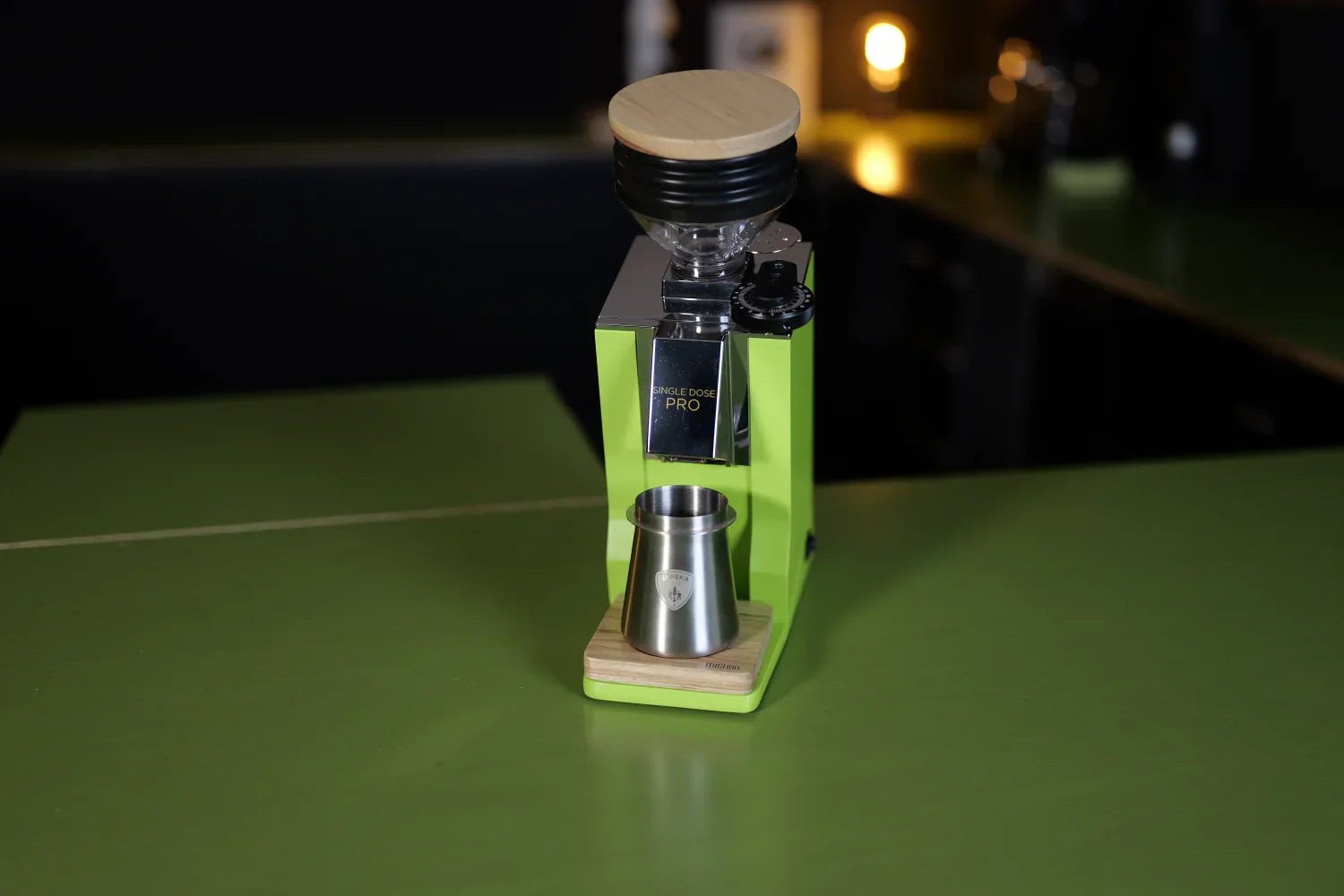

The Eureka Mignon Single Dose Pro is the new version of the popular Eureka Single Dose grinder. The first version was already a rock-solid grinder in the single-dosing category, but it did have its weaknesses—particularly regarding retention and usability. Now comes the Pro model. We tested whether the "Pro" label holds up in the cup, using our full test protocol as always, taking a critical look at what has improved, what has remained, and where there is still room for improvement.
We compared 10 single-dosing grinders in the 500 to 1000 Euro price range. Learn more in our article on the topic.
What's new? A first look
The most obvious change: the new, significantly larger grind adjustment dial with a counter function. One full rotation increments the counter. This makes switching between filter and espresso much easier—and, above all, more reproducible. Anyone who regularly switches between recipes will be very pleased with this. The haptic improvement of the grind dial is noticeable—and genuinely functional.
Furthermore, the grinder has been revised in detail: the lid sits more securely, the chute has been improved, and there is now a new, tapered dosing cup with a bulbous base, which sits better on the portafilter—all without spreading statically charged coffee dust around the kitchen.
The most important change, however, is inside the grinder! The burrs in the new Single Dose Pro are held in place by screws from behind, rather than from the front. While this may sound trivial, it changes a great deal, and we will return to this point throughout the review.
Recommended specialist retailers for the Eureka Single Dose Pro
We look for specialist partners for you who we know offer good work and good service. We are in close contact with these dealers. These are affiliate links. If you order via these links, it won't cost you any extra, but we receive a small commission that we invest in new test equipment.
Retention: Less, but not yet little enough
Eureka has made improvements regarding retention—at least regarding permanent retention. It is now at 0.2 g, which is a reduction compared to the old version (formerly 0.3–0.4 g permanent). The situation is different for temporary retention: 0.7 g remains realistic. For a single-dosing grinder, that is not exactly great—even though it is a good value compared to grinders with hopper bins.
Permanent retention has improved because the upper burr is now screwed in from the top—i.e., from the back. Truly excellent! Additionally, a gap in the burr mounting was narrowed.
In short: the residue in the grinder is lower, but not as low as one would expect from the best grinders in the single-dosing class. At least: static charge is low, and RDT is not necessary.
Speaking of temporary retention: when you slide the chute/gate on the bean hopper into the grinder, the grinder blows the coffee out more effectively because the side slot is closed, directing all the blowing force into the grinder.

Speed, volume, temperature
The grinder is fast. 18 g of espresso is ground in about 11 seconds. With a full hopper, the Single Dose Pro grinds 28 g in 10 seconds. That is impressive for such a compact grinder. The temperature increase is also limited: 32.4 °C on average after five extractions—unproblematic for the flavors.
The noise level is 81.1 dB—not whisper-quiet, but in the middle range. If you have a solid countertop, you will hear less. On lighter furniture, there is noticeable vibration.

Operation: Finally comfortable
Operation is a big plus on the Pro model. The new grind adjustment dial with a counter helps tremendously with reproducibility. Returning to a previous grind setting is also easy to manage.
We determine this by switching from the standard recipe (T4) to Ristretto, then Lungo (T6), and back to espresso. When resetting, we proceed visually by going to a noted grind setting. Afterward, we measure the extraction time and also compare the particle distribution via lab measurement.
A look at the particle distribution helps in assessing reproducibility. The fine peak shifted from 30.2% to 30.5%, and the main peak from 200.5 to 203.2 microns. That is almost zero deviation and an outstandingly good value. With the new grind adjustment dial, this is a real strength of the grinder!
If you put in 18 grams of coffee, you get 17.9 or 18 grams out of the grinder. The standard deviation here, without RDT, was only 0.044 g. But be careful—the 0.7 grams of coffee from the retention is part of the 18 grams dispensed!
The dosing aid reduces static losses, the dosing cup works well, and sits stably on the portafilter.
A genuine update over the old version: something has happened here—and you can feel it in everyday use.

Taste: Dark chocolate meets clarity
The espresso from the Pro version is strong, with notes of dark chocolate, marzipan, and cocoa. The body is medium, the texture silky-creamy. The grinder brings clarity to the cup without losing depth. This is a combination that is rarely achieved—and has been implemented very nicely here. We drank our Apas espresso, which we frequently use in grinder and machine tests.
The particle distribution curves show what we taste: a clear, dense main peak with good reproducibility.
The new Eureka Single Dose Pro benefits greatly from the upper burr being screwed in from the back. The grinder's main peak is much narrower than that of the previous version. We can go really fine without losing clarity.
The fact that many burrs are attached with screws through the burr face is rarely discussed. It is actually surprising, as any nick in a burr otherwise leads to major drama and the purchase of new burrs. Yet the screw openings have such a huge influence on the overall grinder geometry. This becomes obvious when you see the old particle distribution curve next to the new one.

Conclusion: Good grinder gets better
The Eureka Mignon Single Dose Pro is a successful update. The improvements are not spectacular, but they are well thought out. Above all, reproducibility and everyday suitability have been significantly increased. The reduced retention is a step in the right direction—but it still does not reach the level of the best single-dosing grinders.
The best thing about the new grinder is the burr screwed in from the back, which leads to a more uniform particle distribution and thus to better espresso. Bravo Eureka, this is a good path! Now, how about the other burr?!
Anyone who has the first version does not necessarily have to upgrade—but anyone starting out new gets a very good grinder here for a fair price. And: It looks damn good in Kaffeemacher green. What else distinguishes the grinder: it is manufactured in Europe, and the availability of spare parts and repair options is ensured thanks to competent specialist workshops in Germany, Switzerland, and Austria.