






It sounds promising when the German mill manufacturer brings its own single dosing grinder for home use to the market. It's a memorable moment because Mahlkönig started "single dosing" as we know it today almost 15 years ago. Back then, a young Australian named Matt Perger ground his coffee on a grinder for the Brewers Cup and the Barista Championship on a Kaffeemacher that Mahlkönig itself primarily understood as a grain mill. We're talking about the legendary EK43. This grinder began its triumphant march and became home in numerous cafés around the world.
Today, many years later, single dosing is hardly missing from home either. Mahlkönig, once a trailblazer – albeit without any major contribution of its own – became an unwilling pioneer and has pretty much slept on the subject of single dosing for home use until today. But this summer it finally happened. Mahlkönig delivered: with the Mahlkönig x64 SD, it was finally here. Since then, we have extensively tested the grinder from the Swiss-German company. I should mention right away: the x64 SD model is not manufactured in Hamburg, but in the Chinese Mahlkönig manufacturing facility.
Whether the grinder, which comes to market for the competitive price of 499 euros, also shines under the lens of our test protocol, you'll find out in this test report.
Design and Workmanship
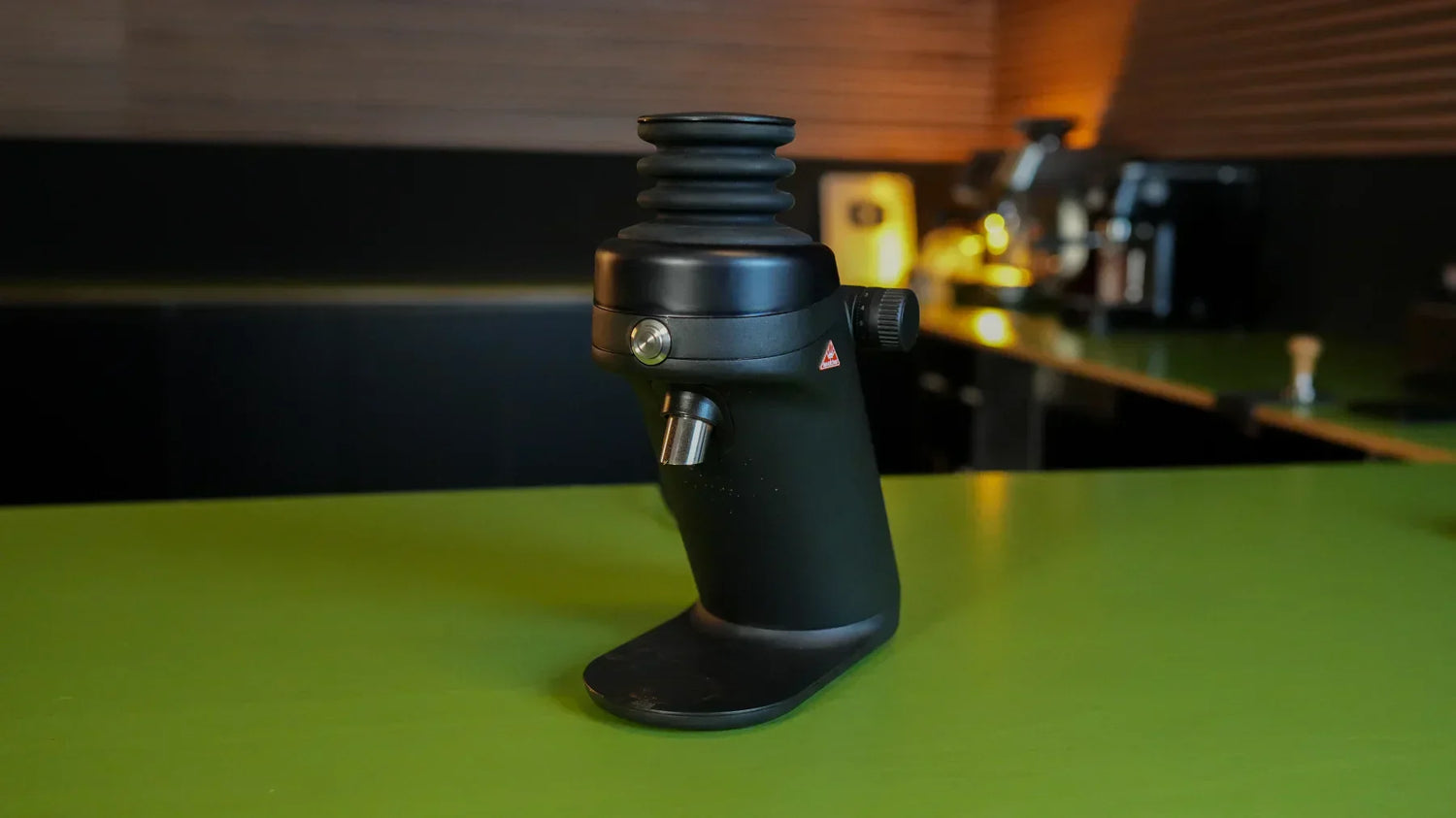
The first impression was – unusual. If you know the clean, industrial lines of the EK43, E65, or X54, you'll be taken aback at first with the X64 SD. The compact design seems almost squat, the curves rather playful. We felt the same way as many: Does a Kaffeemacher look like that?
But when the grinder arrived in our test lab, the impression changed. What looked like plastic in photos turned out to be a solid aluminum housing that gives the grinder a substantial weight of over 4.5 kg. Everything feels high-quality, from the premium silicone blower to the well-thought-out magnetic holders. Despite its compact mass – 14.3 cm in width, 25 cm in height, and around 26 cm in depth – it stands rock solid on the work surface.
Nevertheless, we couldn't help but make an amusing association that solidified over the course of testing: with its squat body and the central, round grind adjustment wheel, it reminds us of a frog cyclops, a figure from Greek mythology. Once in your head, you can't get rid of this image – a likeable, if somewhat quirky, character for the home coffee bar.
Buy Mahlkönig x64 from our valued specialist partner
Are you looking for a good specialist retailer for the Mahlkönig x64 SD? Then we recommend one of the following businesses. We search for and visit specialist retailers for you, of which we know they provide good work and good service. If you order the grinder there, it won't cost you any more, but we receive a small commission that we put into further test machines: Mahlkönig X64 SD at Stoll Espresso.
Technical Data at a Glance
| Measurement Result | Value |
|---|---|
| Grinding Burrs | 64 mm flat grinding burrs |
| Speed / 18 g | approx. 7.0 seconds |
| Speed / 10 sec | approx. 35.0 grams |
| Volume | 81.0 dB |
| Temporary Retention | 0.6 g |
| Absolute Retention | 0.9 g |
| Grind Setting Replicability | Theoretically good |
| Price (RRP) | 499 € / 499 CHF |
 Everyday Operation
The grinder is simply constructed: no display, no gimmicks, no menu. Grind, press the blower, done. We basically like that – but there are nuances you should know about.
The adjustment wheel works with a small planetary gear that translates the rotation. This allows the grind setting to be adjusted very precisely. You can almost feel something "reducing" in movement inside – a clever solution that allows for delicate adjustment.
However, the grind display itself is quite small. The printed dots and dashes are far apart, which means a tiny movement on the wheel often makes a difference of several seconds in extraction time. It is advisable against going to the next line when adjusting the grind setting. For those who stay precisely between the lines and take quarter steps, the grinder can be set very precisely. We would have simply liked more intermediate lines here.
Positive: The zero point can be easily adjusted. For those who regularly open and clean the grinder, finding the zero point again is very simple. Negative: necessary after every opening.

The Ground Coffee: Where the x64 SD Really Shines
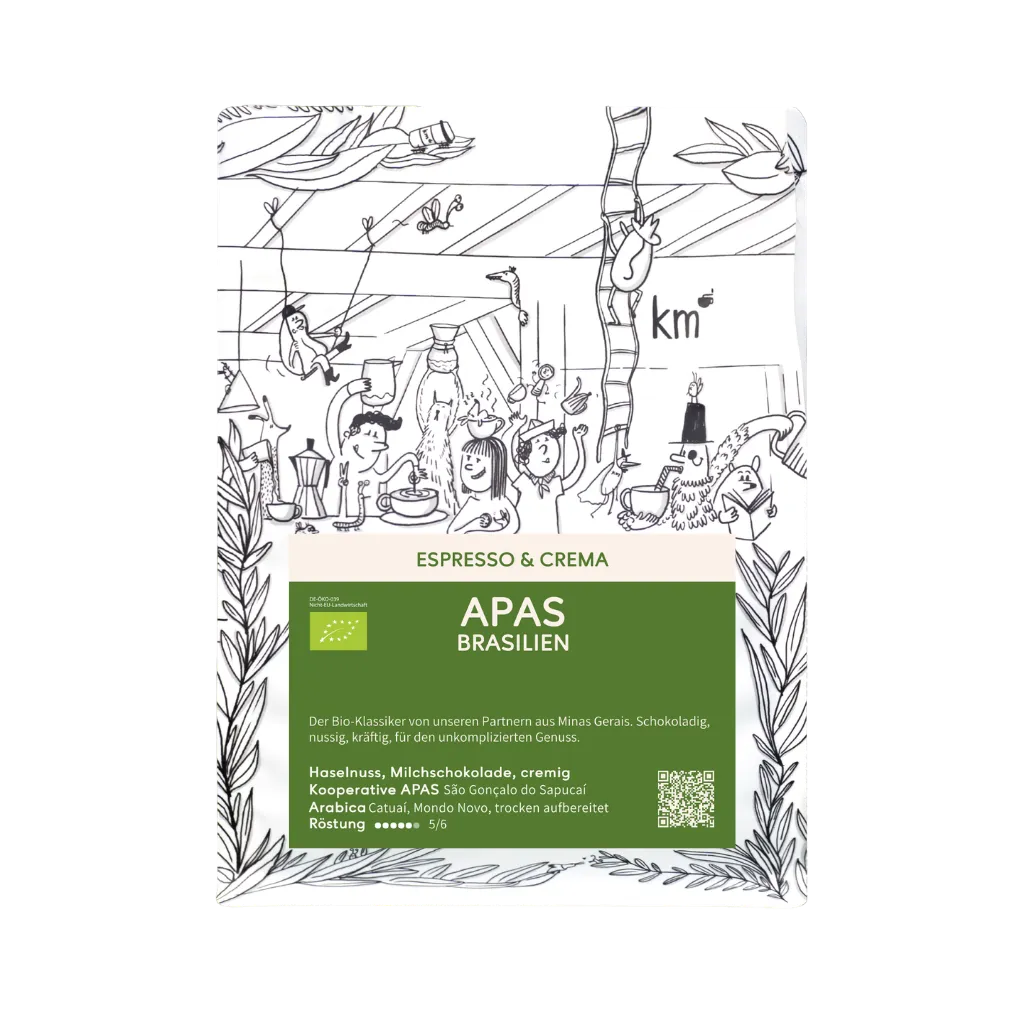
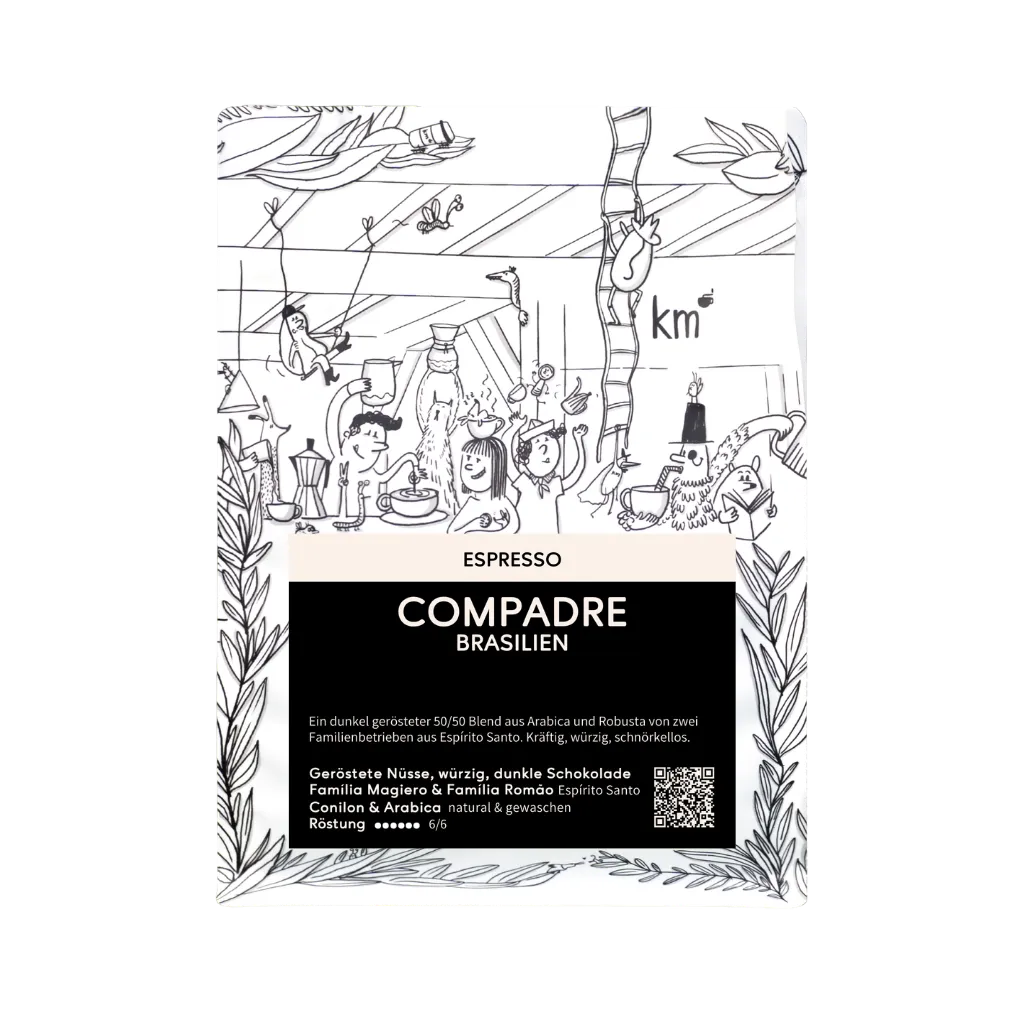
Let's get to the decisive point: the taste in the cup. And here we can keep it short: The espresso from the Mahlkönig x64 SD is excellent. In our tests with our Mano espresso, the results were consistently convincing. We obtained complex, dense, and fruity espressos with a wonderfully silky texture and a long, very pleasant aftertaste. But darker roasts like Apas or Compadre also worked very well.
What particularly sets the grinder apart is its enormous versatility. It is a true all-rounder. With modern, light roasts, it brings out the fruity notes well with shorter extraction times. At the same time, it also masters the classic spectrum. With darker roasts, it delivers full body and clear notes of marzipan and chocolate. This ability to serve both worlds so well is rare in this price range.
Another typical Kaffeemacher characteristic is very little clump formation. Even at the finest grind settings for espresso, the ground coffee remains loose and fluffy. This not only facilitates distribution in the portafilter but is also an important prerequisite for uniform extraction.
This outstanding performance in the cup reveals a clear design philosophy. It seems that Kaffeemacher was willing to make compromises in the external form, acoustics, and even details of the workflow to achieve the price of under 500 euros. However, where they made no compromises is in their core competency: the quality of the ground coffee and the resulting taste. The x64 SD may have its quirks, but it delivers in the cup.
Caveat: Those who coquette with very light roasts and absolute clarity will find more suitable grinders for that. The x64 SD delivers a very good quality compromise in terms of particle distribution, which bridges different worlds of classic Italian roasting (Compadre), transition roasts (Mano), and light and very complex specialties (light and orange line).

A Closer Look: Particle Distribution and Mechanical Precision
To back up our taste impressions with objective data, we subjected the ground coffee from the x64 SD to particle analysis. The result confirms what we tasted: the grinder does excellent work.
The particle distribution for espresso shows a typical bimodal curve, meaning a distribution with two peaks. The so-called "fine peak," which represents the proportion of the finest particles, is at approximately 33 µm. The "main peak," which is crucial for extraction, is at around 210–215 µm with our espresso settings. This distribution is narrow enough to deliver clear flavor profiles even with complex, light roasts, but wide enough to give classic espressos the necessary balance and body. This explains the grinder's versatility mentioned earlier.
However, our test for reproducibility delivered the truly impressive finding. For this, we first ground an espresso with one setting (T4) and measured the particle distribution. Then we adjusted the grind significantly to grind a ristretto and a lungo. Finally, we returned purely by eye, without measuring instruments, to the original T4 marking and performed a final measurement (T7).
The result is astonishing: the main peak of measurement T7 was at 214.61 µm, just a few micrometers away from the initial value of 209.49 µm from test T4. This is a highly precise, almost identical repetition. This test provides the objective evidence that resolves the paradox of operation. The grinder is a precision instrument. Its mechanics, from the planetary gear to the burr holder, work with extraordinary accuracy. The weakness lies solely in the visual representation of this precision on the adjustment dial. It's a shame that such good mechanics are hidden behind an inadequate scale, but it proves that the foundation of the grinder works.
Cleaning capabilities from yesterday
Unfortunately, cleaning the grinder is quite involved apart from the burrs. While other manufacturers have figured out how to do this without tools by now, with the x64 SD we reach for the screwdriver up to seven times. This is always the case when we want to really clean the grinder. We recommend this regularly, especially for grinders that also have a certain retention.
What certainly cleans easily, on the other hand, is the chute. It can be removed simply and quickly, typical of Mahlkönig.
The Achilles' heel: A single doser with backflow
One of the most important properties of a single-dosing grinder is the lowest possible retention, meaning the amount of ground coffee that remains in the grinder after grinding. Here the x64 SD shows its greatest weakness. Our test revealed an absolute retention of 0.9 g. This consists of 0.3 g permanent retention (coffee stuck in screw heads and crevices) and 0.6 g temporary retention.
This temporary retention of 0.6 g is the decisive value for daily use. It's the amount of old ground coffee that is replaced by fresh grounds with each new grinding session. For a grinder marketed as a single doser, this value is "rather high." The top performers deliver values between 0.1 and 0.3 grams.
For everyday use, this means: if you frequently switch between very different coffee varieties – for example from a fruity-fermented natural to a chocolatey-nutty washed coffee – you will taste the influence of the 0.6 g residual coffee. To avoid flavor mixing, we recommend grinding two to three beans of the new coffee before grinding your actual dose ("purging"). This makes the workflow a bit more involved, but ensures the purity of the result.
Speed and acoustics: Small, fast, and hard to miss
In addition to grinding quality, the x64 SD impresses with its speed. For an 18-gram dose, it requires only around 7.0 seconds, which corresponds to a throughput of about 35 g in 10 seconds. This is remarkably fast for a household grinder and ensures a quick workflow in the morning.
However, this speed comes at an acoustic price. At 81.0 dB, the grinder is loud. It sits just above the threshold we would find pleasant. But it's not just the volume, but also the character of the noise that stands out. The grinder sounds and feels slightly "unbalanced" when grinding and especially when running out.
At this point, it's important to clear up a possible misinterpretation: an unbalanced sound could indicate poor alignment of the burrs. However, our particle analysis proves the opposite. The excellent and consistent distribution of the ground coffee shows that the burrs are well aligned. The sound is therefore a characteristic of the motor and construction, but appears to have no negative impact on grinding quality.

Our verdict: excellent value for money
After intensive testing, the Mahlkönig x64 SD leaves a mixed, but ultimately positive impression. It is a grinder of contrasts. On one side is good performance in the cup. The espresso is multi-layered, backed by good particle distribution and mechanical precision that makes a strong statement in this price class.
On the other hand, there are noticeable compromises in the workflow: a frustratingly imprecise grind scale, a relatively high retention for a single doser, somewhat unclean discharge behavior, and a loud, slightly uneven operating noise.
At the end of the day, the decisive question is one of priorities. The price-to-performance ratio, relative to pure taste performance, is very good. For 499 euros, you get a grinder that produces coffee that can hold its own against significantly more expensive equipment.
One last point not to be underestimated is the safety and reliability that comes with purchasing from an established German-Swiss company. In a market flooded with direct imports, the x64 SD offers the assurance of CE certification and a functioning dealer and service network – an important added value that rounds out the overall package.