








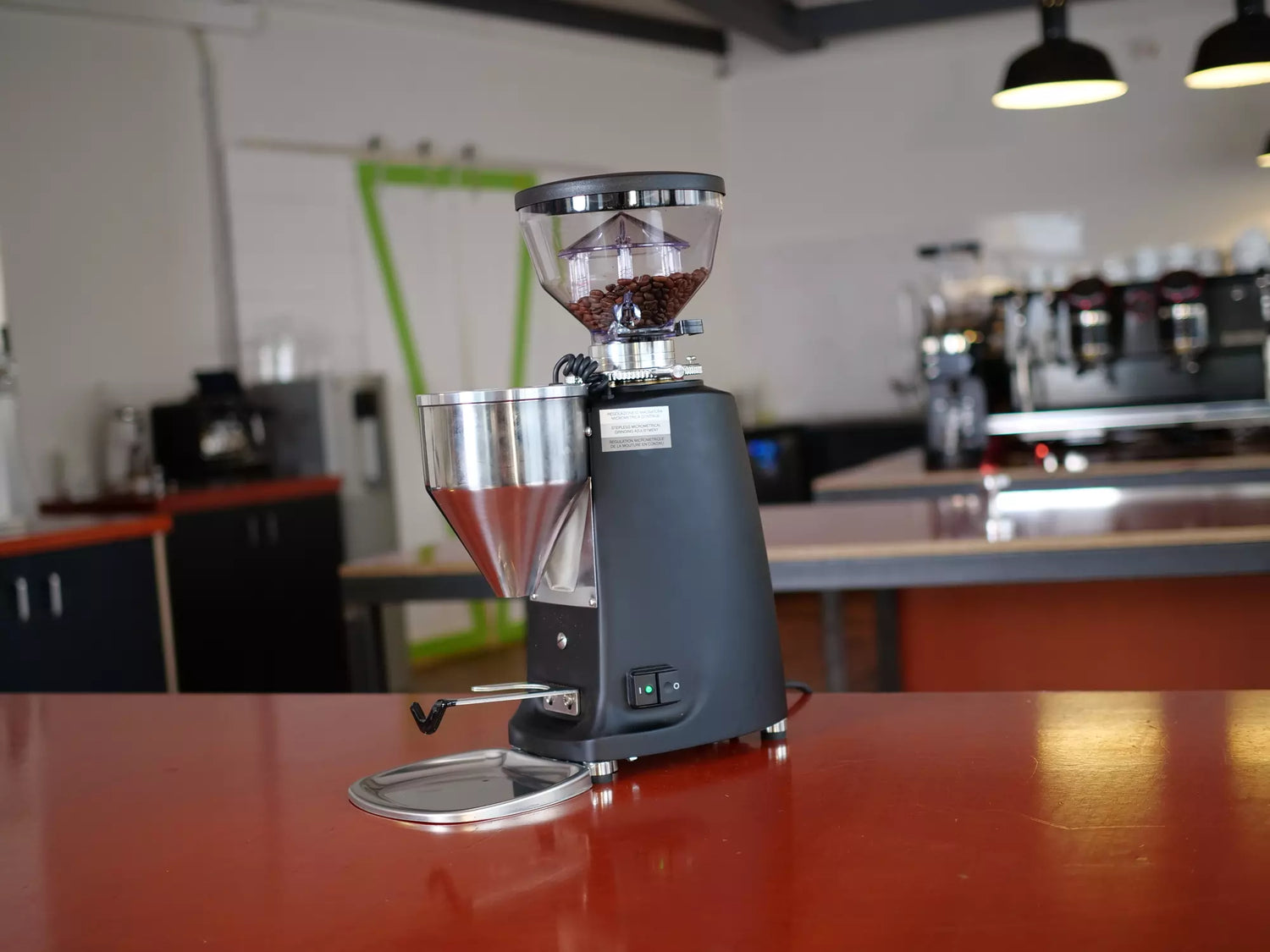

The Mazzer Mini Electronic A has been on the market as an espresso grinder for many years. And to anticipate: it will continue to provide solid work for many years to come. With a purchase price of around 750 Euros/860 CHF, it is one of the more expensive espresso grinders in our comparison test. You can find out how the espresso grinder performs, how it is built, and how the espresso tastes in our espresso grinder review.
Robust, heavy, and cumbersome
The Mazzer Mini Electronic A weighs 10.2 kg. This weight is distributed over a height of 440mm, a width of 150mm, and a depth of 340mm. This makes the Mazzer Mini one of the heavyweights in our test. While the robustness of the grinder is an advantage in terms of stability, it is a disadvantage when it comes to adjusting the grind size. The adjustment wheel is difficult to turn even with considerable force, despite the metal rod. If the wheel then loosens, it often turns past the desired target position.
That is annoying. This turns the otherwise stepless grind size adjustment into a somewhat tedious back-and-forth affair. Greasing the thread helps – but that's not ideal. And adjusting it during grinding also leads to a finer adjustment option. So solutions are in sight, but none of this contributes to the grinder's ease of use.
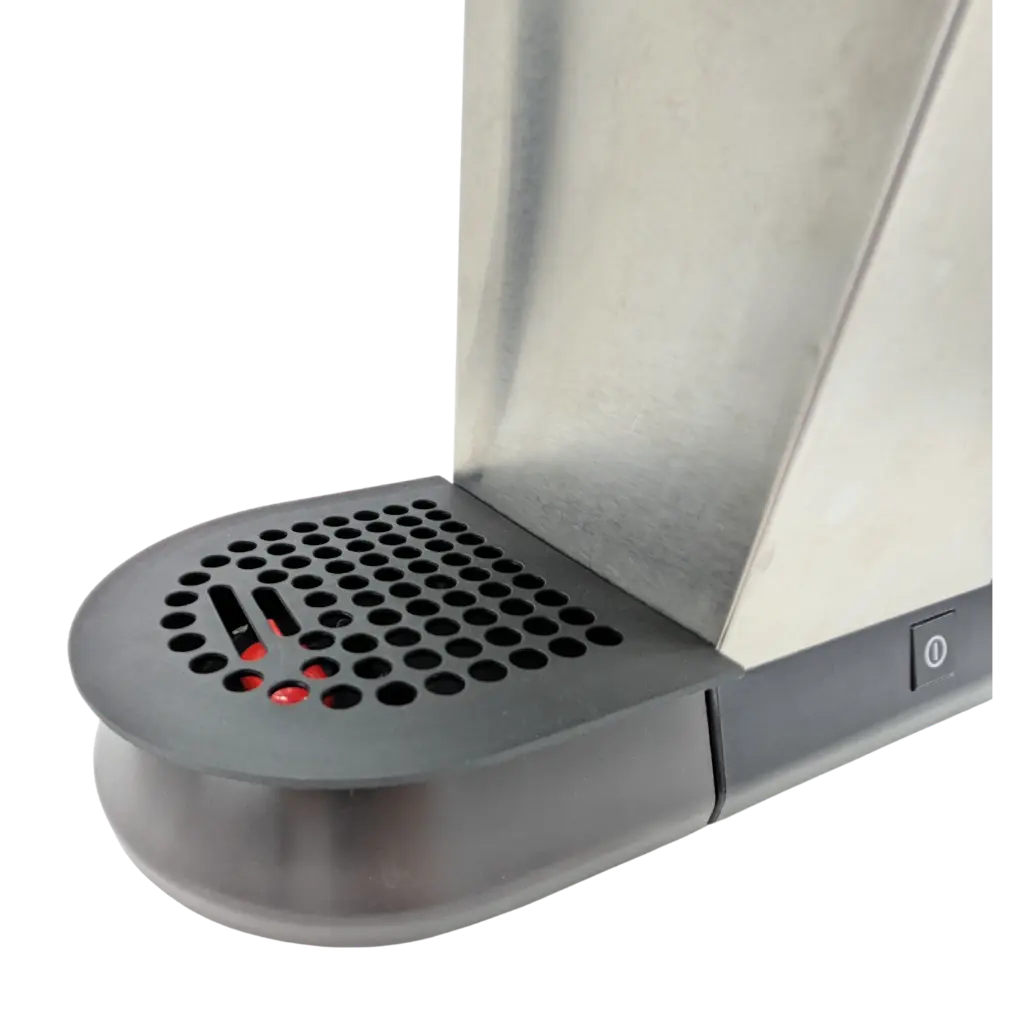
Included in the delivery is a metal tray that collects the falling grounds. However, the Mazzer Mini scattered little and did not clump much in our tests. The centering funnel did a good job here. The portafilter holder of the espresso grinder is exemplary – some manufacturers could learn a thing or two. The grinder holds portafilters with spouts in both directions. Only a slight vibration of the grinder and a resulting slipping of the portafilter disturbs the picture.

Usability of the grinder
The Mazzer Mini Electronic A has two programmable quantity buttons that can be programmed via a second-based setting. This is somewhat intuitive. The grind size adjustment, however, is much more difficult to control. The reason for this is the difficult adjustability of the grinder described above. It is almost impossible to precisely return to the same point after adjusting. Noting or marking reference points thus becomes a gamble.

The curve shows the grinding curves of the Mazzer Mini Electronic after adjusting back and forth to the closest possible grinding position.
Many feedbacks we received under our video review also point in this direction. Many users set the grinder once and then neither change beans nor grind size. This can certainly be a solution, but it compromises the ability to try different coffees. Also, many experienced home baristas want to fine-tune the grind size by gentle readjustment. This is not easily possible with the Mazzer Mini Electronic A.
This leads us to rate the grinder's usability as "rather poor".
We like the portafilter holder. Most standard portafilters fit into the Mazzer Mini. Portafilters with an "inverted" spout, such as those from Rocket, can also be placed on the holder.
During grinding, a vibration occurs which moves the portafilter. However, this should be held anyway to evenly collect the ground coffee powder.

Speed and Noise Level
The noise level of the Mazzer Mini Electronic A was in the mid-range for us. There were grinders that were significantly louder and grinders that were significantly quieter. We measured a noise level of 82.8 decibels.
In terms of speed, the Mazzer Mini was one of the slowest grinders in the test field. It produced a grinding output of 16 grams in 10 seconds. For the desired coffee quantity of 18 grams, the grinder ground for 11.3 seconds.
Temperature and Consistency during Grinding
In terms of consistency, the Mazzer Mini was among the grinders in the lower middle range. We measured a standard deviation of 0.74 grams over 10 grindings. We put 18 grams into the grinder and checked the dispensed coffee weight. Although many samples showed results of around 18 grams of coffee, some outliers were off by +1 gram from the desired amount.
| 17.0 | 17.3 | 17.9 | 17.8 | 18.4 | 18.6 | 18.3 | 17.7 | 18.8 | 19.5 |
With many smaller burrs, the coffee powder heats up during grinding, especially if several shots are pulled in quick succession. In our test, a shot was pulled every 30 seconds. The first and last samples were also used for particle distribution measurements. The Mazzer Mini showed only a minimal temperature increase and remained at a low average temperature of 30.4 degrees. This made the Mazzer one of the coolest and best grinders in the field. Therefore, no flavor change is to be expected due to the temperature of the grounds. The particle distribution varied, but within the standard variance of the grinder.
Is the Mazzer Mini suitable as a single-dose grinder?
Single dosing is in. Especially if home baristas like to switch beans, the single dosing principle is very practical. For this, the desired amount of coffee is weighed by hand in a measuring cup and put into the grinder. The grinder should then grind these beans as completely as possible, one to one. In the English-speaking world, this is called "single dosing".
The most important factors to consider for this are the dead space, the easy adjustability of the grind size, and, depending on the perspective, the amount of coffee between the bean hopper closure and the burrs.
The Mazzer Mini has a dead space of 5.3 grams, which is too large to be convincing as a single-dose grinder. The approximately 5 grams must always be ground first - this is simply not practical. The difficult adjustment also makes it hard to precisely select the grind size for a different bean.
The coffee beans under the chute are another factor that at least complicates changing beans in the bean hopper. 40.9 grams of coffee are located under the closure. So, if we remove the bean hopper, there are still a lot of beans underneath. These beans must be removed before all the coffee can be changed. All of this argues against the Mazzer Mini as a flexible espresso grinder for single doses and against changing coffee.
Espresso and Taste
We usually drank decent espressos with the Mazzer Mini Electronic A. It convinced us more often with darker espresso roasts. The grounds were soft and ground without clumps. However, we repeatedly had espressos that were not brewed to perfection in terms of taste.
This may also be related to the fact that the Mazzer Mini generally produces a relatively large number of fines, but with some curves, it produced significantly more of the smallest particles. These tend to over-extract and contribute to a dry, bitter cup.

This diagram shows four shots at the same grind size. The curves fluctuate, and sometimes relatively fine particles are produced. The proportion of particles under 100 microns was over 23%. In some cases, it was lower, but it always broke out.
At the same time, the Mazzer Mini has a relatively narrow coarse peak of 214. For determination, the highest point of the curve is used and then cut. Particles 30% on both sides of the cut are taken into account. In other words, the Mazzer Mini is relatively accurate here with the desired grind setting due to the narrow peak, but varies more strongly at the fine peak.
But again: the Mazzer Mini Electronic A performs solidly as an espresso grinder. However, some fluctuations in consistency and the large dead space minimize its reliability.

The curve shows how the Mazzer Mini performs compared to other grinders.

About the Test Procedure - What was investigated?
The diagram above shows all particle distribution curves we recorded. The Mazzer Mini Electric A was designated as grinder 19 in our test.
- T1 is a measurement of the particle distribution in the factory setting. This can vary from grinder to grinder. In this case, the Mazzer Mini was factory-set in the Ristretto range.
- T2 is a measurement of the first setting of a standard recipe of 18g coffee in, 45g espresso out in 25 seconds. Previously, 500g of coffee was ground through the grinder to remove residual materials from manufacturing, etc.
- T3 is a verification of the particle distribution after 6 espressos were pulled in succession every 30 seconds. The temperature of the grounds was recorded each time.
- T4 was taken after the initial recipe was reset.
- T5 shows the setting for a strong, 1:1 brewed espresso/ristretto with 18g coffee in and 18g espresso out in 25 seconds.
- T6 shows the setting for a long coffee. 18 grams of coffee were used, and an extraction of 120g in 25 seconds was achieved.
- T7 shows a curve that results when an attempt is made to achieve the same setting as in curve 4, solely based on the marking. For curve 4, the grind setting was photographed, and for curve 7, it was reset according to the image.
More about the protocol here.
The detailed test report will be published on Wednesday, December 8, 2021.
How do Mazzer Mini A and Mazzer Mini B differ?
Internally, the Mazzer Mini A and Mazzer Mini B do not differ significantly. It is mainly the exterior that differs. The control of the Mazzer Mini Electronic A is located on the centering container of the grinder. The control of the Mazzer Mini B is located below the dosing container. The burrs and other components are the same. The Mazzer Mini B closes with a plastic lid over the centering container.
Conclusion on Mazzer Mini Electronic A
Let's start with the potential. A second metal pin for adjusting the grind size would be a useful addition. If you don't have one, you can also use a threaded screw. It doesn't look as nice, but it works.
And that brings us to a problematic area of the grinder. The adjustability, and the associated flexibility and applicability. The Mazzer Mini is a long-established grinder and accordingly robust and solid. With its performance, it is not recommended for the top spots in our test.

Even though there were always decent and even good espressos, we also tasted some unpleasant outliers. Therefore, it is difficult to recommend the Mazzer Mini Electronic to the experienced and experimental home barista today. The high price is another counter-argument. The biggest pro is probably the proven longevity of the grinder, which modern and cheaper grinders still have to prove.