






The Profitec Twist SD54 is a compact single-dosing espresso grinder that truly convinced us in testing, both in terms of flavor and in many other respects. We thoroughly tested the grinder in all categories – from design and workmanship to grind adjustment, noise level and particle distribution, through to retention, cleaning, accessories and value for money. In this article, we summarize our impressions and reveal who this grinder is particularly suited for.
Extended version of our test video for the Profitec Test SD54. To the short version and the English translation (in progress).
We compared 10 single dosing grinders in the price range of 500 to 1000 euros. More information in our article on the topic.
Recommended specialist retailers* for the Profitec Twist
We recommend specialist partners we know provide good work and reliable service. When you order through our commission links, you don't pay more, but we receive a small contribution – which we invest directly in new test equipment.
Design and Workmanship
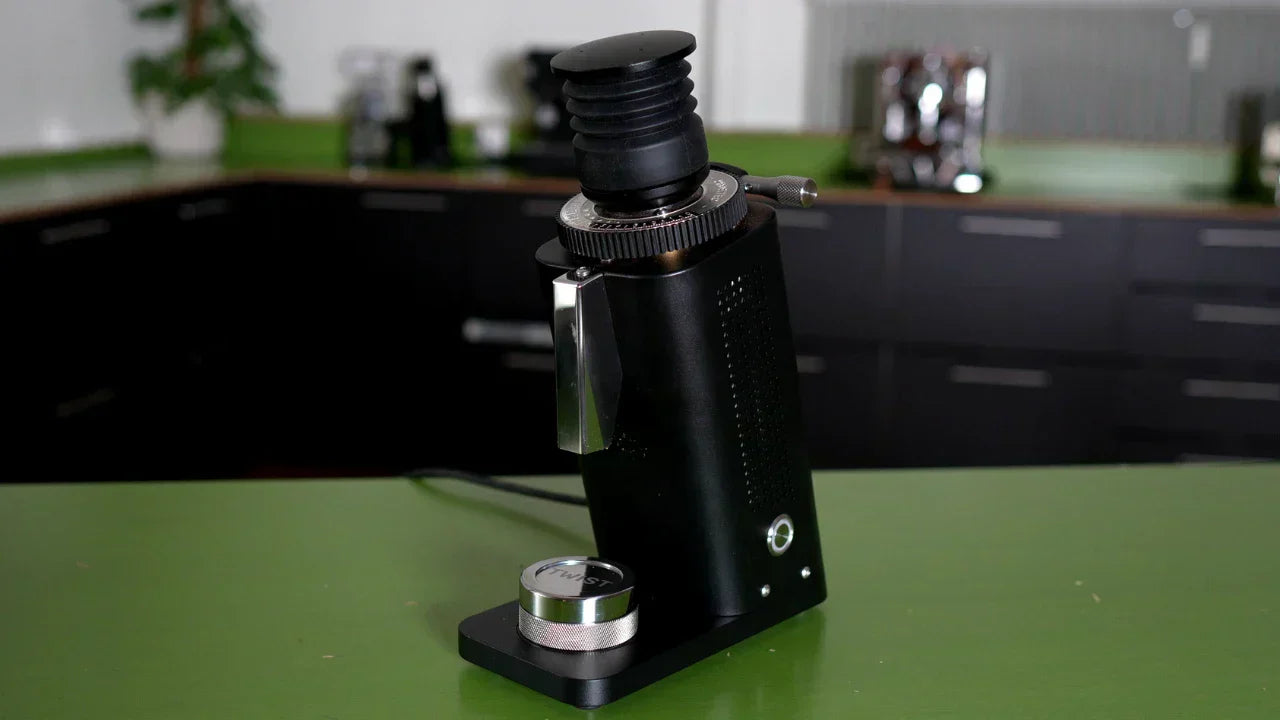
At first glance, the Profitec Twist SD54 makes a high-quality impression. The design follows modern Profitec design language and visually fits perfectly next to current Profitec espresso machines. The housing is cleanly finished, solid and slightly tilted forward – sleek, functional design. With 7 kg in weight, the Twist brings substantial mass to the scale. The compact dimensions (approx. 12 cm wide, 22–23 cm deep and 35 cm high) ensure it fits on any kitchen counter. Despite the small footprint, thanks to the solid metal base, it looks stable and high-quality.
We first saw the grinder last year as a prototype at the World of Coffee and were curious to see what would come of it. We're all the more pleased with the finished model: The Profitec Twist feels really good – nothing wobbles or rattles. A small note on the side: Our test unit will be used in our Kaffeemacher Academy in the future. The responsible trainer has already noted "Academy" on it – a good sign of how impressed we are with the grinder. Of course, the Twist also has a few minor points to quibble about (more on that shortly), but overall the build quality is spot on. The fact that Profitec, as a German company (production in Europe), stands behind the grinder, is evident from its robust construction.

Grind Adjustment and Operation
The Profitec Twist SD54 features stepless grind adjustment via a worm gear screw. This means: the adjustment is very fine and precise, but a larger change – such as switching from espresso to filter grind – requires many turns of the adjustment dial. In everyday use, this is no problem, as long as you primarily grind espresso. Small changes to the grind are easy to make and the resistance of the adjustment mechanism is pleasant. You can dose extremely finely, which is ideal for espresso fine-tuning. However, we wouldn't want to switch between espresso and filter in our daily practice. For the occasional test filter coffee, the range is there if you set the grinder to the coarsest setting.
We discovered a small weakness in the grind scale: The adjustment ring is finely graduated and in principle allows precise adjustment. However, the fixed detent point on the grinder is located lower down. The worm gear sits in between and tempts you to use the grind adjustment as a reference point. However, this wheel is noticeably coarser in its ratcheting than the grind adjustment, making it harder to find the exact grind again.
In practice, this means you need to look carefully to find your grind setting again. In our test, it happened once that after multiple adjustments (espresso → lungo → back to espresso), we didn't return exactly to the original position. The result was a change in extraction time of about 5 seconds – nothing dramatic, but worth noting. We suspect it was because we didn't hit the exact line. With a little care, however, the grind can be set reproducibly.
If necessary, you can also adjust the zero point: If you loosen the three screws on top, carefully screw the burrs together until the grinding point and then re-adjust the scale, the reference is correct again. This is a bit cumbersome, but at least possible. Overall, we rate the grind adjustment as good – precise and sensitive, with minimal deductions for the somewhat fiddly scale display.
The general operation of the grinder is simple and intuitive. There is no timer or display, just a single button for turning on and off. This glows white while the grinder is running and goes out on standby. We like that Profitec has avoided unnecessary permanent illumination gimmicks here. In everyday use, this means: weigh coffee beans, drop them in, press the button and grind until everything is through. Done.

Speed and Noise Level
Let's look at the performance figures when grinding: The Twist SD54 is rather leisurely in operation. In our tests, it took around 15 seconds to grind 18 g of coffee to espresso grind. This roughly corresponds to 1.2 grams per second – definitely on the slower side compared to larger grinders with, for example, 64 mm burrs. This is probably due to the somewhat smaller 54 mm flat burrs and the precision-tuned motor at 1400 rpm (no load). For home use, however, the speed is perfectly fine. You're happy to watch those 15 seconds, especially since there's no stress involved. In a hectic café environment, the Twist would be too slow, but it's not designed for that anyway.
In terms of noise level, the Profitec Twist falls in the middle-to-lower range. In idle mode (without beans) it runs surprisingly quietly. As soon as the beans are ground, the noise level rises noticeably. We measured approximately 84 dB directly above the grinder. It's not whisper-quiet, but it's not a noise maker either – in our large test series, the loudest grinders approach the 90 dB mark, and the quietest hover around 72 dB. So the Twist is in the normal range. On the positive side, the grinding doesn't sound strained or shrill, but relatively full and gentle on the ears.
One of the standout qualities is temperature stability. In our continuous performance test, the Twist surprised us: We ground many extractions in succession (something you rarely drink at home all at once) and measured the temperature of the burrs and ground coffee. The result: Hardly any heating! Even after several doppio shots in a row, the dispensed coffee powder felt only minimally warmer and our measurements showed virtually no significant temperature increase. The open design with ventilation openings in the housing probably helps here – heat doesn't build up. This excellent cooling performance gives confidence that even with intensive use, there's no risk of flavor loss from overheated ground coffee. In this discipline, the Twist outperforms many other grinders.
Retention and Cleaning
An important topic for single-dosing grinders is retention, i.e., the amount of coffee that remains in the grinder. A lot has changed in recent years – older grinders (we remember with a shudder the ECM S-Manuale 64) had double-digit gram amounts of retention! The Profitec Twist opens a new chapter here and shows very encouraging values. We measure different types of retention:
- Permanent retention: These are coffee residues that really stick in corners and crevices and don't come out even with tapping or blowing. With the Twist, this was only about 0.2 g – a negligible amount. These crumbs settle, for example, on screws or in the grinder gap and accumulate over many grinding operations. 0.2 g is top-notch here and significantly better than many older grinders.
- Temporary (exchangeable) retention: This is coffee that, after each grinding operation, initially remains in the grinder but can fall out during the next grinding or tapping. In other words: coffee grounds that are theoretically "exchanged" on the next shot. With the Twist, we measured approximately 0.6 g here. This value is in the middle to slightly higher range for a single-dosing grinder. For comparison: Several other current single-dosers (e.g., in the Eureka SD class) also hover around 0.5–0.6 g. You hardly notice this during operation because the grinder delivers overall very consistent results – what you put in at the top comes out at the bottom (plus/minus a few tenths of a gram). But you should keep in mind that about half a gram per grinding is "parked" in the grinder.

The total retention of the Twist thus adds up to approximately 0.8 g. That's worlds away from earlier models with 5, 10 or even 12 g and means in everyday use: Little loss and hardly any old coffee in the ground coffee. Nevertheless, we recommend cleaning the grinder regularly so that the permanent retention doesn't unnecessarily increase. Over time, more residue could accumulate on the discharge chute or at the grinding chamber entrance, which might then end up as a little tail of old coffee in the next shot. But don't worry: The Twist is relatively easy to clean.
For quick cleaning in between, Profitec has a clever solution. The discharge chamber is held by a single hex screw. Turn this screw and you can open the discharge shaft and sweep out coffee residue with a brush or dry toothbrush down to the flapper. We're impressed by how quickly and easily you can access the problem areas – the grinder is cleaned from the bottom in under a minute. This encourages you to really do this operation every one or two weeks. In testing, after a few kilograms of coffee, a brief brush-out was sufficient to get the Twist sparkling clean again.
For a deep clean of the entire grinding mechanism (which we recommend every few months), you need to do a bit more screwing on the Twist, but it's manageable. First, remove the rubber air bulb on top. Underneath, three small screws appear that secure the upper part of the grinder (the adjustment ring). Remove these three screws and lift off the outer ring. Underneath is the inner ring with fine threads – unscrew it completely to gain access to the burrs and grinding chamber. This process requires no special tools other than the appropriate hex wrench and a little patience when unscrewing the fine thread. It's not more difficult than with many other grinders, but also not quite as convenient as models with magnetic locks or bayonet-like quick releases. One tip from our experience: Before screwing the grind ring back in, definitely thoroughly clean the thread with a dry cloth or brush of coffee crumbs. The fine thread is somewhat sensitive to foreign objects and could otherwise jam when reassembling. If you pay attention to this detail, assembly is just as uncomplicated as disassembly.
In terms of ease of cleaning, the Profitec Twist rates as satisfactory to good. Daily maintenance (quick brush-out, air bulb puffs) is child's play. Thorough disassembly is somewhat more involved than with some competitors, but absolutely doable. We might wish for an even simpler solution in the future – but we're complaining at a high level. Overall, the Twist is thoughtfully and practically designed in this category too.

Grind Distribution and Espresso Quality
Let's come to what is perhaps the most important point: the espresso in the cup. How good is the grind quality of the Profitec Twist SD54? To get straight to the point: excellent for a grinder with 54 mm burrs! We had the particle distribution measured in the laboratory and also tasted many espressos sensorially. The results match: The Twist grinds very homogeneously and delivers a narrow particle spectrum with only low fine content ("fines").
The main peak of the particle size distribution in our tests was at approximately 200 µm, in a very narrow profile. This means that most of the coffee grounds have the same grain size – ideal for reproducible and even extractions. At the same time, the proportion of ultra-fine particles was noticeably low. Of course, every espresso grinder produces some "dust" and doesn't have perfectly unimodal grinds (the Twist doesn't either), but with the Twist, the second, finer particle peak turned out very small. Translated into practice, this means: The espresso is clear and balanced, without excessive bitterness or astringency from too many fine particles. At the same time, the grounds still bring enough fine particles to give the espresso body – it's a good sweet spot between clarity and fullness.
Our tasted espressos confirmed these measurement results. The shots from the Twist were consistently delicious and balanced in our trials. The Apas Espresso, our bestseller from Brazil (nutty-chocolatey), came through thick, creamy and with pronounced dark chocolate notes – just as we wanted it. With lighter roasts, clear aromatics also showed through without unpleasant acid peaks. The extraction consistency from shot to shot was high, provided you work with clean tools (keyword WDT and consistent tamping). We didn't have the impression that the Twist tends to "fluctuate" anywhere.
An interesting aspect is the versatility of the grinder. Profitec markets the Twist primarily as an espresso grinder, but our particle analyses suggested it could also just barely handle the finest filter coffee range. Initial tests confirm this. However, the grinder really needs to be set to the absolute coarsest setting and switching back and forth is rather tedious due to the precise and slow grind adjustment. In testing, we drink decent filter coffees, but they tend to show some dryness and bitterness in the aftertaste. So filter coffee is possible, but it's not the Profitec Twist SD54's strength.
Accessories: Air Bulb, Dosing Cup and Tamper
The Profitec Twist SD54 thinks of useful accessories. Included in the package is a matching dosing cup that you place under the discharge. This cup catches the coffee grounds cleanly and can then be conveniently transferred to the portafilter. It's made of metal and dimensioned so that it fits exactly into a 58 mm portafilter (and can also be placed on smaller portafilters, such as 54 mm). We often ground directly into our portafilter, but those who prefer to dose via the cup have a high-quality item at hand. Nothing spills around it, and static charging was hardly an issue in testing – the coffee grounds flowed evenly into the cup.
The included air bulb is high-quality and functional. This rubber bulb sits on top of the grinder instead of a classic bean hopper. So you fill beans in portions through the opening at the top. After grinding, you can press the air bulb forcefully a few times to blow out any remaining coffee grounds from the grinding funnel. With the Twist, this works really well: Already with 3–4 pump strokes, everything that should come out is out. Clever detail: Small holes are cut into the lid of the air bulb so that when you release it, no strong vacuum is created that sucks the grounds back up. The air bulb looks very robust and is cleverly designed – it has a small bead inside and outside through which it sits firmly in the opening without having to be screwed in. Comfortable and minimizes retention effectively.
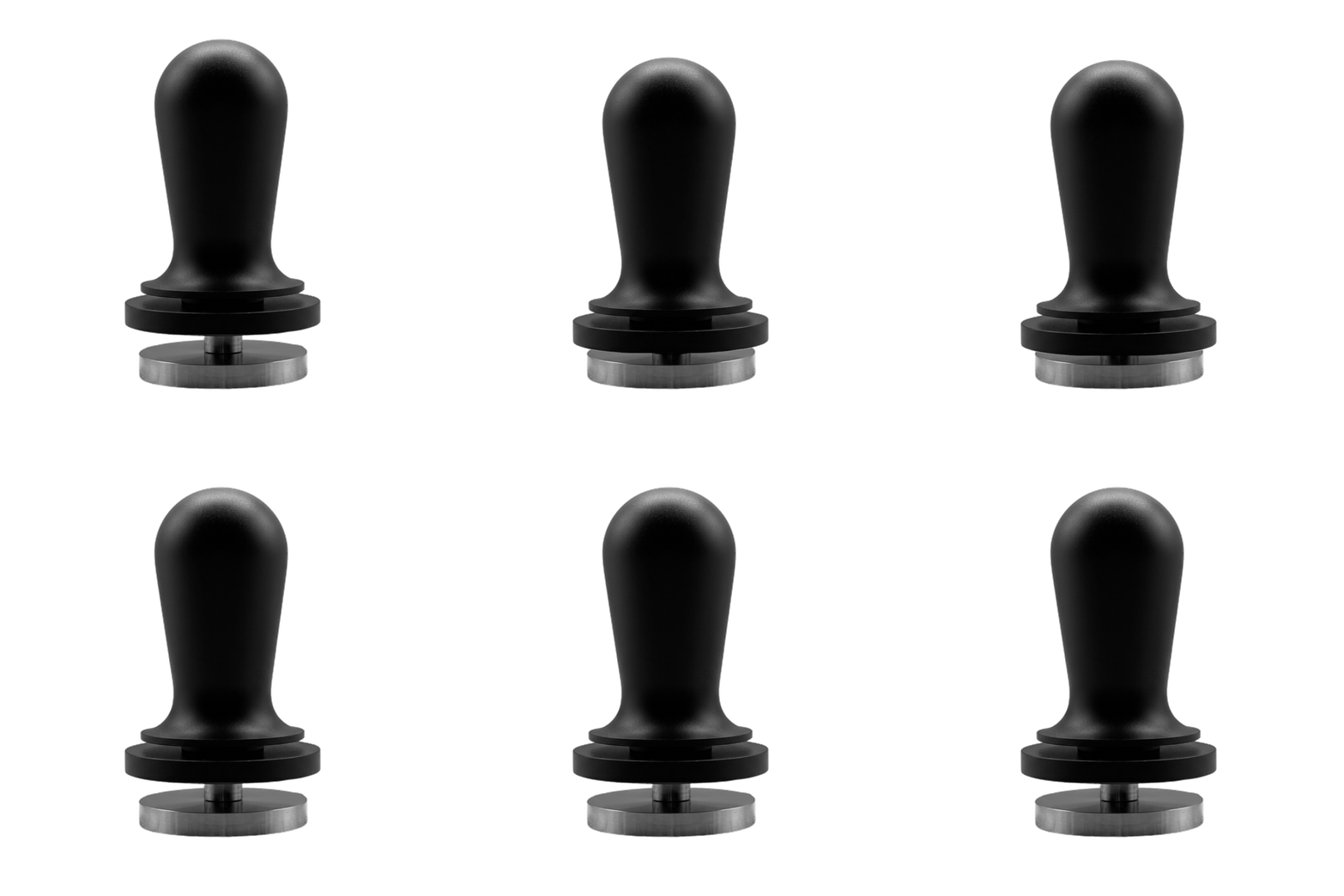
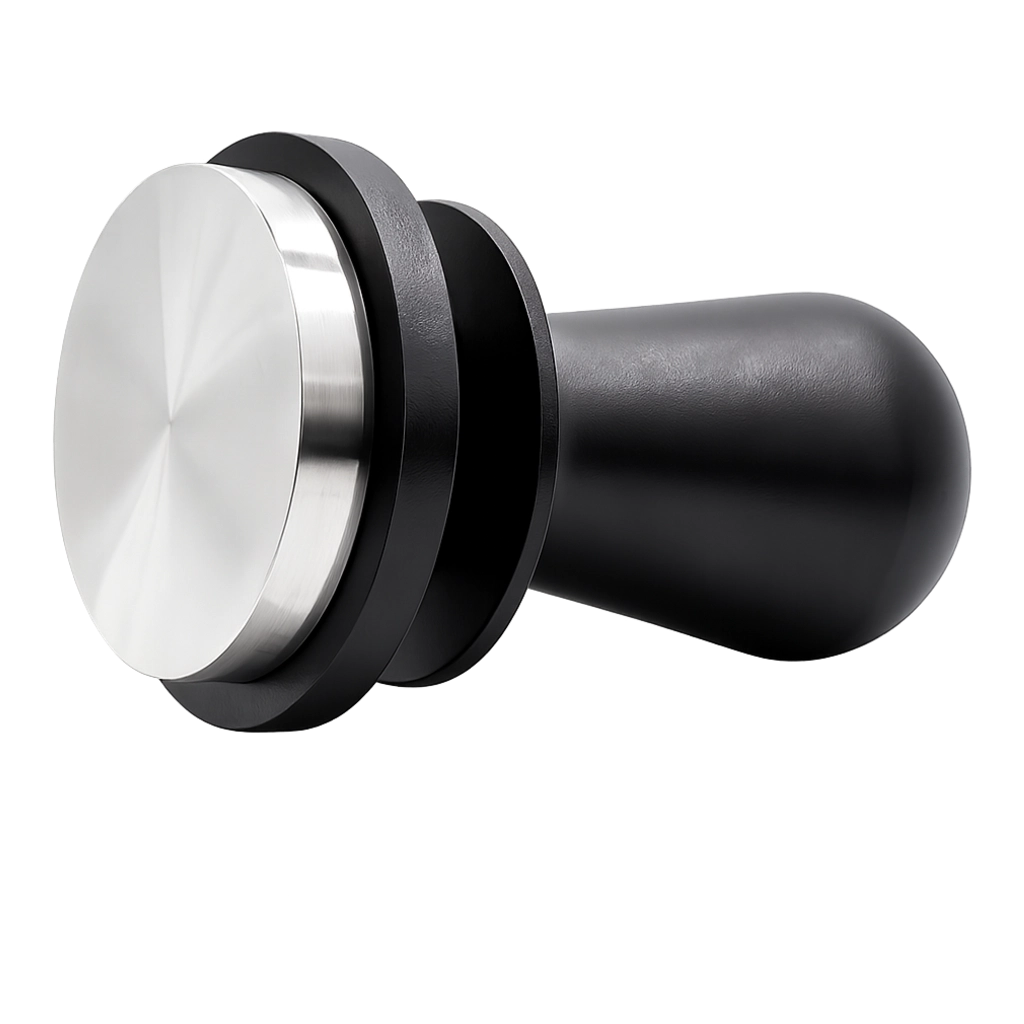
Finally, Profitec even includes a tamper/leveler that matches the grinder. Officially this accessory is called a "leveler," but we'd interpret it more as a tamper – and a successful one at that, provided it's set correctly! The piece has substantial weight, feels good in the hand and is height adjustable. You can adjust it so that it reaches exactly the right depth in the portafilter and presses the coffee grounds to the point. In our test, we used the included tamper extensively. When correctly calibrated, it enables clean, straight tamping – which especially helps beginners form an even puck.
Value for Money and Area of Use
The Profitec Twist SD54 is priced in the upscale home barista class. Currently, depending on the retailer, it's around 600 to 650 €. That's certainly not a bargain and is in the range of more expensive grinders for home use. But you get a lot in return: European manufacturing quality, solid engineering and direct distribution partners or specialist retailers who can provide support if needed. The latter is a plus point that shouldn't be underestimated. Profitec is an established company with German roots – in case of problems, there are contacts and service, which is often lacking with OEM import grinders.
From our perspective, the value for money with the Twist checks out. Why? The grinder delivers top performance in core categories: excellent espresso quality, consistent results, high-quality workmanship and thoughtful features (see air bulb, tamper, etc.). It has a few weaknesses, such as moderate speed and not minimal but manageable retention. But measured against the price, these compromises are acceptable. Other single-dosing grinders in similar price ranges sometimes have less equipment or poorer particle distribution. Of course, there are also alternatives – if you want absolute quiet during grinding or turbo speed, for example, you might find another model more interesting. But overall, the Profitec Twist offers good value for the money.
The area of use for this grinder is clearly the ambitious home barista or even prosumer. In a private household where a few to perhaps 5–10 espressos are prepared daily, it feels right at home. But its robust construction suggests it could also serve well in small offices, workshops or training rooms – as mentioned, we'll be using it ourselves in our Home Barista courses in the future. Thanks to its excellent temperature characteristics and solid consistency, it could also handle a larger influx of guests, although grind speed sets limits. It's not designed for a café with constant traffic, but nobody expects that in this category anyway. However, if you appreciate quality-assured espresso at home, want to try different beans and enjoy manual dosing and tamping, you'll find the Profitec Twist SD54 a reliable partner. It's equally suited for dark and light roasts and allows you to get the maximum out of your beans.
Conclusion on the Profitec Twist SD54
The Profitec Twist SD54 convinced us in testing. It scores with first-class espresso quality, even particle distribution and high consistency. Workmanship and handling are thoughtful. Sure, there are minor criticisms: The grinder grinds leisurely and isn't whisper-quiet, the grind scale could be more precise to read, and the exchangeable retention of ~0.6 g is rather high for a pure single-doser. But these aren't dealbreakers – they're points you can easily live with in everyday use.
In the final analysis, the Twist delivers exactly what you'd expect from a modern single-dosing grinder – and a bit more. Given the fair price of approximately 600–650 € and the fact that Profitec values service and longevity, we can draw a positive conclusion: The Profitec Twist SD54 is an excellent choice for demanding home baristas who value taste, consistency and high-quality feel. It's earned a permanent place with us and we look forward to using it in future courses and tastings.
Have fun grinding, make coffee yours and see you at the next test! ☕️