






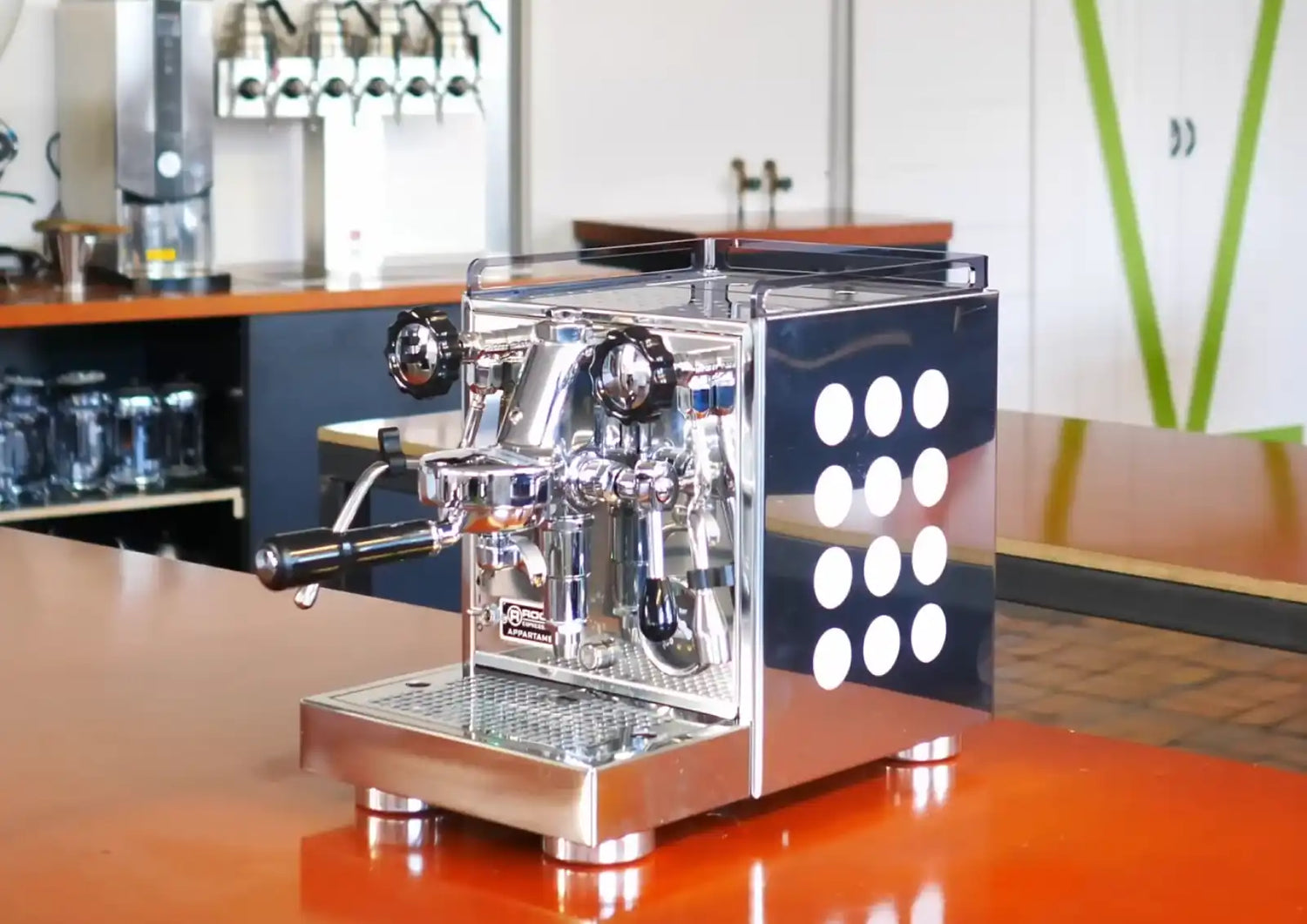

The Rocket Appartamento is a heat exchanger in the entry-level segment – the smallest machine in Rocket's portfolio. We tested it for over two years in continuous use at our academy.
For transparency: At the time of testing, you could still buy the Rocket Appartamento from us. Since June 2024 (see also our YouTube video where we explain this in detail), we no longer sell espresso machines. We always tested objectively in our view, but wanted to make this even clearer separation to be able to look at equipment completely independently.
The Appartamento costs around 1,490 CHF in Switzerland, and about 1,200 to 1,300 euros in Germany. For a classic heat exchanger without PID control, that's positioned in the mid-price segment.
In 2024, Rocket launched the Appartamento TCA, a successor model to the classic Appartamento. We've tested that machine as well.
Design & Build Quality: Stylish, But Sharp Edges
The Rocket Appartamento weighs in at 20 kilograms and measures 27.4 cm wide, 42.5 cm deep, and 33.5 cm tall. Like almost all E61 brew groups, the machine is built quite deep – so plan for enough counter space.
Design-wise, Rocket is currently at the forefront. The new pressure gauges with the small time window are real eye-catchers, and the perforated side panels add nice accents. The stainless steel housing looks great.
But: The build quality has its quirks. You'll find sharp, unbeveled edges everywhere. On the drip tray, on the housing seams, on the grate – Italian manufacturers simply can't deburr edges. This isn't Rocket-specific (ECM has the same issue), but at this price point it's annoying. Nothing dangerous, but unpleasant to touch.
Another criticism: The cup rail comes standard with a plastic overlay that breaks quickly. We've tested both the white and copper editions here – both times the plastic part was trash. You have to buy the stainless steel rail separately: 99 CHF in Switzerland. That should be included on a 1,500-franc machine. The new black version at least includes it – but also costs more.
Positive: The 2.9-liter water tank can be filled from the top and completely removed. No hose, no fiddling. Practical for cleaning or if the machine sits under a cabinet.
Temperature Management: Flatline Without Compromise
Here the Appartamento completely convinces. We measured with the Scace tool and consistently got 93.7 to 93.8°C throughout the entire brew time. No fluctuations, no drop, no rise – a flatline straight from the textbook.
The problem: You can't adjust the temperature. There's no PID control. The 93.8°C is fixed. Theoretically, a technician could manually lower the boiler pressure, but you shouldn't do this yourself – especially since you'd also have less steam power.
For the vast majority of coffees, 93.5 to 94°C is absolutely suitable. Only with extremely dark roasts might you want to go lower. For everyone else: The temperature is spot on, consistency is excellent. Done. Period.
Espresso Quality: E61 Group Delivers
The Appartamento uses the classic Faema E61 brew group – the same basic framework you'll find in countless machines. Rocket buys the group from Faema and builds a "dress" around it. How consistently the machine performs depends mainly on the boiler and temperature regulation.
With the Rocket, both are right. Extraction is clean, we pull balanced espressos with body and sweetness. In testing with a blend of one-third Robusta, Nicaragua, and Brazil each, the flavors came through clearly – strong but balanced.
The E61 group simply works. Anyone who prepares espresso correctly – with good puck preparation, clean tamping, and proper grind size – gets reliably good results here. The machine is consistent enough that errors are more likely with the user than the equipment.
Milk Foam & Steam: Plenty of Power
The steam performance is really strong for a heat exchanger. The milk spins "like crazy" – you barely need to move the pitcher. The roll phase runs almost by itself, the foam becomes fine-textured and creamy.
The temperature is deliberately at the upper limit, which benefits steam power. On a heat exchanger where you can't control temperature separately, this is a good compromise: You have enough power for steaming without the espresso getting too hot.
Only limitation: If you plan to work with very dark coffees, the 94°C might theoretically be slightly too hot for you. But for 95% of all applications, the setting is perfect.
Workflow & Operation: Good Ideas, Annoying Details
Operation is simple: Turn on, let it heat up, pull espresso. No complex menus, no PID settings. That's exactly right for beginners.
But: The positioning of the brew group and the short drip tray are annoying. The portafilter therefore needs to be locked in very far forward. So that espresso still flows into cups sitting cleanly on the drip tray, Rocket mounted the spout on the machine-facing side. You can do that, but it makes tamping harder because the portafilter can no longer be supported on the portafilter holder, but only stands on its feet.
Additionally: The drip tray isn't deep enough overall. You can see plenty of air underneath – they could have made it larger. And because the brew group sits so far forward, it tends to overflow at the edge when flushing. That's annoying in daily use.
The portafilter spout should be on the other side. We don't understand why it's built this way. The machine would be a few centimeters deeper, but the workflow would be vastly better.
Positive: The water tank is perfectly solved. Lid off, tank out, fill or clean, done. No hose, no fumbling.
Noise & Maintenance
The vibe pump is audible but not annoyingly loud. Compared to the Quick Mill Rubino, we measured a 1 to 2 decibel difference – basically identical.
On maintenance: If you ever need to take the machine apart, be warned. It's doable, but not well organized. We needed an hour and a half to replace a solenoid valve. That's tedious. In comparison: An ECM is similarly annoying but slightly more accessible.
The boiler isn't insulated, which is a disadvantage compared to a Quick Mill Rubino. That theoretically costs more energy, though we didn't measure this here.
Important: These machines last forever – if you use clean, filtered water. Scale is the main cause of broken espresso machines, regardless of price class. Use filtered water, do occasional backflushing, and the machine will survive decades. For comparison: The Sage Barista Pro already had a defective component after six months – with an E61 machine like the Rocket, that typically doesn't happen.
Value for Money: Mid-Segment Without PID
1,490 CHF (or 1,200 to 1,300 euros in Germany) for a heat exchanger with vibe pump without PID – that's positioned in the mid-price segment. There are machines with similar features that are cheaper. But: The Rocket scores with design, temperature consistency, and steam power.
For this money, we expect absolute top range – and you get that with temperature and extraction. But there are deductions for workflow and details (rail, edges, positioning).
If you're willing to spend 200 to 300 francs more, you can get a heat exchanger with PID control from other manufacturers. Then you have more flexibility. But: At 93.5 to 94°C you can already prepare almost all coffees perfectly. PID is nice to have, but not a must.
Conclusion: Solid Machine with Annoying Weaknesses
The Rocket Appartamento is a machine for beginners who are serious. The strengths: absolute temperature consistency, very good steam power, stylish design, durable. The weaknesses: brew group too far forward, drip tray too short, sharp edges, plastic rail must be purchased separately.
Who is it suitable for? For home baristas looking for an uncomplicated heat exchanger machine and don't need PID control. Anyone who's fine with 93.8°C (and that should be most people) gets a machine here that simply runs and runs.
Who is it not for? For people who work a lot with dark roasts or want to run temperature profiles. And for anyone who's bothered by poor workflow details.
Another plus: Rocket has an active Facebook community. If you have questions or need tips, you'll find German-speaking users there who can help.
Would we buy it? If the budget fits and you can live with the mentioned weaknesses: Yes. But we'd buy the stainless steel rail for 99 francs right away. The plastic part is not an option.
And one final note: With portafilter machines like this, training makes the difference. You need to understand how espresso works – grind size, dosing, tamping, puck preparation. The machine delivers the consistency, you need to provide the rest. Then you'll pull damn good espresso from this Appartamento.