



Admittedly, the title is a bit sensational. But the Sage Barista Express Impress sets out to bridge the sometimes complicated world of portafilter machines with the simple and clean world of fully automatic coffee machines. It aims to combine the convenience of an automatic system with the precision of a barista, promising delicious espresso – with almost zero effort. But is that even possible? Is this machine a jack-of-all-trades or a poor compromise that ultimately leaves no one happy?
What is new about the Barista Express Impress?
Sage markets the Barista Express Impress as a semi-automatic coffee machine. “No stress. No effort.” This clearly defines the machine's target audience. Sage is aimed at people who want a stylish, high-quality coffee machine with that portafilter feel but don’t want to deal too much with a barista's workload. Brewing recipe, flow temperature, grind distribution, leveling, tamping, channeling? The owner of an Express Impress hardly needs to think about these things.
On the other hand, this machine is by no means a fully automatic one. If you have it at home, you cannot simply press a button and drink a clean cup of coffee in a few seconds. The Sage Barista Express Impress does not take all the work off your hands, only part of it. It attempts to position itself between the worlds of a portafilter machine and a fully automatic one – and it only manages to do so in a mediocre fashion.
You can prepare truly delicious espresso with the machine, but to be perfectly honest, you often have to put in more effort than with a classic portafilter machine like the Barista Express, the predecessor to the Impress. You have to work with the machine’s predefined automatic settings or even bypass them – and that is not so easy.
However, those who use the machine without thinking too much – in the spirit of “no stress, no effort” – will hardly be able to enjoy a truly delicious espresso.
That is why we decided to include a section with tips and tricks in addition to a standard review of the machine. Furthermore, we are currently developing an online course that will take you by the hand step by step to get absolutely everything out of this machine. So, if the Barista Express Impress is already on your kitchen counter and your espresso doesn’t taste right, you should definitely sign up for our Online Course.

The Exterior of the Sage Barista Express Impress
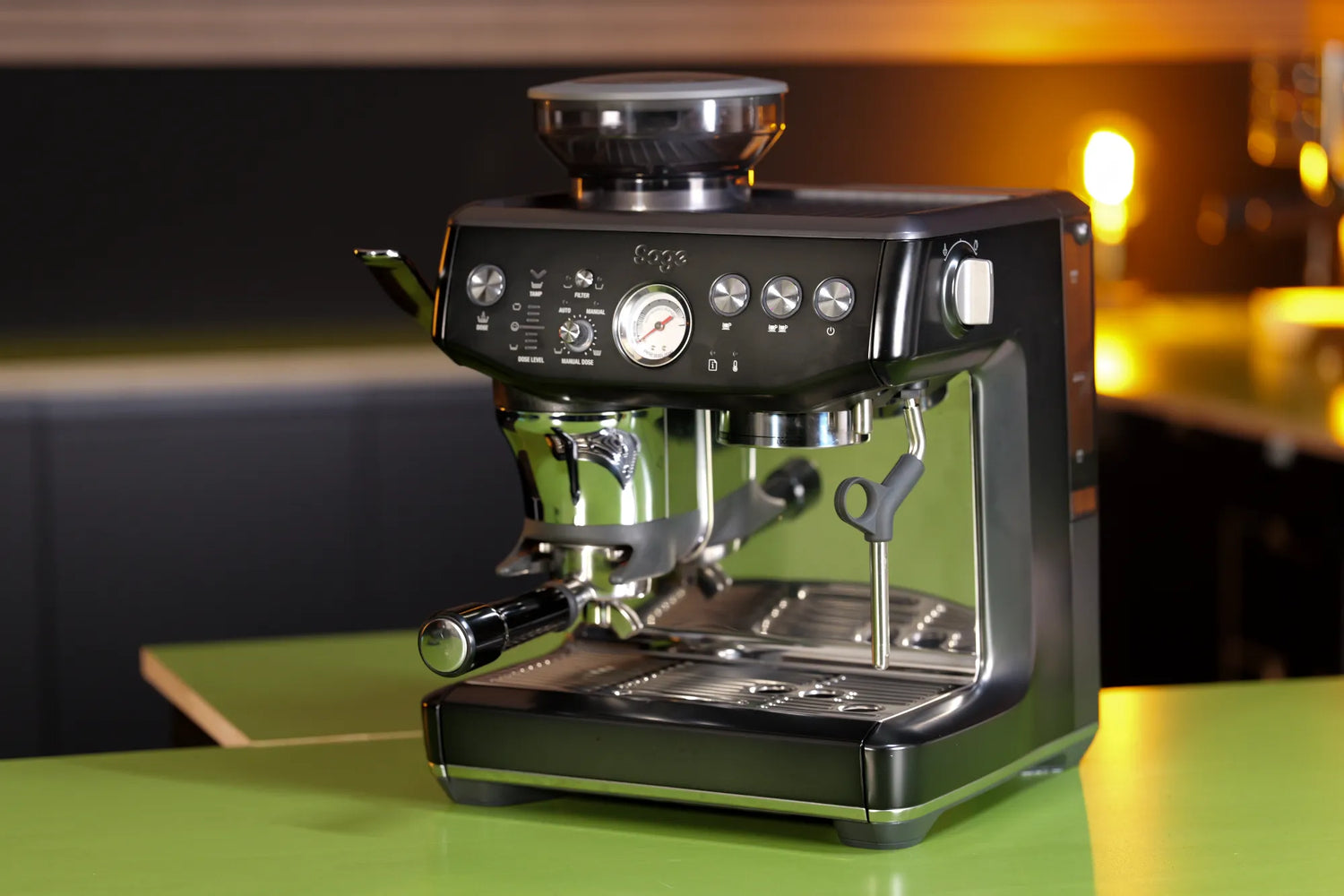
The Barista Express Impress features the typical Sage design and is available in silver stainless steel or black. It has a built-in grinder that is based on the solid entry-level Sage Smart Grinder Pro and holds 250g of beans in the hopper. The water tank has a volume of 2 liters, while the drip tray holds about 1 liter. The scope of delivery includes a water filter system, which allows you to use regular tap water without having to run it through separate filters. It works well!
The machine is a thermoblock machine. It does not heat up one or two separate boilers, but uses a thermocoil. This type of continuous flow heater allows the machine to reach operating temperature in a short time. However, unfortunately, it doesn’t work as well as it does on other thermoblock machines – more on that later.
Sage also sticks to a 54mm portafilter system for the Barista Express Impress. So, if you want to buy standard accessories for 58mm portafilters, they will not fit the Sage machine. That’s a shame, but we have gotten used to that with Sage by now.

On the front of the machine, in addition to the power button, there are buttons for single and double shots as well as a button and a dial for adjusting the grinder. The machine features a so-called volumetric system that allows you to adjust the amount of water flowing through for the espresso, so you don't have to measure with a scale for every shot. While the volumetric system isn't entirely precise, it works quite well. The pressure gauge is a nice gimmick, but the displayed pressure is no guarantee for a delicious espresso.
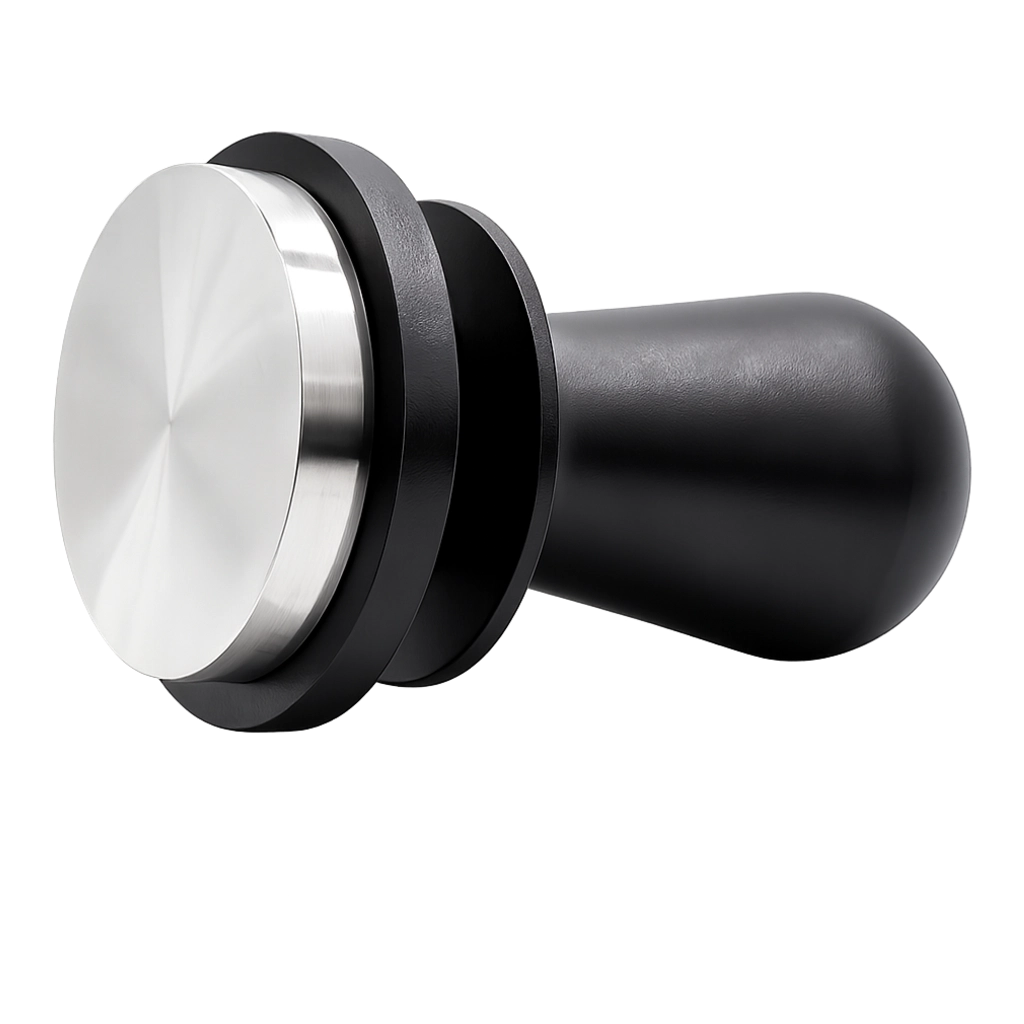
On the left side of the machine is the “tamper lever,” arguably the machine’s biggest innovation. This is where the coffee grounds are compacted after grinding. It also simultaneously analyzes whether the portafilter is full enough or too full.
The grinder in the Barista Express Impress is essentially based on the Smart Grinder Pro from Sage. The grind size can be set precisely and finely, and it is definitely capable of grinding fine enough for espresso. If the preset range on the side wheel isn't sufficient for your coffee, you can also adjust the grinder coarsely at the burrs. We have made a video about this.
The scope of delivery is quite satisfactory. There is a milk pitcher, filters, a water filter, and all sorts of other useful accessories. A cleaning program is even built into the device, an absolute rarity for machines in this price range. All in all, the build quality and the scope of delivery are at a standard and very good Sage level. How do I prepare an espresso with the Barista Express Impress?

How do I prepare an espresso with the Barista Express Impress?
You take the warm, clean, and dry portafilter and lock it into place under the grinder. The portafilter is automatically pulled into the correct position so that very little coffee grounds fall beside it.
Then you press the grind button and wait about 10 seconds until the ground coffee is in the portafilter. The machine now indicates that you should operate the “tamper lever” on the left side. When you pull the lever down, the machine shows how full the portafilter is. Ideally, a smiley face lights up – then you have the right amount of coffee powder in the portafilter. If the indicator shows too little or too much, you must adjust the grind duration in manual mode using the dial to optimize the fill level in the portafilter. This indicator can be useful and helpful for beginners.
After all, more coffee powder does not automatically mean “better coffee.” The coffee expands in contact with water. This presses it against the shower screen, which, depending on the shower screen and properties, causes an uneven extraction. Therefore, you should always be careful not to overfill the portafilter! By the way, there is also always a minimum fill quantity so that the coffee powder can form enough resistance.
Now you flush the brew group once without the portafilter to clean the shower screen and bring it up to temperature. Then you insert the portafilter, place your cups underneath, and press the button.
For a cappuccino, you froth cold milk with the steam wand. While this is a bit slow with the Sage Barista Express Impress, the steam power is sufficient to produce fine microfoam. Thanks to the thermoblock principle, the temperature change between brewing and frothing and back is quite fast, which we also liked.
All in all, it is relatively simple and uncomplicated to prepare your daily coffee using the machine’s automatic functions.
But the question remains: Does automatic tamping immediately after grinding really ensure good espresso extraction? We come to the problems of the Express Impress:
Problem 1: Coffee puck preparation
The process with a traditional portafilter machine involves tapping the portafilter after grinding to distribute the coffee grounds evenly. There are even levelers that create a flat surface or espresso distributors that loosen up the coffee grounds before tamping.
Why is this important? Ideally, the coffee grounds should be distributed evenly and without clumps in the portafilter. Afterward, the coffee grounds are compressed evenly by tamping. If everything has been done correctly, the espresso is extracted evenly over the entire area of the portafilter.
However, if the coffee grounds were not distributed evenly, spots will develop in the portafilter where the espresso water flows through faster, and others where it flows slower. This leads to the coffee being partially over-extracted (too long extraction) and partially under-extracted (too short extraction). Under-extracted espresso tastes sour; over-extracted espresso tastes bitter.
Poor preparation in the portafilter therefore leads to an unbalanced espresso in the cup. A good barista is recognized above all by the fact that they take a lot of time preparing the puck in the portafilter. What does this mean for the Barista Express Impress?
Since the process of grinding and tamping is automated, we have no influence on the result. The coffee powder does not fall evenly into the portafilter, but instead forms a small mound due to the process. If we then don't shake the portafilter and don't distribute the grounds, but simply pull the lever, the machine tamps an uneven mountain. The result is an uneven coffee puck. In addition, the tamper does not sit flush with the portafilter, leaving a rim on the outside that is barely or not at all compressed.
A word about the automatic dosing mode: If you have too little powder in the portafilter, the smiley doesn't light up during tamping, and the machine prompts you to press the grind button again. The machine then grinds for another second and creates a mountain on top of the already tamped coffee cake when you tamp again. This surface is then so inhomogeneous that the espresso can never taste good. The automatic dosing actually prevents a satisfying coffee experience.
The espresso you prepare with all this inaccuracy is therefore always a compromise between “too sour” and “too bitter” and never really tastes round and balanced. However, there are coffees that are very forgiving and taste good despite the inaccurate preparation, such as our Apas Organic Coffee.
At the end of the article, you will find a little trick to better distribute the coffee grounds.
Problem 2: Temperature
Sage already has several thermoblock machines on the market, including the Sage Bambino and the Barista Pro, both of which are equipped with a thick-film heater. The great thing about these devices is that after a heat-up time of just a few seconds and flushing the portafilter, the brewing temperature for the espresso remains constant at a good level of around 90 °C or better, 92 °C.
The problem with these machines was rather that they were preset to be too hot. In the past, Sage argued that they let the machines heat up too much after switching on to help warm up the portafilter. With the Barista Express Impress, Sage is taking a different path and heating up more cautiously.
After switching on, the Impress does indicate that it is ready for operation after about 40 seconds. However, according to our measurements, the Barista Express Impress does not reach a temperature of 90 °C even after 5 minutes. After a flush shot to preheat the portafilter, the brewing temperature for the first preparation after 5 minutes is about 84 °C. This espresso tastes sour and undrinkable. Only after 3-4 brews does the machine reach temperatures of 90-92 °C. Even after 10 minutes, you still need 2-3 brews until the desired temperature is reached.

To really ensure that the first espresso can be perfectly prepared, a heat-up time of up to 25 minutes is required. That is how long a large dual-boiler machine usually takes, not a thermoblock machine.
We found a hack on how to shorten the heat-up time. You will also find it at the end of the article.
Problem 3: Brew Ratio
To brew a consistently delicious espresso, you follow a so-called brew ratio or a brewing recipe. The amount of ground coffee powder is set in a ratio to the milliliters of beverage in the cup. We often recommend 1 gram of coffee powder for 2.5 grams of espresso in the cup (brew ratio 1:2.5). Because the machine manages the coffee amount independently and manual control is also rather inaccurate, we don’t even know exactly what brew ratio we end up with. So it is a gamble whether the semi-automatic espresso tastes good. Sometimes an espresso turns out well, sometimes not. It is really not satisfying.
Tips and Tricks
Since we work very intensively with the machines, measure them, and sometimes even take them apart, we often come across small, hidden functions or hacks. We will introduce two tricks that will surely make your espresso from the Barista Express Impress taste better. To dive into every detail of the machine, however, you should sign up for our Online Course!
Fast-Heatup
Anyone who buys a thermoblock machine certainly doesn’t want to wait 25 minutes for their first cup of espresso. Through a so-called fast-heatup, you can bring the machine to temperature faster.
To do this, turn the machine on as normal. As soon as the machine is “heated up” after 40 seconds, place a milk pitcher under the steam wand and turn the steam on for about 2 minutes. Since milk frothing requires a much higher temperature than brewing, this process ensures the machine gets “too hot.”
If you then insert the empty portafilter and flush it once, you are at the ideal espresso temperature. Another major advantage of this method is that the temperature curve remains more stable for subsequent espresso brews than without it.
However, if we are honest, it is not a really elegant solution. Who wants to leave their chic new espresso machine loudly steaming for minutes before it is even ready to go? This hack is useful, but it’s not exactly pretty!
Puck preparation
To prepare the coffee puck better and more homogeneously, you can remove the portafilter from the machine after grinding. Then tap it with the palm of your hand (“karate move”) and gently tap it on the work surface. This closes air channels that were created during grinding and creates a homogeneous surface.
Now you can lock the portafilter back under the grinder and pull the tamper lever. Or you can tamp outside the machine with an external 54mm tamper.
This way, the espresso is extracted much more evenly, and you get a more balanced beverage where sour and bitter flavor notes are integrated much more in balance.
Conclusion: Automation at its worst
Automation sounds good, progressive, and somehow sexy. We think of daily conveniences, fewer production errors, and consistent quality. Thus, the step Sage is taking with the Express Impress would be completely understandable: portafilter quality but still little work.
In our opinion, however, the concept does not work at all. The automation takes the most important processes in espresso preparation out of your hands as a home barista and performs them much worse than you can do yourself. This is not automation, but a deterioration.
After extensive testing, we have come to the conclusion that you can only produce delicious espresso with the machine if you bypass a large part of the “innovations” and pull the espresso as traditionally as possible. However, that is more cumbersome than with a normal portafilter machine.
If you already have the Express Impress at home, you can make good espresso with our tricks and our online course. However, if you are only thinking about buying the machine, we advise against it!