





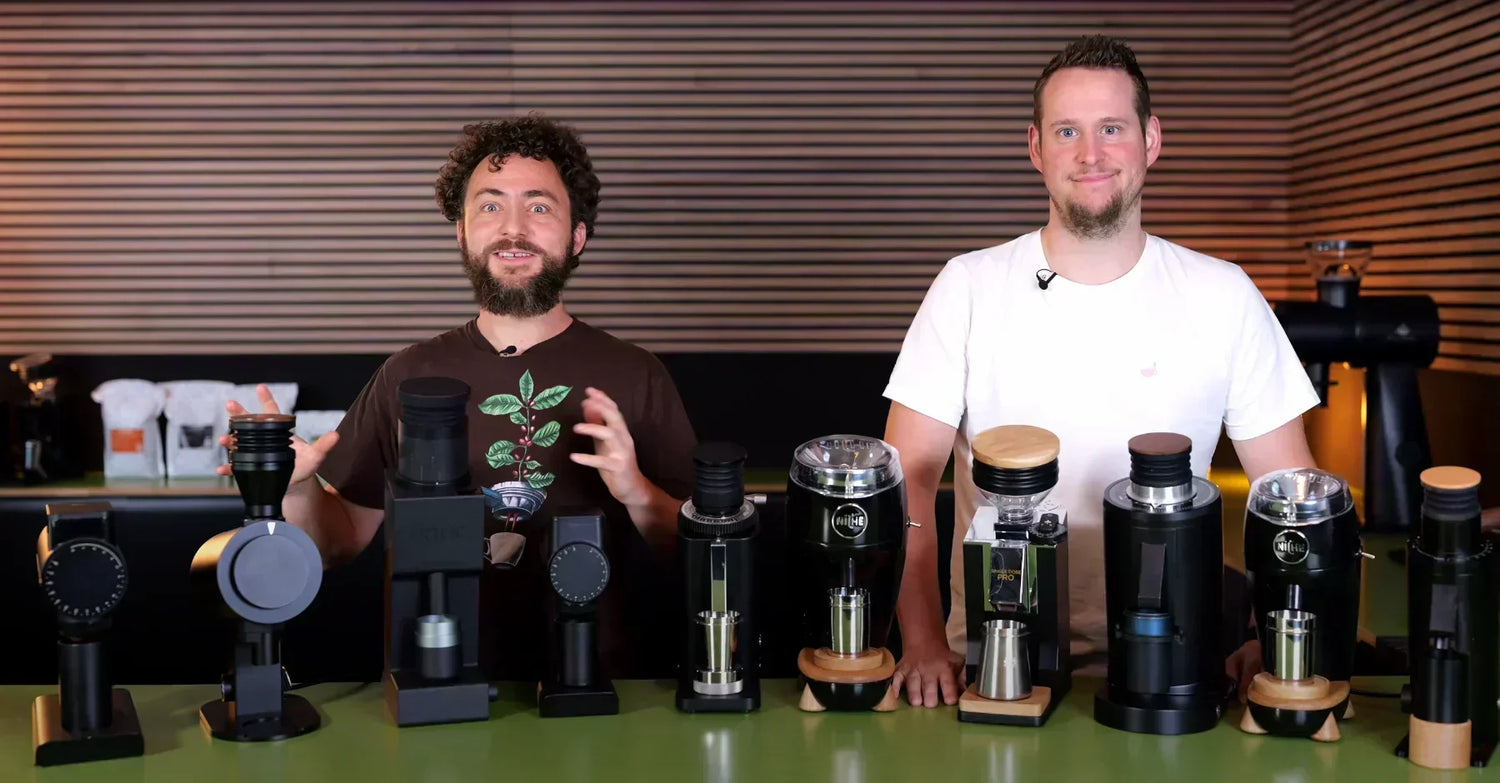

Over the years, we've spent a lot of time with espresso grinders. But rarely has a test field been as tight and as consistently high-quality as this one: ten single dosing (SD) grinders in the upper home-barista segment, between 500 and 1,000 euros. Buy anything in this class today and you fundamentally can't go too wrong. For us, that means the criteria need to get sharper. We're no longer asking whether a grinder can produce good espresso, but rather what kind of espresso it's best suited to bring out, and how smoothly the workflow holds up in daily use.
In this report, we summarize the results of our months-long testing and go into detail on what technically and sensorially sets these grinders apart.
We've written more on the topic of single dosing, along with its general pros and cons, in a separate article.
If you prefer the convenience of automatic dosing and don't switch bean varieties all the time, it's also worth looking at grinders with grind-by-weight. From around 600 € there are decent models with a built-in scale.
The tested grinders, in individual reviews
| Grinder | Price (approx.) | Link to full review |
|---|---|---|
| Timemore Sculptor 78S | ~€900 | Read the full review |
| Timemore Sculptor 64S | ~€700 | Read the full review |
| DF64V | ~€500 | Read the full review |
| DF83 | under €600 | Read the full review |
| DF83V | ~€840 | Read the full review |
| Niche Zero | ~€600–750 (import) | Read the full review |
| Niche Duo | ~€850 (import) | Read the full review |
| Varia VS6 | ~€760–770 | Read the full review |
| Eureka Mignon Single Dose Pro | ~€630–650 | Read the full review |
| Profitec Twist SD54 | ~€650 | Read the full review |
The test field and the philosophy of single dosing
The test field ranges from the DF64V as the most affordable entry point (just over 500 euros) to the Timemore Sculptor 78S, which at around 900 euros is the most expensive grinder in this lineup.
The mechanical variety is impressive and shapes each grinder's specialization. We see 54 mm flat burrs on the Profitec Twist SD54, the common 64 mm burrs on the Eureka Single Dose Pro, the Timemore 64S, and the DF64V. The DF83, the DF83 V, and the Niche Duo step up with substantial 83 mm burrs. The Niche Zero holds a special position, as it's the only grinder in this comparison built around conical burrs.
What all of them share is the single dosing principle: only the amount of coffee you need gets weighed out, poured into the hopper, and fully ground. The core benefit is that no coffee ages sitting in a bean hopper, and you can switch between different coffees or grind settings without much hassle.
The central challenge: specialization rather than just baseline quality
The high overall quality of these grinders calls for a broader way of looking at them. In the past, tests mostly focused on individual grinders, grind consistency, and how far absolute retention could be pushed down.
In this comparison, we also focus heavily on the sensory specialization each single dosing grinder shows — does a grinder lean toward clarity and complexity ("clarity extremist"), or toward body and sweetness ("body-forward")? Or does a grinder manage to bring out every facet of a coffee at once?
At the same time, workflow becomes a decisive quality factor. We've found that the best grinding quality doesn't help much if the blower knocks the grind setting out of place, if the dosing cup wrecks the grounds bed in the portafilter, or if cleaning is so complicated that the home barista avoids doing it.
Our entire analysis aims to tease out these nuances and show that, in the 500-to-1,000-euro segment, what you're really paying for is a smooth daily workflow and a specific sensory direction.
Noise and speed: the time factor
Speed is certainly not the most important criterion for single dosing at home. But it correlates directly with noise level and the grinder's thermal behavior.
The extremes: pace and noise
The test field shows stark differences in raw performance. The speed leaders are the two 83 mm grinders: the DF83 is extremely fast at 35.6 grams in 10 seconds, needing just 5.1 seconds for 18 grams. The DF83 V tops even that, managing an impressive 66 grams in 10 seconds, which means 18 grams are ground through in only 6.5 seconds.
That speed comes at a cost in noise, though: at 91.6 dB, the DF83 V is the loudest grinder in the comparison. Internally, we like to call it the "little bazooka." At least the extremely short grind time means you barely have to endure the noise for long.
At the other end of the spectrum, we find the quietest grinders: the Niche Zero is whisper-quiet at just 72.9 dB. The Timemore grinders (74.9 dB and 76.7 dB) and the Varia VS6 (75.7 dB) also sit comfortably below 80 dB.
These grinders pay for their low noise level with noticeably more leisurely speed, though. The Niche Duo (10.8 g/10s), the Varia VS6 (11.5 g/10s), and the Timemore 64S (12.4 g/10s) are among the slowest in the lineup, all needing around 20 seconds for 18 grams of grounds.
The relationship between speed, temperature, and grounds
One detail we captured during testing is the temperature of the grounds after several grinds. The DF83 V heats up the most on average. That's not a problem for flavor, but it is noticeable. The Profitec Twist SD54, on the other hand, delivers a surprise: it reaches the lowest grounds temperature of the field, showing excellent thermal management.
The lower speed of the Niche and Timemore models isn't a flaw at all — it's a deliberate trait that ties directly into particle distribution. A slower burr speed (RPM) can produce a narrower main peak in the grounds, which in turn has a positive effect on the sensory clarity of the espresso.
So here we see a direct correlation between lower mechanical output and higher sensory precision. That said, we can also say this clearly: heat buildup across all the grinders is completely uncritical and stays within a very narrow range. No flavor impact is to be expected from it.
Core technical performance compared
| Grinder | Noise level (dB) | Speed / 10 sec (g) | Time / 18g (s) | Temperature (grounds, °C) |
|---|---|---|---|---|
| Timemore 78s | 74.9 | 21.6 | 14 | 30.8 |
| DF 83 V | 91.6 | 66 | 6.5 | 34.58 |
| Varia VS6 | 75.7 | 11.5 | 20 | 28.6 |
| Timemore 64s | 76.7 | 12.4 | 20.5 | 31.3 |
| Profitec Twist SD54 | 84.3 | 14.7 | 15 | 25.44 |
| Niche Duo | 77.6 | 10.8 | 18 | 30.6 |
| Eureka SD Pro | 81.1 | 28 | 11 | 32.38 |
| DF 83 | 85.2 | 35.6 | 5.1 | 29.1 |
| Niche Zero | 72.9 | 11.9 | 13.5 | 30.4 |
| DF 64V | 81.6 | 19.2 | 12.5 | 32.4 |
The essential factor: retention and single dosing performance
Arguably the single most important technical criterion for a single dosing grinder is retention — the amount of ground coffee that stays behind in the grinder instead of landing in the portafilter. Why does it matter so much? If you choose a single dosing grinder, you expect the coffee you put in to come back out at 100%.
We draw a clear line here between permanent and temporary retention.
Retention: separating permanent from temporary
Permanent retention is coffee that settles in hard-to-reach spots (for example around screws or in gaps in the grinding chamber) and doesn't get exchanged from one grind to the next. This coffee ages, turns rancid, and can affect the flavor of future shots if the grinder isn't fully disassembled and cleaned regularly.
Single Dosing Performance (SDP), which we use as our term for temporary retention, is the figure that matters day to day. It tells you how much coffee from the previous grind ends up in your current shot. We're aiming for values under 0.2 grams.
The champions of near-zero retention
In the SDP category, the Timemore Sculptor models deliver the best results of the entire test field. Both the 78S and the 64S achieve temporary retention of just 0.1 gram. That figure comes from the vertical burr arrangement, a direct grinding path, and a clever ejection mechanism that makes a separate blower unnecessary.
The Niche Zero (0.2 g) and the DF64V (0.3 g) are also excellent. The Niche Zero achieves this in a particularly uncomplicated way: simply closing the lid is often enough to keep retention at this low level.
Things get more critical at the bottom of the field. The Eureka SD Pro sits at the upper end with 0.7 gram of temporary retention. That's still better than many classic grinders, but not ideal for a dedicated single-doser.
A clear outlier is the Varia VS6. While its single dosing performance, at 0.35 gram, is still very good, its permanent retention of 2.0 grams weighs heavily. Absolute retention comes to 2.3 grams.
One caveat: we didn't use the blower on the Varia VS6, which arguably put it at a disadvantage. There's a reason for that, though — using the blower regularly knocks the grind setting out of place on this particular grinder. Still, it's worth noting that the design of the Varia's grinding chamber encourages old coffee to build up, and it demands the most frequent, most thorough cleaning of any grinder in this comparison.
Retention as a symptom: static as a catalyst
We found that one of the main causes of elevated retention is electrostatic charge in the grounds. High static causes the finest particles and coffee dust to cling to the inner walls of the chute and refuse to move.
The DF64V tends toward massive static buildup without targeted countermeasures and is barely usable with many coffees unless you use a water spray (the Ross Droplet Technique, RDT). It only reaches its good SDP figure of 0.3 gram through consistent use of the blower combined with RDT.
By contrast, grinders like the Timemore models or the Eureka SD Pro naturally carry less static charge. That contributes significantly to their frictionless workflow and low retention, since less powder clings to the walls.
Retention and single dosing performance (retention in grams)
| Grinder | Temp. retention (g) | Perm. retention (g) | Abs. retention (g) | SD Performance (g) |
|---|---|---|---|---|
| Timemore 78s | 0.1 | 0.2 | 0.3 | 0.1 |
| DF 83 V | 0.4 | 0.4 | 0.8 | 0.4 |
| Varia VS6 | 0.35 | 2.0 | 2.3 | 0.35 |
| Timemore 64s | 0.1 | 0.2 | 0.3 | 0.1 |
| Profitec Twist SD54 | 0.6 | 0.2 | 0.8 | 0.6 |
| Niche Duo | 0.6 | 0.8 | 1.4 | 0.6 |
| Eureka SD Pro | 0.7 | 0.1 | 0.8 | 0.7 |
| DF 83 | 0.4 | 0.4 | 0.8 | 0.4 |
| Niche Zero | 0.2 | 0.7 | 0.9 | 0.2 |
| DF 64V | 0.3 | 0.5 | 0.8 | 0.3 |
The heart of the flavor: particle distribution and extraction behavior
Particle size distribution (PSD) is the foundation of what ends up in the cup. We look at two main factors: the width of the main peak (a measure of how uniform the grounds are) and the fines content Qf (the share of particles under 100 microns, which matters for body and puck stability).
A narrow main peak points to more even extraction and clarity. A higher fines content adds body, but too much fine dust can quickly tip over into bitterness.
The analytical basis: peak width and fines content
The grinders in this segment fall neatly into two extremes and a large, all-rounder middle ground.
The extremes: clarity versus body
Clarity extremists: Timemore Sculptor 78S and 64S
The Timemore Sculptor models are extremists when it comes to particle distribution. They deliver the narrowest main peaks we've ever measured in this segment (64S: 145 µm; 78S: 154 µm). Sensorially, this profile translates into maximum clarity and complexity, with a precise resolution of sweetness and acidity. For light, complex roasts, these grinders are fantastic.
The downside of such an extremely narrow distribution shows up in extraction behavior: the puck is fragile, and you need to grind extremely fine just to build up any resistance against the pump at all. That often leads to a long pressure build-up followed by a sudden, fast rush of extraction (a "stall-and-shoot" phenomenon). These grinders are therefore more "nerd tools" for advanced home baristas who have precise puck prep (WDT) down cold and, ideally, own an espresso machine with pressure or flow profiling.


Body extremist: Niche Zero
The Niche Zero forms the clear counterpoint. As the only grinder in the test field with conical burrs, it shows the widest main peak (270 µm) and the lowest fines content (19.8%).
Sensorially, that translates into a profile that emphasizes sweetness, body, and balance. Shots are smooth, creamy, and forgiving. It delivers that "classic" espresso character, leaning heavily into chocolate, nut, and marzipan notes. The coarser x50 combined with low fines produces a stable puck that's uncomplicated to extract, even if you're not yet working at the most advanced level of puck prep.
The broad all-rounder middle ground
Bold & punchy: DF83 V and Profitec Twist SD54
Both grinders show some of the highest fines content in the test (around 34–35%). That produces a denser texture and a punchier body. This is especially notable on the Profitec Twist SD54, since despite its smaller 54 mm burrs it delivers a surprisingly dense particle profile. If you're after a bold, dark espresso, this is the profile for you. That said, the high fines content demands clean puck prep, since the risk of astringency or channeling increases.
Clarity-leaning all-rounders: DF64 V and Varia VS6
These models offer a relatively narrow peak (VS6: 183 µm; DF64 V: 196 µm), which gives them more clarity than the broader middle of the field. The DF64 V is the most affordable way into this "clarity" range. The Varia VS6 combines a narrow peak with RPM adjustment, making it an exciting all-rounder for structured espressos.
Balanced middle: DF83, Niche Duo, Eureka SD Pro
These grinders sit in the middle of the field for both fines content and peak width. They're solid all-rounders that deliver good results across roast levels without much drama, and are easy to dial in. The Eureka SD Pro tends toward a slightly coarser grind (x50 298 µm), with rounder, less "sparkly" results in the cup.

The RPM lever: actively steering flavor profiles
A key feature present on several grinders in this segment (DF83 V, DF64 V, Varia VS6, Timemore 78S/64S) is variable speed (RPM). This is the strongest lever a home barista has for steering the flavor profile.
Changing the speed has a direct, causal effect on particle distribution: a lower RPM reduces turbulence in the grinding chamber, which narrows the main peak. That boosts clarity and is ideal for light roasts or brewing filter coffee.
A higher RPM does the opposite: it tends to widen the peak and can add more body and sweetness. Being able to adjust this parameter lets the home barista temporarily shift a grinder's specialization and get the best out of different coffees.
Particle distribution and flavor profiles (T4 espresso)
| Grinder | Main peak width (µm) | Fines content Qf (<100µm) | x50 (µm) | Sensory profile |
|---|---|---|---|---|
| Timemore 64s | 145 (narrowest) | 31.0% | 205 | Extreme clarity, complexity, fruit-forward. |
| Timemore 78s | 154 | 29.7% | 221 | Extreme clarity, complexity, fruit-forward. |
| Niche Zero | 270 (widest) | 19.8% (lowest) | 343 | Velvety, creamy, body-forward. |
| DF 83 V | 232 | 34.4% (highest) | 251 | High body and punch, prone to astringency. |
| Profitec Twist SD54 | 206 | 34.5% (highest) | 285 | Dense, sensuous, can lean toward bitterness. |
| DF 64V | 196 | 27.0% | 255 | Good clarity, balanced all-round readability. |
| Varia VS6 | 183 (very narrow) | 32.0% | 243 | Lively, structured, pulls well. |
| Niche Duo | 255 | 26.4% | 271 | Solid balance, easy to dial in. |
| DF 83 | 204 | 28.4% | 249 | Solid balance, crowd-pleaser. |
| Eureka SD Pro | 201 | 30.2% | 298 | Round, medium, less "sparkly" up top. |
Feel, workflow, and everyday usability
Beyond pure grinding results, the feel of the grind adjustment dial, the quality of the included accessories, and the overall workflow determine whether a grinder is actually enjoyable to use day to day.
The grind-adjustment feel and its pitfalls
This is where serious design weaknesses show up — weaknesses that can overshadow even the best grinding quality. We rate the grind-adjustment feel of the Varia VS6 as red (poor). The adjustment is too loose and shifts if you use the blower or so much as tap the grinder. That's a "worst-case scenario for a single dosing grinder," since the grind point you carefully dialed in keeps getting lost.
Grinders like the Niche Zero and the Niche Duo, on the other hand, earn a very good rating (dark green). Their wide adjustment range means small movements of the dial only have a minimal effect on extraction time, which makes dialing in very pleasant and forgiving.
The biggest workflow killer: our criticism of the dosing cups
A seemingly minor accessory can completely undo an otherwise perfect workflow. On the Timemore Sculptor models, the included dosing cup is exactly this kind of "workflow killer."
The problem: the cup has a thick rim. When you tip the ground coffee directly into the portafilter, that thick rim leaves an uneven, ring-shaped crater around the edge of the coffee puck. This unevenness promotes serious channeling, even if you've already done WDT (grounds distribution) beforehand. That means the home barista either has to swap out the cup or transfer the coffee in some roundabout way, which undercuts the grinder's otherwise excellent single dosing workflow.
Other grinders, like the DF83, the Eureka SD Pro, and the Niche Duo/Zero, come with better cups that sit cleanly on the portafilter and allow for even distribution of the grounds.
Maintenance and cleaning: a hidden consistency factor
How easy a grinder is to clean is a factor that's often underestimated. It affects not just your daily routine, but also long-term sensory quality, since permanent retention needs to be removed.
Cleaning ergonomics and keeping your grind setting
It's a big advantage if your dialed-in grind setting survives cleaning. Only the Timemore Sculptor models manage to retain their grind setting after disassembly, which means you can skip a time-consuming recalibration. On the Eureka SD Pro, this is theoretically possible too, but it requires loosening and retightening grub screws that bear on a plastic part — repeated tightening risks damaging it over time.
The Profitec Twist SD54 gets the worst mark in this category. Disassembly is relatively complicated, requires a lot of screwing around, and parts like the grind-scale disc are loose, which turns recalibration into a tedious process.
The DF models and the Niche Zero/Duo are easier to open (by turning the grind-adjustment ring), but doing so loses the grind setting, which then has to be reset afterward.
The must-do routine for dark roasts
Looking at permanent retention, especially on the Varia VS6 (2.0 grams), makes clear that regular maintenance is essential. Permanent retention builds up over time, particularly with oily, dark roasts.
We therefore recommend fully opening and dry-cleaning any grinder prone to this kind of buildup at least once a month. If you'd rather avoid that effort, either go for grinders with the lowest permanent retention (Eureka SD Pro, Profitec Twist, Timemore models, all between 0.1 g and 0.2 g), or stick to light roasts only.

Conclusion and our recommendations
The bottom line up front: every grinder in this comparison is a first-rate machine that's a joy to use. Upgrading to different burrs is usually only worthwhile if you're specifically chasing a different sensory extreme, or want to fix a specific workflow shortcoming.
The value champion and entry into clarity: DF64V
At just over 500 euros, the DF64V punches well above its price. It delivers very good single dosing performance (0.3 g) and a clarity-leaning grind peak (196 µm). It's a fantastic prosumer entry point with RPM control, but it does require consistent use of RDT (water spray) to keep static in check.
The classic for beginners and body lovers: Niche Zero
The Niche Zero is the quietest grinder in the test (72.9 dB) and, thanks to its conical burrs, delivers a forgiving, sweet, body-rich profile with the lowest fines content of the field. Its workflow is uncomplicated, and the repeatability of its grind setting is excellent (dark green).
The perfectionists and clarity nerds: Timemore Sculptor 78S/64S
If you want the absolute maximum in sensory clarity and complexity, there's no getting around the Timemore models. They offer the narrowest grind peaks (down to 145 µm) and the best single dosing performance (0.1 g). These are uncompromising tools for home baristas willing to invest in advanced puck prep (WDT) and flow profiling.
The 78S offers the higher speed; the 64S delivers the same grinding output at a lower price. The dosing cup, though, needs to be swapped out right away. The grinder also demands fairly advanced skills in grounds distribution and very even puck prep — otherwise, given its particular particle distribution, you risk channeling and coffee that falls well short of the grinder's potential.
The power user and gastro contender: DF83
The DF83 (non-V) is the fastest grinder (5.1 seconds/18 g) and delivers a balanced, punch-forward profile. If you grind larger quantities of coffee daily, or you're after a grinder for a small office or a café setting, this machine has enormous throughput in reserve.
The all-rounder with a catch: Varia VS6
The Varia VS6 impresses with its low noise level, RPM control, and a clear grind profile (183 µm peak). Its central weakness — a grind dial that shifts when you use the blower (red) — along with its critically high permanent retention (2.0 g), calls for a deliberate decision to skip the blower, hold the dial steady while adjusting, and commit to very regular, thorough cleaning.
We're convinced that today, in the 500-to-1,000-euro segment, the home barista isn't just paying for grinding quality — above all, they're paying for a frictionless, well-thought-out workflow. Poor ergonomics (VS6) or subpar accessories (Timemore) can overshadow even the best mechanics in daily use. It's worth choosing the grinder whose trade-offs best fit your own way of using it.