





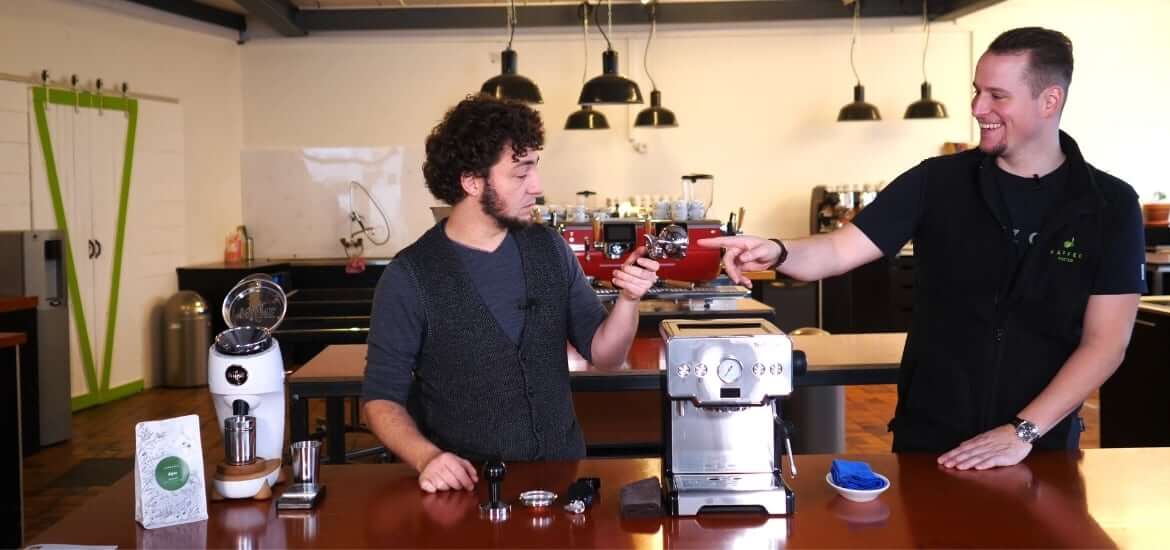

The Satrap Espresso XA is an espresso machine sold in coop supermarkets and at coop Bau und Hobby. It was named the test winner in the Kassensturz espresso machine test. We took a closer look at the Satrap XA and have summarized what this 249-franc machine has to offer.
Test and tips for the Satrap Espresso XA
Our goal as coffee makers is to help espresso machine users get better results from their machines. We find this particularly important and exciting when it comes to more affordable espresso machines. The more expensive an espresso machine is – and we test machines costing 1000, 2000, or 3000 francs – the more we expect it to perform. The cheaper an espresso machine is, the more a test report serves as a supplement to a manual, providing tips and tricks to get the absolute most out of a coffee machine.
That was our approach with the Satrap Espresso XA. There are some things we actually really like about it. With that motivation, we approached the machine’s biggest drawbacks to figure out how to work around them.
Accessories and build quality: A crowning achievement in tamping
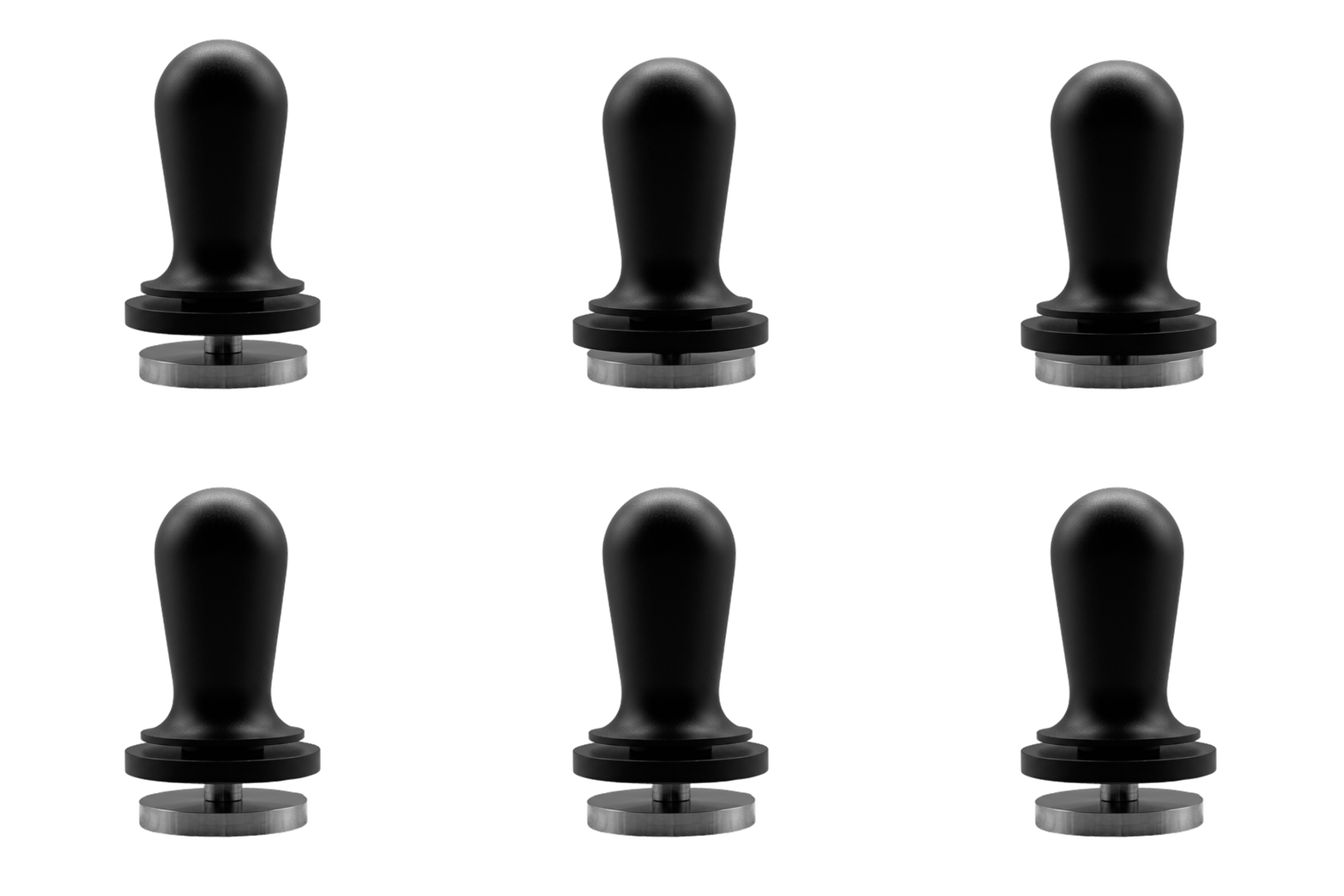
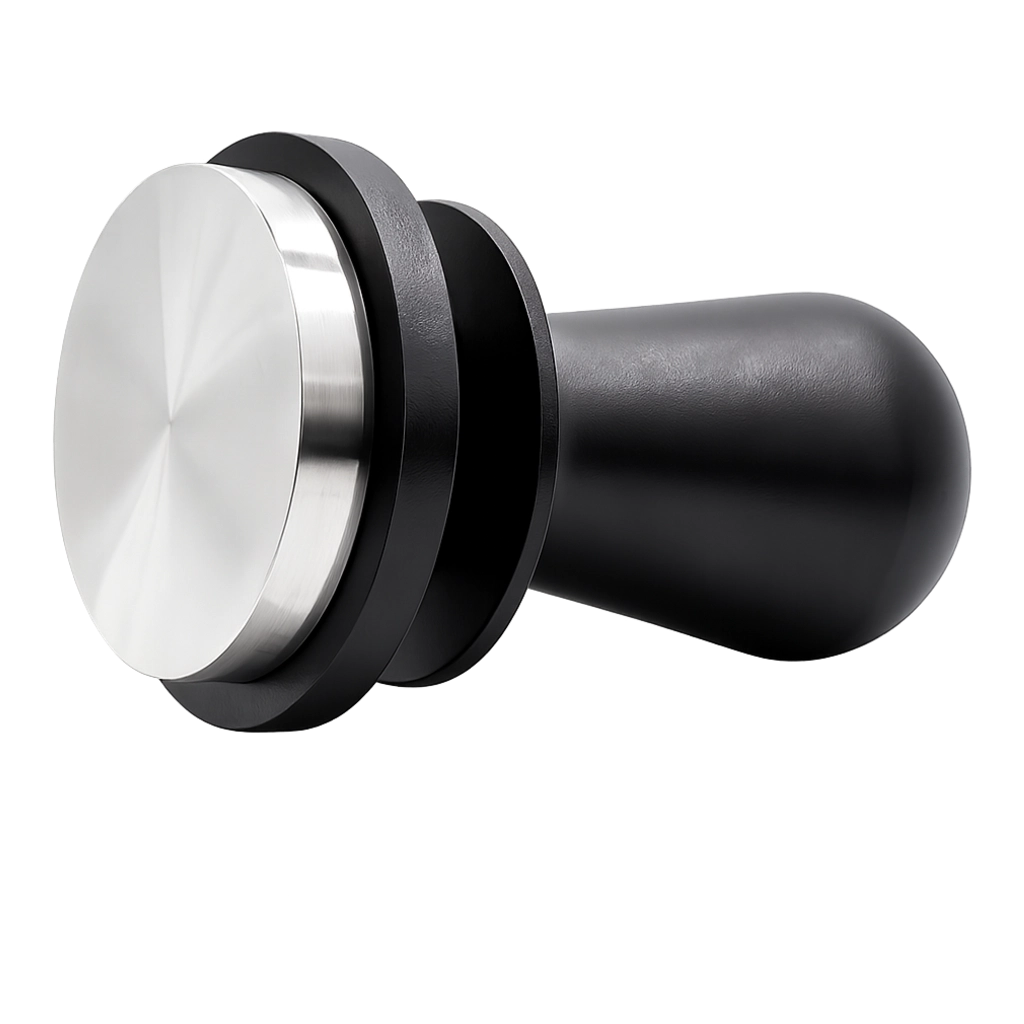
Three accessories or features are a positive highlight of the Satrap Espresso XA. The tamper is excellent, especially for this price range. It fits perfectly into the portafilter basket, has a solid metal base, and is therefore perfect for leveling and tamping coffee grounds well. We wish some dual-boiler espresso machines costing over 1000 francs came with a tamper like this.
The portafilter is equally impressive. The basket is 58mm, which is a standard size for professional espresso machines and machines with a Faema E61 group head. The same applies here as with the tamper: the portafilter would not look out of place on an espresso machine costing well over 1000 euros. The double or single spout can be unscrewed and replaced.
While we don't believe pressure gauges are a real help for adjusting an espresso machine, we like the timer display. It gives the barista a sense of how long the espresso shot has been running. We discuss why this can also lead to confusion in the chapter "Adjusting the espresso machine and grinder." Nevertheless, a timer is generally helpful and anything but standard in the price range under 300 CHF.

As positive as the tamper, portafilter, and timer display are, the rest of the espresso machine is a complete contrast. Cheap plastic everywhere – perhaps appropriate for the price. What’s unfortunate, however, is that the model we tested was already the second one that leaked from the steam wand during an espresso extraction.
Otherwise, the machine is compact at 35.5 cm in length, 31.9 cm in width, and 38.4 cm in height. The water tank can be removed and refilled. Important: always use softened water with all espresso machines!
Espresso quality like Russian roulette
We did manage to make good espresso with the Satrap Espresso XA. Unfortunately, despite all our tricks and tips, we were unable to achieve consistent results. The machine's biggest problem is temperature stability.
What we can reliably say is: run water for at least 5 seconds before pulling a shot. If you don't, the temperature will definitely be too high during extraction. However, even with the water flush, it often shoots past the desired target temperature anyway. For brewing espresso, the perfect temperature is around 93 degrees. Depending on the choice of coffee, this may vary slightly up or down. But we are talking about a deviation of 1–2 degrees Celsius.
The Satrap Espresso XA is not only inconsistent with its starting temperature every time, but also with its end temperature. In some extractions, we measured temperature fluctuations of up to 15 degrees.

The temperature curve of the Satrap Espresso XA is impressively inconsistent.
In terms of extraction and taste, it borders on a game of Russian roulette, where alternating bitterness and acidity will blow your socks off. Low temperatures significantly intensify perceived acidity. High temperatures bring out unpleasant bitterness. In both cases, a balanced acidity is missing.
Furthermore, the fluctuating temperature also affects extraction speed. This is usually adjusted via the grind size, which we discuss in the following section.
Adjusting the espresso machine and grinder
The Satrap Espresso XA has a built-in timer control. This means it stops the water flow after an adjustable and therefore predetermined time. By default, the espresso machine stops after 25 seconds.
Such a control is actually more advanced than many controls on more expensive espresso machines, e.g., in the dual-boiler segment. These do not stop automatically at all but are manually stopped by the user after time X or volume Y.
In this regard, the Satrap Espresso XA actually provides more than other espresso machines. However, this can lead to confusion, especially if one follows classic setup manuals and guides, or if the user has not fully internalized the principle of adjusting the grinder and espresso machine.
- A good grinder is a prerequisite for making decent coffee with the Satrap Espresso XA at all.
- A scale is essential for monitoring the yield, for every single shot.
The Satrap Espresso XA comes without a pressurized basket. A pressurized basket allows for the use of pre-ground coffee. Normally, the flow rate of the espresso is adjusted via the grind setting of the grinder. Since pre-ground coffee is already ground and cannot be adjusted, the resistance in the pressurized basket takes over the task of extending the brewing time of the espresso.
Explanations for setting an espresso grinder usually read like this: the grind size is to be set so that the espresso run time takes approx. 25 seconds to achieve a yield of approx. 20 ml/g in the cup.

Unlike a De'Longhi Dedica EC 685 or a Solis Barista Perfetta Plus, the Satrap Espresso XA does not stop after 20 ml/g in the cup, but after 25 seconds. If the grinder setting is too coarse, the cup fills up way too quickly. The machine will still stop after 25 seconds. The cup will then be full or overflowing. If the grind size is too fine, there will barely be a few drops in the cup after 25 seconds. The consequence is the same as with a machine with volumetric dosing. The grinder must be adjusted correctly. However, the approach is different and requires a more consistent and steady check of the yield in the cup for every shot.
Frothing milk for cappuccino with the Satrap Espresso XA
Those who enjoy cappuccino or latte macchiato are better off with the Satrap Espresso XA than those who prefer drinking espresso straight. Because while the espresso rarely tastes the same as the previous one, the milk foam can be frothed decently with this machine if you use a small pitcher (0.35 liters).
And when you pour milk foam over an espresso, the quality of the espresso no longer plays the most important role.
Conclusion on the Satrap Espresso XA espresso machine
The Satrap Espresso XA is labeled on the packaging as a piston machine, even though it is not a piston machine. A piston machine would be a fully automatic coffee machine or a manual lever machine like, for example, the Flair or the manual Aram espresso device.
The discrepancy between packaging and content also runs through the machine itself. While the tamper and portafilter make us want to jump for joy, the temperature inconsistency makes us shudder. While we find the timer control interesting instead of volumetric control, we would wish for this on an advanced machine and consider it problematic in the entry-level segment.
Therefore, we can hardly recommend the Satrap Espresso XA for making espresso, except for processing into coffee liqueur or cappuccino. Some shots will be delicious and you can drink the espresso black. Often, however, the American double-latte variation will be the best solution to neutralize bitterness and acidity.