






Wow, the Zerno Z1 blew us away from the moment we unboxed it. So much love for detail and craftsmanship has gone into this grinder – it really stands out! We've now tested over 90 espresso grinders. The Zerno Z1 doesn't have to hide behind any other grinder and without question belongs among our top favorites.
But you do pay for that! In the basic version, it starts at around $1,200. As always, we bought the Zerno Z1 ourselves, at full price. In the end, that came to almost $2,000, including accessories, burr sets, beautiful wooden covers, and a case.
That's a statement and makes it crystal clear that this is no entry-level grinder, but rather a premium-class device. Since the grinder also delivers on this price point both in terms of content and quality, it's no wonder that my test colleague Michel Indelicato and I discussed at the end of the test series who gets to take the grinder home until the next Home Barista professional course.
Design and Feel: A Solid Block
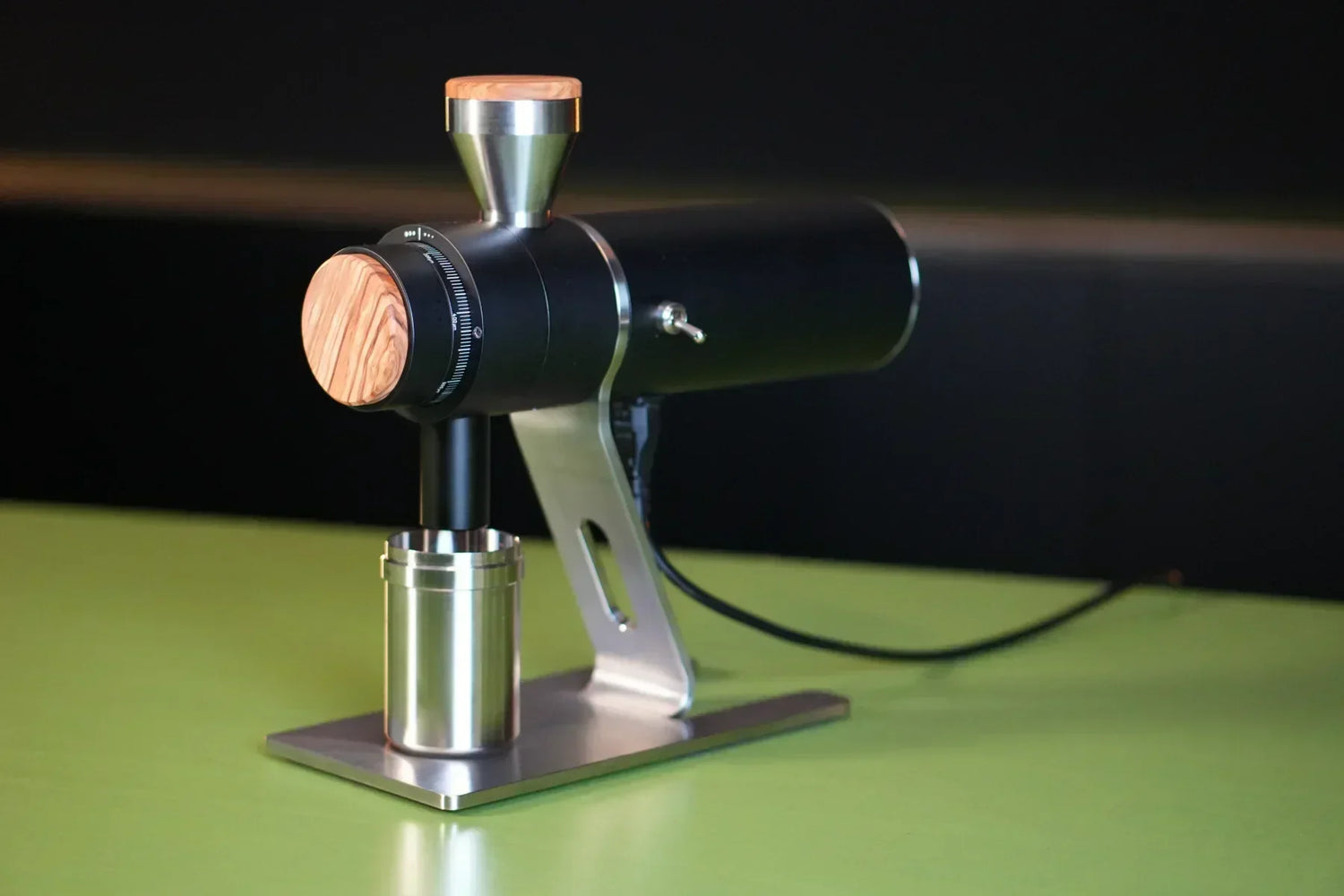
When the Zerno Z1 sits on the counter, it makes a statement. It's surprisingly slim in design, which we rarely see, but it tips the scales at a hefty 6.5 kilograms. The massive stainless steel base carries the grinder with elegance. Zerno manages this balancing act in every aspect. While other manufacturers often slip into bulky, blocky design language with coffee equipment and use militaristic terms like "tank" to describe it perfectly, the Zerno looks more like a bird of prey. Powerful, dynamic, aesthetically elegant. The workmanship is seamless, thought through to the last detail, and reaches its peak in the grinding chamber.
The 64 burr set is positioned vertically in the grinder and is screwed in or magnetically held from the back ("Blind Burrs"). They can be removed and changed with just a few simple steps. In my opinion, the significance of Blind Burrs is still vastly underestimated. We were able to verify this through measurements when another manufacturer switched only one burr side to Blind Burrs while keeping the other burr sides the same. Suddenly their main peak narrowed by 30 microns!

We'll get to the particle distribution of the Zerno Z1 later, but I can already say this much: The homogeneity of the Zerno Z1 is spectacular. The entire interior is built in such a way that there's hardly any room for retention. For this purpose, Zerno forgoes sharp edges inside the grinding chamber. Even the carriers have rounded edges and thus empty the chamber very effectively.
The grinder is modular in design. This allows you to change aesthetic elements like wooden covers on one hand, but also technical components like the pre-breaker (auger) on the other.
Included is a massive stainless steel dosing cup that magnetically positions itself at the right spot under the coffee outlet.
Due to its design, the grinder in its basic configuration is absolutely "aligned," meaning the burrs are parallel to each other and properly aligned. To encounter the same grind setting after opening the grinder and to find very well-aligned burrs, we recommend using a torque screwdriver.

The Technology: Slow, But Precise
Inside, a 300-watt motor operates at a constant 900 revolutions per minute. Compared to other grinders, that's relatively slow. We measure a grinding speed of about 1.0 to 1.1 grams per second. For an 18-gram dose, the Zerno Z1 therefore needs about 18 seconds to grind completely empty. It's not a speed record, but with single dosing, we're primarily concerned with quality, not time saving. The slow grinding combined with the pre-breakers used has a strong influence on particle distribution, which, alongside the Blind Burrs, explains the high homogeneity of the ground coffee. The pre-breaker additionally has a slowing effect on the grinding that resembles slow feeding.
What we noticed during operation: The grinder is quite audible at around 81 decibels. Compared to whisper-quiet competitors like an Acaia Orbit, that stands out. It's not an unpleasant sound, but it's present.

Retention and Workflow
The topic of retention is essential for single dosing grinders. We distinguish here between temporary and permanent retention. The temporary retention – that is, what gets exchanged between two shots – is an excellent 0.1 to 0.2 grams for the Zerno Z1. That's absolutely top-tier and means you basically get out exactly what you put in.
But we also need to talk about permanent retention. That's coffee grounds that settle in cracks and corners and stay there. Here we measure about 0.6 grams, which collect primarily behind the burrs and in the discharge area. This is due to design and a good reason to clean the grinder regularly.

Behind the burrs, some coffee accumulates in the permanent retention area.
Fortunately, Zerno makes it easy for us: With just two screws on the front, you can open the entire grinding chamber. You get immediate access to the burrs, can brush them out, and reassemble everything. An important note for daily use: When you screw the grinder back together, make sure to tighten the screws properly. If you only tighten them loosely, the grind setting gap changes, which has direct effects on your espresso.
The grinder tends to build up some static depending on the bean variety. In these cases, we recommend the Ross Droplet Technique (RDT), that is, a light spray of water on the beans before grinding. This reduces static significantly and ensures that the ground coffee lands cleanly in the cup.
Excellent too is the grind setting accuracy and adjustment precision of the grinder. The grind setting is given as a value in microns. This expresses the distance between the burrs from each other. Interestingly, the displayed grind setting is fairly close to our measured x50. When we adjust the grinder for other drinks and then return to espresso, or to the noted grind setting, we get particle distribution that's within a few microns of the original. Long story short: the Zerno Z1 is very well suited to switching between recipes and coffees and then returning to the original coffee.

Taste: Precision Meets Body
Let's get to the most important point: What lands in the cup? The particle distribution measurement in the lab shows an extremely narrow main peak. The SSP High Uniformity burrs combined with the low RPM produce very homogeneous ground coffee. The x50 value (the median particle size) lies very close to the desired target range, which speaks to high precision.
In terms of taste, that translates into a wonderful balance. We tested our "Apas" espresso and were impressed. The espresso shows clear structure. We taste a nice balance between sweetness and bitterness, with notes of nut and nougat, accompanied by a subtle but clear stone fruit fruitiness. It's not an aggressive acidity, but rather a very well-integrated, bright stone fruit quality.
At the same time – and this pleasantly surprised us – the espresso has good body. Often grinders with high clarity (high clarity) lose texture and mouthfeel. The Zerno Z1 manages this balancing act: It delivers the differentiation of flavors without the espresso tasting thin.
However, the grinder demands a lot from the barista. Due to the very homogeneous particle distribution, you need to grind very fine to achieve correct shot times. This means your puck preparation has to be spot-on. Sloppy tamping or poor distribution immediately leads to channeling. Those who work cleanly here are rewarded with excellent results.
Interestingly, the grinder also works very well for filter coffee. When we set the grind setting coarse, we get a very clean, almost unimodal grind image that enables clear and structured filter coffees. That's an exception for pure espresso grinders.

Conclusion: An Engineer's Dream with a Small Hurdle
So who is this grinder right for? The Zerno Z1 is not a grinder for the absolute beginner who just wants a quick caffeine hit. It's a precision tool for home baristas who want to understand what burr geometry and pre-breaker design do to the taste. It delivers results that compete in the absolute top tier.
Unlike other single-dosing grinders in the top tier, the Zerno Z1 forgoes the option to adjust the speed (RPM). Instead, the grinder invites you to play with different burrs and pre-breakers and delivers a grinding speed of 900 RPM tuned to the pre-breakers. From my perspective, that makes a lot of sense. When a company like Zerno, which intensively deals with burr and pre-breaker geometry, develops toward a certain RPM, then a grinder can be optimized toward that.
Does the filter coffee taste good? We only tested that initially and it obviously depends on the burr sets used. Basically, though, we can say: yes, the filter coffee we ground and brewed with the Zerno Z1 was among the best filter coffees we've ever had from single-dosing grinders.
For all our enthusiasm for the Zerno Z1, there's one clear "but." Zerno is a US-based company. For us in Europe, that means: imports, customs, and most importantly, no local service network. If something goes wrong with the motor, you don't just send the device quickly around the corner for repairs. In the US that's a no-brainer, but here in Europe you have to be aware of this risk. On the other hand, the grinder is built in such a way that technical defects seem rather unlikely.
Technically and in terms of taste, we have nothing to fault the Zerno Z1 with – quite the opposite. It's solidly built, delivers measurably excellent results, and is fun to use in the workflow – if you're willing to pay the price and take the import hurdle. If you already have a good grinder and are looking for that last bit of clarity and nuance, you'll find it here. For us, it remains one of the most exciting grinders we've had on the table recently.
And who gets the grinder to take home? First of all, Michel. But the deal isn't bad for Benjamin either. Early in the year, we hope to get our hands on the Z2 model, and maybe that one will then find its place next to Benjamin's espresso machine...