








The Graef CM800 is consistently referred to as THE entry-level grinder into the world of espresso. At just under 130 Euros/150 Swiss Francs, it is also competitively priced compared to many other options on the market.
But what can this small grinder do, which is recommended by many forums and receives decent to good reviews in tests?
We tested the Graef CM 800. After the first few hours with the grinder, our impression was not good. Frankly, we cursed and were frustrated, and the coffee didn't taste good.
When a device performs poorly or partially poorly in one of our tests, the following happens:
- we test even more intensively to objectively substantiate our impression.
- we look for ways to rectify the weaknesses of a device or provide you with tips and tricks to still achieve good results with the device.
Our test was first published on January 27, 2020. Two years later, the Graef was back on our table and tested by us in comparison with 24 other home espresso grinders. Both tests have been incorporated into this report and two videos.
Why do we test, and why do we test at all?
Before I delve deeper into the grinder, I want to briefly explain why we even test coffee machines and grinders. Kaffeemacher is a coffee school. We also roast and operate a coffee farm in Nicaragua, as well as two cafes in Basel. This grinder test and all others come directly from our coffee academy.
Our goal is that as many of you as possible can enjoy good coffee with simple means. We are convinced that if many coffee drinkers drink good coffee, the willingness to spend more money on good coffee beans also increases, and the producer benefits from this. As long as the espresso machines, grinders, or water limit the quality of the coffee (or make it bad), good coffee will not be used.
So, when we recommend a machine to you, it's because we believe you can make good coffee with it. And if some tips are needed, we provide them. Unlike many test portals, we don't live off you buying the machine via an affiliate link.
If you compare our articles, comparisons, and tests with classic test portals, you'll notice that our tests are much more complex. We don't sugarcoat anything so that you later buy inferior material.
 We tested the Graef CM800 in good company. On the one hand with the La Marzocco GS3 and on the other hand alongside a Cimbali M100.
Overall Impression of the Graef CM 800
The greatest strengths of the small Graef CM 800 are its price and size. With a depth of just 13.5 cm, a width of 23 cm, and a height of 39 cm, it fits into any kitchen nook. With its aluminum housing and a weight of around 2.6 kg, it also feels quite solid.
If you manage to adjust the grinder well, you can even make espresso with the Graef CM800! This grinder is an espresso grinder, unlike many other grinders in the under €200 range. Most grinders from Tschibo, Melitta, Rommelsbacher, etc., are filter coffee grinders and cannot be set finely enough! Don't let misleading tests lead you astray here.
Our Verdict on the Graef CM 800 Upfront
- Can you make espresso with the Graef CM 800? Yes, that is possible.
- Is it easy to use? No. If you're not lucky and the grind range is somewhat accurate, then the Graef is very complex to operate.
- Who is this grinder suitable for? Not for sensorily demanding coffee drinkers. You should also be able and willing to handle a screwdriver.
- The Graef CM800 is sensorily suitable for beginners and technically for advanced users.
Freshly Grinding Espresso with the Graef CM800
Freshly ground coffee is always better than pre-ground. Within just 15 minutes, a large portion of the volatile aroma components of coffee are lost. Therefore, the first step to better coffee is to get a grinder that allows for minute-by-minute grinding.
Basically, there is a distinction between espresso grinders and filter coffee grinders. Espresso grinders allow for a finer grind setting. This is necessary to build resistance in the portafilter of the espresso machine.
If the grind is not fine enough, the brewing water flows too quickly through the coffee. If an espresso is brewed in less than 20 seconds, the coffee is under-extracted. The espresso tastes sour, aggressive, and watery. Therefore, it is very important when choosing a coffee grinder to ensure that it grinds fine enough for espresso.
The Graef CM 800 does exactly that. It grinds fine enough and is therefore also suitable for preparing espresso. It is the most affordable espresso grinder we have tested so far. The espresso tastes much better with the Graef CM 800 than when using pre-ground coffee powder.
But how does the quality of the espresso compare to other espresso grinders?
Can So Cheap Be Delicious?
We invested many hours of work into the Graef CM800 test. This was due to the complex grind setting and the fact that we were not satisfied with the taste result.
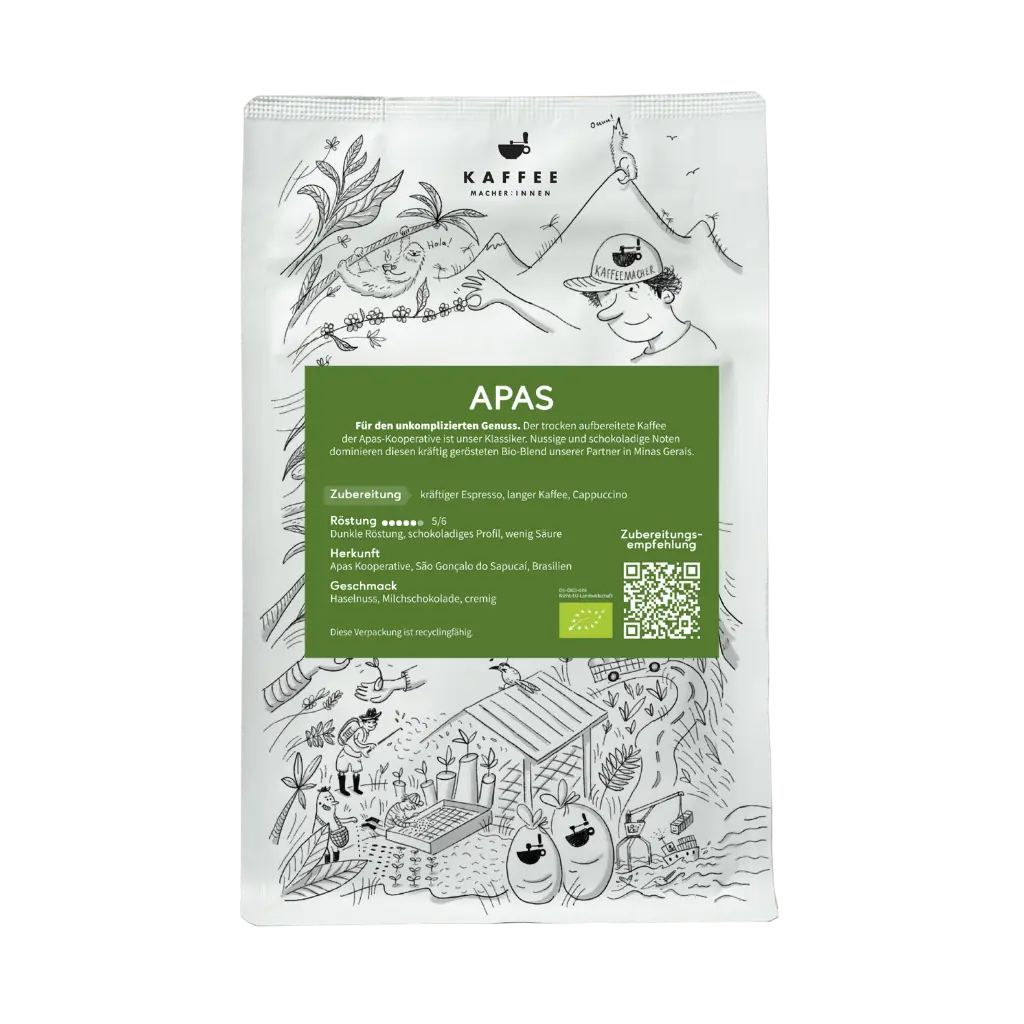
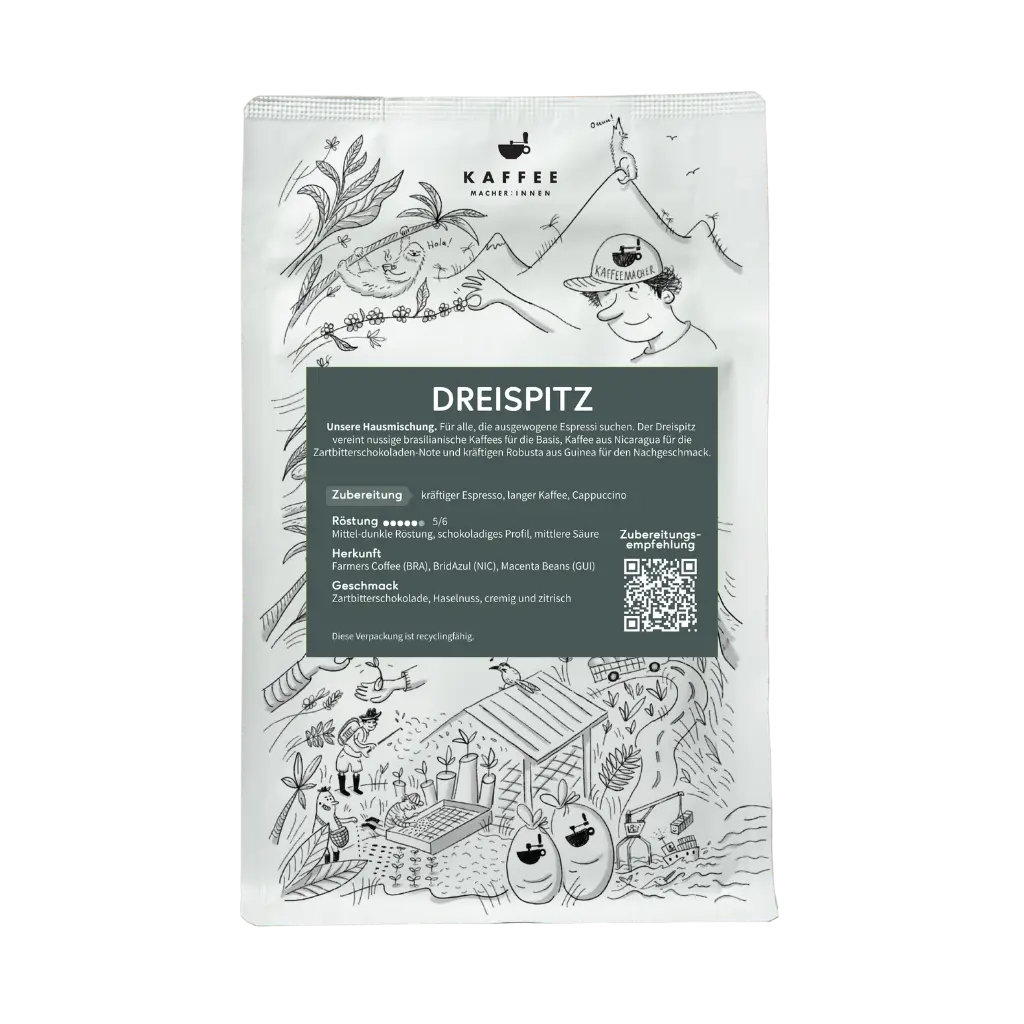
First, I tested the grinder. Afterwards, the professional barista and vice-barista champion Michel Aeschbacher worked with the grinder. Although we brewed espresso, none of it truly convinced us. To rule out that the taste result was limited by the espresso machine, we worked with a professional espresso machine as expensive as a small car (La Marzocco GS3/Cimbali M100). The espresso was our standard Dreispitz coffee, which we serve in our Kaffeemacher Café at Basel train station.
The espresso was both bitter and had a higher proportion of aggressive acidity. We brewed the espresso with a classic brewing ratio of 1:2.5. 18 grams of coffee in the portafilter yielded two espressos, each weighing 22.5 grams, with a brewing time of 25 seconds.
To verify the result, we compared the espresso with the same parameters using three other grinders (Sage Smart Grinder Pro, Eureka Mignon Perfetto, Niche Zero) in a triangle test. In the triangle test, 3 cups are compared at a time. Two of these cups are identical in taste, and one is different. The differing cup is marked from below, invisible to the taster.

The subject's task is to find the different cup each time. In this case, we doubled the test series and posed the additional task of stating which cup tasted worse.
Across all 6 sets, I consistently found the differing cup and selected the worse-tasting ones as the extractions from the Graef CM 800.
But why does the Graef CM 800 struggle to keep up with the other grinders in terms of taste?
Grind Particle Distribution as a Reason for Bad Espresso
The assumption was that the distribution of particle sizes in the ground coffee is highly variable. Every coffee grinder has a scattering of particles of various sizes. This is also true for the Graef CM 800. The only question was how pronounced the number of different sizes is. The better a grinder, the greater the number of particle sizes in the desired range. If many fine particles and, especially, many coarse particles are present alongside the main peak, they extract differently than the desired particle size.
 Depending on the particle size, it is easier or harder for the brewing water to effectively extract the grounds. Finer particles extract much easier than coarse particles.
With small particles, it is much easier for the brewing water to penetrate the coffee bean and dissolve everything. With coarser particles, the effort is significantly greater, and only a small extraction is achieved.
So, we are talking about under- and over-extraction on a macroscopic level here! It's not about whether a whole cup of coffee tastes over- or under-extracted, but rather how many particles in total are well-extracted. The fewer particles that have the same size, the more we have under- and over-extracted coffee particles. Under-extracted tastes sour, over-extracted tastes bitter. Haven't we written that before today? Exactly, further up in the taste description of the espresso we brewed with the Graef CM800.
 Particle distribution of the Graef CM800 The curve above illustrates the particle size distribution curve of the Graef CM 800. The X-axis shows the particle size in microns, and the Y-axis shows the volume of the corresponding size in percent. It is typical for a grinder to have a distributed curve. Usually, this manifests in two main peaks – a fine one and a coarser one.
Before we go into more detail about the curve, a quick note on our further procedure. In our coffee academy, we do not have the possibility to perform particle analysis by image or laser analysis. These devices are incredibly expensive, in the six-figure range. However, there is a simpler method, namely a laboratory sieve. Michel Aeschbacher used two micron sieves of 800 and 400 size to examine the proportion of the finest and coarsest particles.
He put 50 grams on the sieves. His result was as follows:
- 19.06 grams – Coarser than 800 microns
- 20.69 grams – Coarser than 400 microns and finer than 800 microns
- 8.28 grams – Finer than 400 microns
The rest got stuck somewhere in the sieve. But the numbers already make it clear. The typical espresso peak is somewhere between 300 and 600 microns. With the Graef, there is still quite a lot that is coarser. Some particles are really as big as sugar grains. While fine particles definitely have a role to play in espresso extraction – coarse grains are a real problem. Fine particles sit between the larger ones and help to build up enough resistance.(1) Coarse particles cannot be successfully extracted in the short brewing time of espresso extraction (approx. 25 seconds) and therefore contribute significantly to an unpleasant under-extraction acidity. In addition, they facilitate channeling, as they make a compact coffee bed more difficult.
 Front left coarser than 800, right between 400 and 800 and back finer than 400. Espresso extraction time: 25 seconds, 50 grams.
Grind Analysis via Laser and Image Acquisition
After the sieve test, we wanted to have our results externally verified. Coffee professional and roaster Benjamin Schütz helped us with this.(2) I also spent a day with the company Symphatec and compared very different grinders and grinds. This helped me to better understand the specific surface area of ground coffee.
I adjusted the espresso on six grinders so that it produced an end weight of 50 grams in the cup in as close to 25 seconds as possible, using 18 grams of coffee. At this grind setting, I ground 200 grams of coffee as a sample from the following grinders.
Anfim Practica as a professional benchmark, Eureka Mignon Perfetto, Macap M2D, Sage Smart Grinder Pro, Sette 270wi, Graef CM800.
The grind analysis showed the following picture:
 Comparison of particle distribution of 6 espresso grinders.
May be used with a link to this article.
This image clearly shows that the Graef CM800 (dark blue) has the lowest peak of all tested grinders. It is also the widest and, together with the Sette 270wi, has the largest proportion of coarse particles.
This visual representation explains quite well what we experienced sensorially with the grinder. The extraction measurements in comparison also underscore the low extraction evaluation.
Lowest Strength and Extraction Evaluation with the Graef CM800
With the values mentioned above, I set the espresso, took the grind samples, and of course also made a comparison of the strength and extraction.
Strength is the concentration of dissolved particles and is expressed in TDS% (total dissolved solids). Strength can be measured with a refractometer .
Knowing the strength, the extraction can be calculated based on the amount of coffee used and the weighed amount of espresso (volume of espresso in grams * TDS % / amount of coffee powder used).
I came to the following results:
| Grinder Name | Powder Amount | Time | Volume/g | TDS | Extraction |
| Sage Smart Grinder Pro | 18.00 | 24.50 | 49.8 | 7.50% | 20.75% |
| Graef CM 800 | 18.00 | 25.50 | 49.6 | 6.52% | 17.97% |
| Eureka Mignon Perfetto | 18.00 | 25.50 | 49.8 | 7.10% | 19.64% |
| Macap M2D | 18.00 | 24.50 | 49.6 | 7.64% | 21.05% |
| Sette 270 | 18.00 | 25.00 | 49.4 | 6.95% | 19.07% |
| Anfim Practica | 18.00 | 24.50 | 49.2 | 7.88% | 21.54% |
The Graef CM 800 shows the lowest strength and extraction. This also corresponds to the sensory description I found during the tasting. The low strength manifests sensorially in the same way: the espresso tastes more watery and less creamy and mouth-filling compared to the other espressos. The lower extraction is expressed in the already described more pronounced acidity.
Grinder Test 2022 - Graef CM800 Under the Magnifying Glass Again
As part of our current espresso grinder test series, we returned to the lab with seven grind samples of the Graef CM800. The result confirmed our previous measurement. Across all 24 espresso grinders, the Graef CM800 has the third widest coarse peak and a correspondingly lower peak. This is an expression of the large spread and shows how difficult the Graef finds it to precisely grind coffee particles.

The difficulty in handling the Graef is also evident in another category. In principle, the particle size distribution curve shown above depicts the same grind setting four times. However, the grind settings effectively differ significantly each time.
The following list reflects the data that leads to the graph shown above. In all four key measurements, the numbers jump from one reading to the next.

In the context of all other grinds, the following graphic also shows that the Graef CM800 falls behind the better grinders.

Operation and Grind Adjustment of the Graef CM800
So far, I have extensively described the results of the grinder, but have not yet touched on the grind adjustment. This is a very important function, as the grind setting also allows for controlling the extraction time of the espresso. The finer the grind, the greater the resistance for the brewing water and the longer the espresso runs accordingly. The coarser the grind, the faster the water shoots through the coffee grounds and the faster the espresso is in the cup.
 Grind adjustment of the Graef CM800
The Graef CM800 has a grind adjustment from 0 to 40. This doesn't mean much at first. The central question is how much the grind can actually be adjusted with it. The external adjustment is very easy to make and can be done by any user without further ado.
However, we had the problem that we couldn't achieve an acceptable result with the 40 settings. Our espresso ran through in 12 seconds even on the finest grind setting. This can be due, for example, to lighter roasted coffee or coffee with a different density due to its altitude. In any case, the espresso ran through much too quickly.
The solution is to adjust the inner burr setting finer. To do this, the grinder must be opened. Then, two small screws can be removed from the upper burr insert, and it can be set finer or coarser. It's best to watch our video for this.

Otherwise, what happened to us during the first adjustments will happen to you. If you don't reinsert the burr holder correctly, the grinder will not only not implement your desired adjustment – it will be operating at a completely different level (much coarser).
We couldn't make sense of the instructions themselves. A YouTube video from Graef itself then clarified the function for us. We think: the whole adjustment of the grinder is really a no-go. The external adjustment option is easy to use. But if you don't happen to land exactly in this range, then the screwdriver work begins.
This is really not well designed at all. Other devices, such as the Sage Barista Express, sometimes require readjusting the grinder. But that can be done without a screwdriver, and above all, inserting the cone is self-explanatory.
In any case, our mood was not exhilarating after adjusting the grinder, and we have really adjusted many grinders before. For these reasons, we do not recommend these grinders to anyone who is new to making espresso. The potential for frustration is too great from our point of view. We opened and unscrewed the grinder a total of 4 times until we were satisfied with the basic adjustment of the grind size.
The Graef CM has an on/off button and then grinds continuously. The grinding time cannot be programmed. Therefore, the ground coffee must be weighed manually.

"Dead space" for coffee powder
Many other reviews also address this point – but for us, it's almost secondary to the ones mentioned above. Dead space is the coffee powder that is not dispensed after grinding. It accumulates at the exit of a grinder and is only pushed out by the coffee powder pushing from behind during the next grinding.
This powder is then not fresh and thus affects the taste. Depending on how long ago the last grinding was, the coffee then tastes of slight aging notes.
Due to its relatively large spout in the dispensing area, the Graef CM 800 has a large dead space. Depending on the grind size, up to 8 grams of coffee powder accumulated there (the finer the more). This can also lead to uneven extraction.
However, by vigorously tapping the grinder, the coffee can be removed from the dead space before or after grinding.

Conclusion on the Graef CM800 and for whom is this grinder?
As already mentioned at the beginning: the Graef CM800 grinds espresso-fine. No other grinder achieves that for the price. That is the biggest pro of the small grinder. But it is a problematic grinder for beginners.
If the preset external grind size range does not match the coffee beans you are using, then adjusting the grinder becomes very time-consuming. If you like to try different beans, then good night.
You can make espresso with the Graef CM 800. Compared to other grinders and what the coffee beans we tried can do, the grinder clearly does not unleash the potential of the coffees.
Especially for high-quality, more complex coffees, we tend not to recommend this grinder. These already bring a relatively high acidity with them, which is further intensified by under-extraction acidity.
Due to its price, the Graef CM800 is the logical counterpart to the Delonghi Dedica EC 685, which many use as an entry-level espresso machine. Of course, espresso can be made in combination. But we predict a difficult relationship, because neither partner really provides support.
Especially if you are new to the espresso world, it is important that your equipment fulfills its task. Only then can you be sure that you have done everything correctly. For this reason, we recommend a grinder that runs solidly and reliably, especially in combination with an espresso machine like the Dedica EC 685.
Footnotes:
1) In modern espresso preparation, fines are sometimes deliberately omitted, and instead, a higher main peak is used. However, this also requires fewer boulders.
2) Many thanks at this point to the company UCC, whose device Benjamin was allowed to use for the analysis.