








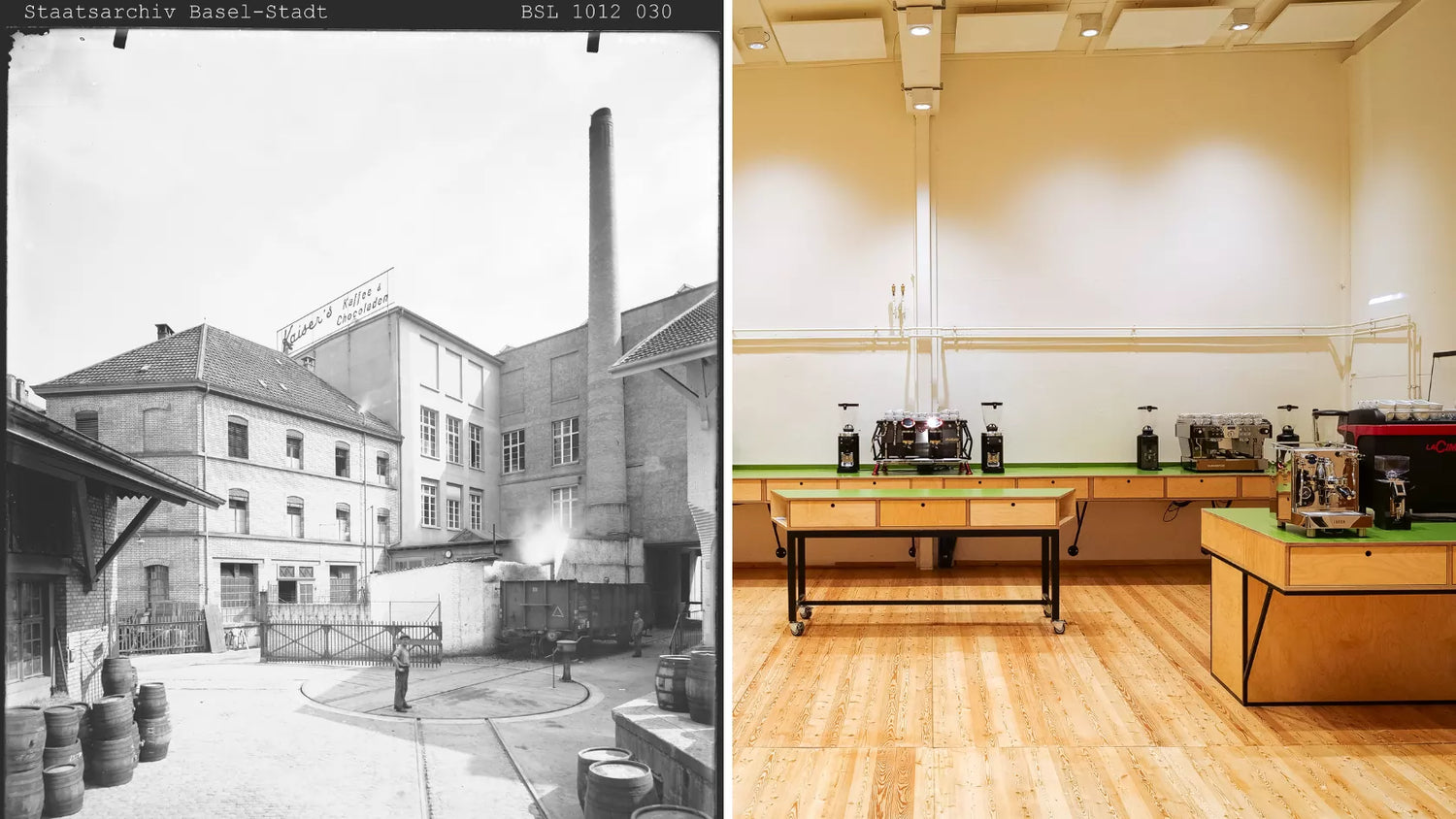

A new era begins for us. Since January 1st, we, Kaffeemacher:innen, have made our home in the Haus des Kaffees in Basel. On over 700 square meters, we roast coffee, introduce the intricacies of preparation, and test coffee machines and accessories.
The Haus des Kaffees is our new company headquarters and the platform where we want to further develop ourselves as a company and, at the same time, provide impetus to the coffee market. With this building, we are connecting to the eventful history of Güterstrasse. As early as 1940, a roastery was located at number 140 for the first time. Production was for the Berlin company Kaiser's Kaffee Geschäft, which already supplied 2000 branches at the beginning of the 19th century. Coffee was roasted in Viersen, Dülken, Spandau, Breslau, Heilbronn, and indeed Basel. In 2001, Kaiser's Kaffee Geschäft merged with the Tengelmann Group and now operates as Kaiser's Tengelmann AG.

However, that's music from the past. Most recently, the house on Güterstrasse was revitalized as a place of activity, training, and dance studio by jazz legend Othella Dallas. The Grand Old Lady of Jazz passed away in 2020 at the age of 95, but was active in Basel until the very end. From 2000, the back building on Güterstrasse, not far from the main train station, was the Rudolf Steiner Upper Secondary School for "School and Work," but its use has steadily decreased recently.
Kaffeemacher:innen through time
As Kaffeemacher:innen, since our founding as the "Kaffee-Akademie" project, we have strived for one goal: to improve the sensory coffee quality in the cup. For this, we offer training for gastronomy and private individuals and connect the coffee cultivation process from cultivation to the cup. We are convinced that better coffee helps coffee drinkers at the end of the chain to be more willing to pay a higher price for coffee. This, in turn, benefits producers in the growing countries if the funds flow as directly or transparently as possible. We are committed to this as a platform, training, and network company.
Better quality in the cup is influenced by further factors. In particular, the sustainable ecological orientation of the coffee farms, as well as social interaction and secure jobs, are essential factors to achieve quality from a holistic perspective.

Benjamin visiting our partners at 18 Conejo in Honduras. Together with Napo and Flhor, we started an experiment with organically grown Robusta.
In this sense, our company has evolved. The Kaffee-Akademie started as a project within "unternehmen mitte" in Basel. With Café frühling, we founded Switzerland's first café focused on specialty coffee and "slow coffee" in 2013. The academy and coffee school were then housed in the small adjoining room of Café frühling. In 2015, the course frequency and usage outgrew the space and found a new starting point at Emil-Frey-Strasse 77 in Münchenstein, opposite Schaulager.
In 2017, we transferred the Café frühling and Kaffee-Schule projects to the newly founded Kaffeemacher GmbH and detached ourselves from unternehmen mitte in Basel. Development has accelerated since then and the impulse has concretized. Already in the statutes of the new Social Business, we stipulated that we wanted to fully realize the connection of the coffee chain within the company. With the roasteries spring roasters and in the name of, we started with two different roasting impulses, which were reunited under the Kaffeemacher brand at the beginning of 2019. Today, we sell Kaffeemacher:innen coffee in Switzerland and Germany and work as contract roasters for many cafés and companies in the background (in the name of).
In the summer of 2017, the circle closed, and we became co-owners of a coffee farm in Nicaragua. Santa Rita is located in northern Nicaragua, in Tablazon, Dipilto, about 30 km from Ocotal.
Haus des Kaffees as a platform for the transformation of the coffee market
The Haus des Kaffees is our starting platform to move the coffee market. For us, Güterstrasse 140 is not just the place where our company has arrived. It is also intended as a platform to bring together people from the coffee industry who want to work on making the coffee chain fairer, more social, more ecological, and more sustainable.
And our perspective ranges from sensory to chemical, from economic to social to political questions. We take a stand, report on our perspectives in the blog, on YouTube, and in the podcast.


The roastery then (above) still in the basement and today (below).


Back then, the roastery had an advantage. The train could pull up. The old chimney seen here is now back in use. Thanks to its height, odors and smoke are carried far beyond the residential buildings after being catalyzed with Reicat cleaning technology.

Photomontage showing the front view from Güterstrasse. Source: Staatsarchiv BS