





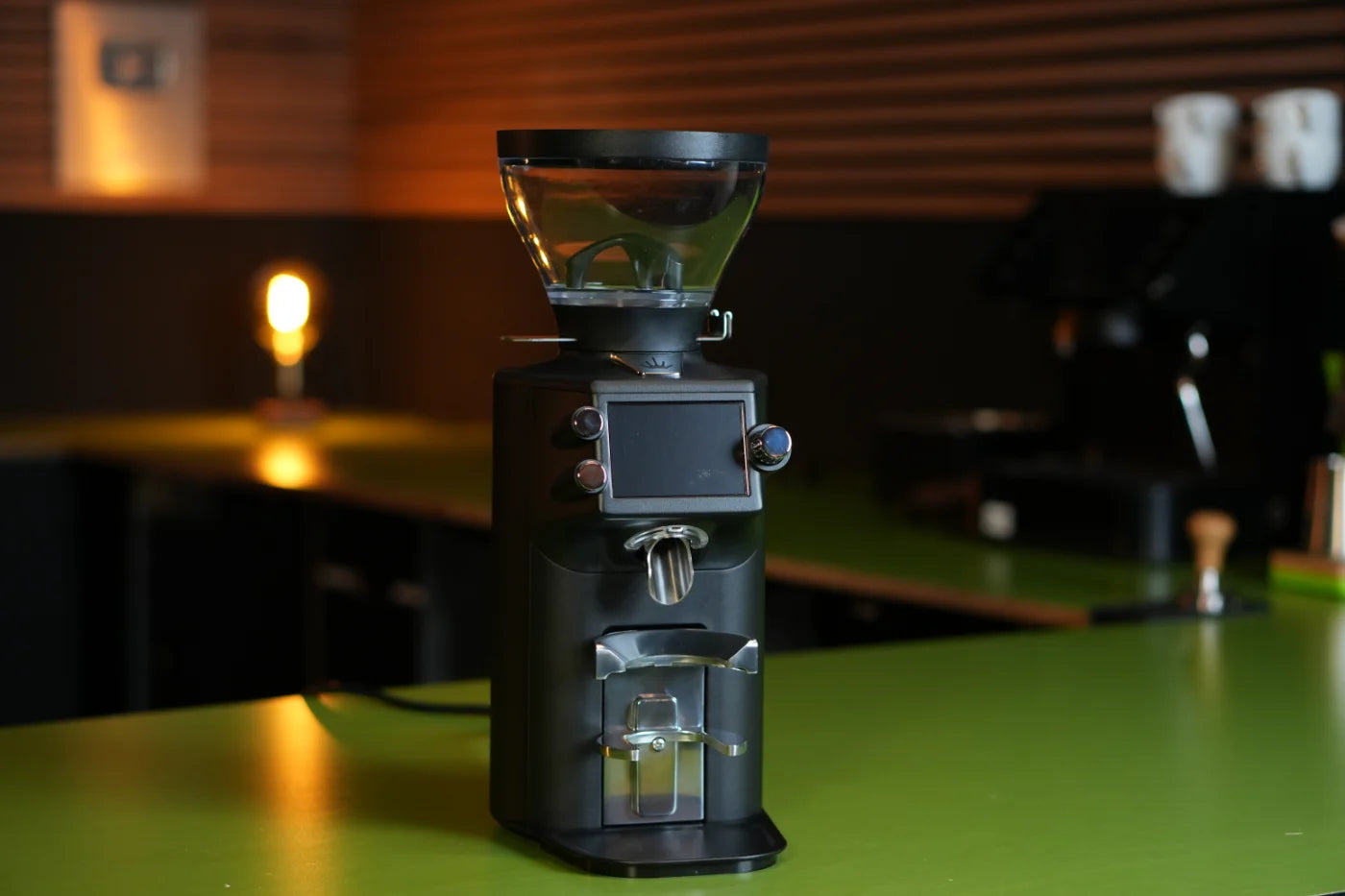

Mahlkönig packs the technology of its commercial E65S grinder into a compact housing for the home—complete with Grind-by-Weight, electronic grind size adjustment in micron steps, and a portafilter recognition system that is otherwise nonexistent in this price bracket. The E64 WS costs €999, is manufactured in China, and shares its grinding chamber with the well-known Mahlkönig SD64. We purchased the grinder and tested it across several iterations.
By now, the third unit of the Mahlkönig E64 WS is sitting on our test bench. Slowly but surely, the potential of this compact grinder is showing. Unit number three is shaping up to become the most interesting entry-level espresso grinder for home use if you are looking to invest €1,000 and if all of its features truly match your workflow.
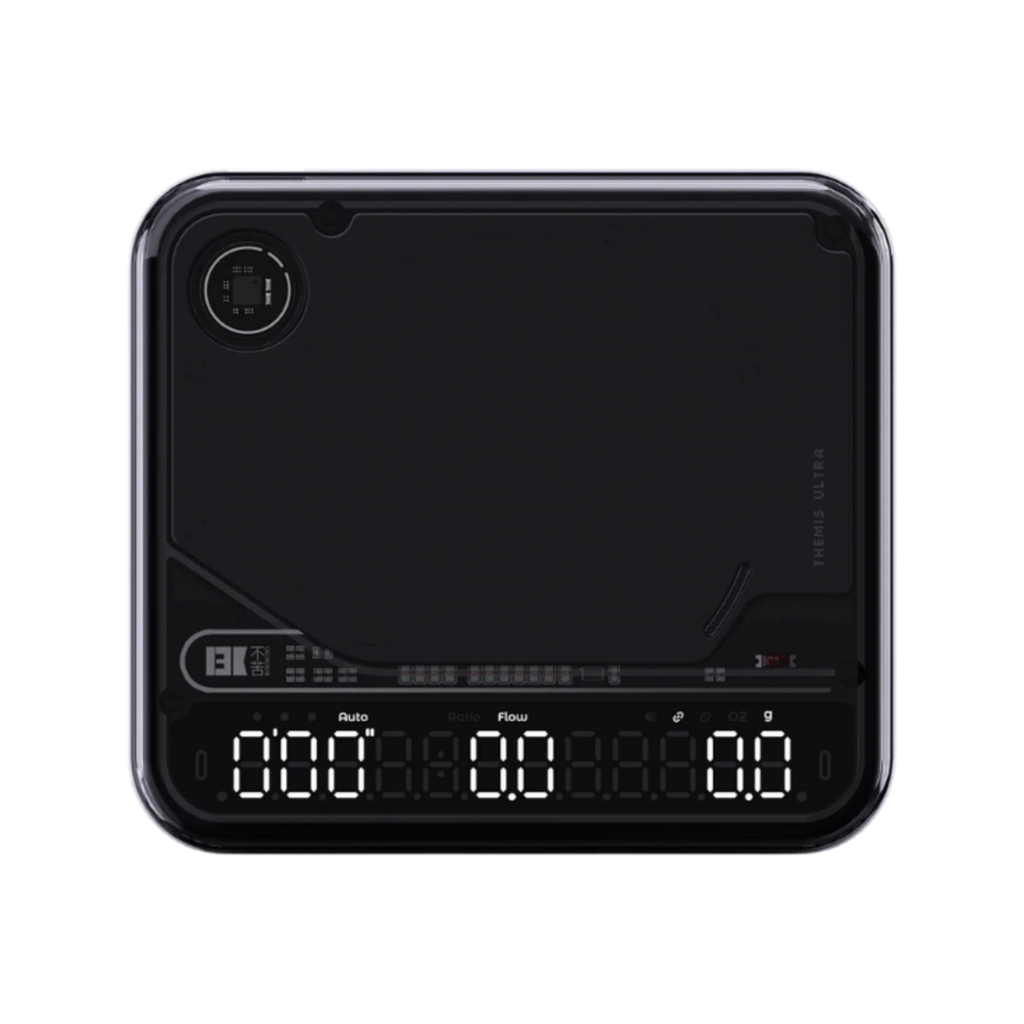
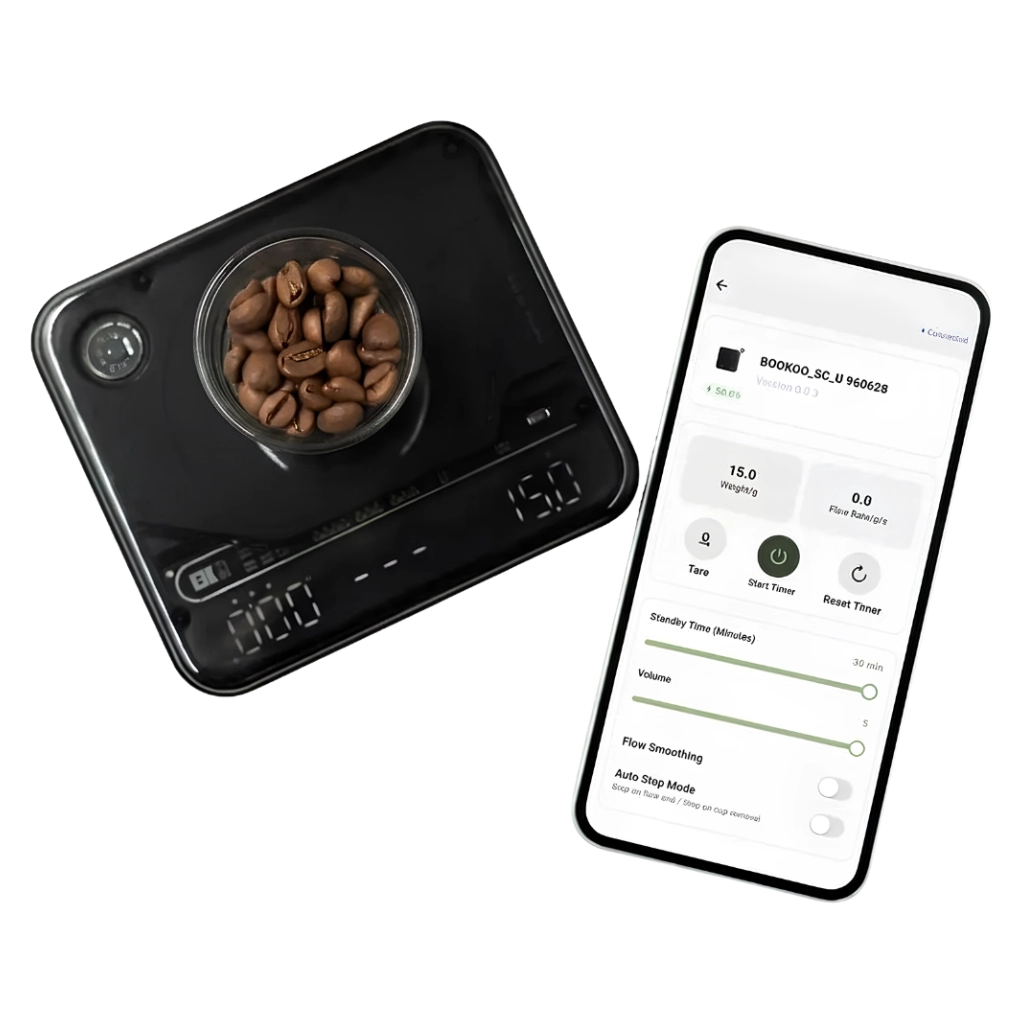
A quick note: we tested the grinder both standalone and synchronized with the Mahlkönig Sync Scale. In the future, we will also take a closer look at its synchronization with the Mahlkönig Xenia.

🛠️Recommended Specialist Workshop for the Mahlkönig E64 WS: Stoll Espresso: [Affiliate Link]
We recommend specialist retail partners who we know deliver solid work and reliable customer service. When ordering via our affiliate links, you pay no extra, but we receive a small commission that we invest directly into new lab testing equipment.
Design & Build Quality
The E64 WS weighs nearly 6 kg, stands 39 cm tall, and sits firmly on the countertop. The housing feels solid, and the portafilter fork is high-grade and has been redesigned compared to the earliest production runs. The bean hopper holds 250 g.
What stands out negatively: the control buttons feel slightly flimsy, particularly when compared to what we have seen on other grinders in this price category. Furthermore, the chute—which should be a highlight because it is height-adjustable—still tends to slide down slightly at its highest position. It is better than on the initial units, but not yet flawless.
An essential point: the original de-clumper (flapper) shipped with the first deliveries is inadequate. Static electricity was severe, spraying coffee grounds in every direction. Mahlkönig now supplies a redesigned metal flapper—be sure to request one from your dealer if you own an earlier batch. On newer shipments, the updated flapper comes installed as standard. With this new flapper, the grinder enters a completely different league: clean, fluffy, powder-like grounds with minimal clumping. Without it, clean workflow is virtually impossible.
Grinding Mechanism & Technology
The core engine: 64 mm flat burrs—sharing the exact same grinding chamber as the Mahlkönig SD64. There is no RPM control; the motor operates at a fixed idle speed of around 1,950 RPM.
What sets the E64 WS apart from every other grinder in this price segment is its electronic grind adjustment. There is no dial, no collar—everything runs internally via a motorized mechanism controlled from the display screen. Adjustments are made in microns, and the precision is impressive: a single micron change yields hardly a second of difference in shot time.
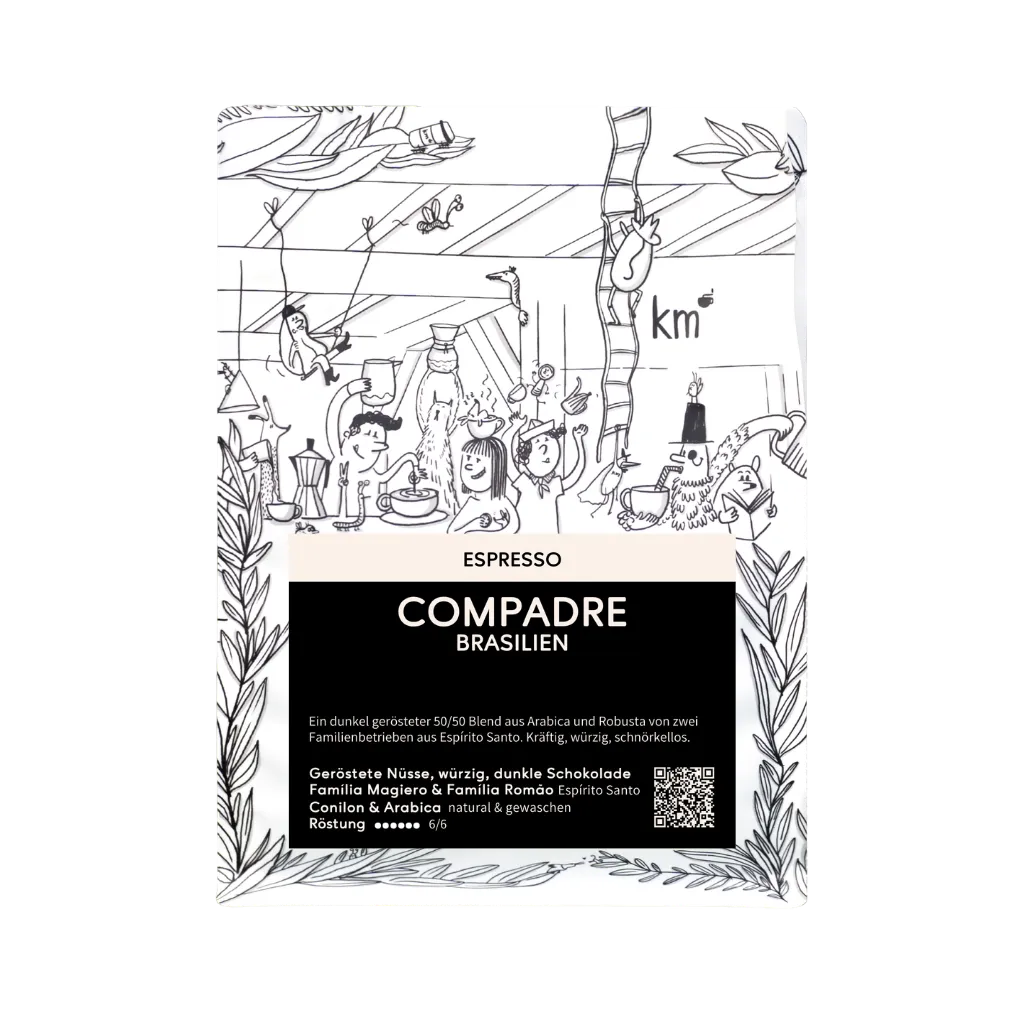
We recommend performing a zero-point calibration immediately after unboxing. Under "Maintenance" in the menu, you bring the burrs together until you hear the touch point, then set zero. Once calibrated, all E64 WS units operate within comparable micron ranges—enabling us as roasters to provide concrete grind size recommendations that you can use as a direct starting point. For instance, we dialed in our Compadre roast at 95 microns. You should easily find your sweet spot within +/- 10 microns of that value.
Grind-by-Weight & Guided Dial-In
The E64 WS is a gravimetric grinder: hang your portafilter on the fork, the built-in scale tares, and the grinder dispenses until it reaches the set target weight. No fiddling with timers, no weight shifts due to adjusted grind sizes. This is the primary advantage over time-based grinders and the reason why we consider this category to be the future of home espresso. It makes dialing in a true pleasure.
The portafilter detection feature deserves special praise: you can save multiple portafilters, and the grinder recognizes which one is inserted by its tare weight, automatically adjusting the recipe. No other Grind-by-Weight grinder in this price class offers this. It is incredibly convenient if you alternate between single and double portafilters.
The Guided Dial-In feature was what we were most curious to test. You enter whether your coffee is light, medium, or dark roast, set your target brew weight and time—and the grinder adjusts its setting automatically. You tell it how long the shot actually ran, and the grinder corrects its micron setting accordingly.
Our result: within two to three test shots, we hit our target range on every coffee we tried. That is impressive. Particularly clever: the grinder anticipates its own retention (exchange). It knows that after a grind size adjustment, a small portion of ground coffee from the previous setting remains inside the chamber, and it compensates proactively.
However—and this is a significant caveat—there are currently software limitations: you cannot set a brew weight of less than 40 g for a double shot. That poses a challenge for anyone pulling 1:2 ratios on 18 g doses (36 g in the cup). Additionally, the dose input is capped at a maximum of 19 g—so if you use a 21 g basket, you are out of luck for now. Mahlkönig has announced that software updates will address these issues. Over-the-air updates are supported, which is the good news.
Grind Speed & Noise Levels
27.3 g in 10 seconds—a moderate grinding speed. For an 18 g dose, the grinder takes 7.5 seconds, which is fast and feels effortless in daily use.
During operation, we measured a noise level of 85.1 dB(A). That sits in the upper-middle range—clearly audible, though not annoyingly shrill. For context: a vacuum cleaner runs around 80 dB, and the E64 WS sits just above that. It is acceptable for a morning kitchen setup, but if you are sensitive to noise, you will notice it.
Grind Temperature & Consistency
After five consecutive grinding cycles (18 g each, with a 20-second pause between runs), we measured an average grounds temperature of 32.52 °C. That is a solid result—no thermal stress, and zero thermal degradation even during back-to-back shot preparations.
We recorded a standard deviation of 0.067 g across dose consistency measurements. That is outstanding. The scale operates with high precision: 18.0 – 18.1 – 18.0 – 18.1 – 18.2 g. For a Grind-by-Weight grinder, this is precisely what we expect. Here, the commercial DNA inherited from the E65S shines through.
Retention
The absolute retention measures 4.1 g in total—consisting of 3.8 g of exchange (temporary retention) and only 0.3 g of true permanent retention. The low permanent retention is a big positive: hardly any stale coffee remains permanently caked inside the grinding chamber.
However, 3.8 g of temporary retention (exchange) is noticeable for home use. On an 18 g dose, that represents over 20% of your dose that is one generation older than the freshly ground beans. When you pull your first espresso in the morning after an overnight pause, those 3.8 g have been sitting in the chamber since yesterday. And you can taste it in the cup.
For comparison: grinders like the Zuriga or the Acaia Orbit have exchange values between 0.5 and 0.7 g. The Fiorenzato Allground sits around 6 g. The E64 WS falls right in the middle—not disastrous, but certainly not a standout benchmark. Retention becomes particularly relevant in combination with the Grind-by-Sync feature: the grinder is designed to adjust automatically even after hours of idle time. But if nearly 4 g of grounds from the previous setting remain trapped in the chamber without being purged, automatic compensation becomes trickier. The software manages this surprisingly well—but lower retention would make its job much easier.
Single-Dosing Performance
The E64 WS is not a single-dosing grinder. It is designed as a hopper-fed, Grind-by-Weight machine. The 3.8 g dose discrepancy observed when feeding a single 18 g dose directly corresponds to its temporary retention—the grinder simply does not discharge everything that enters the top in a single run. That is an inherent structural trait, not a defect.
If you wish to switch between different coffee beans regularly, you will need to purge about 4 g between changes. It is doable, but far less convenient than on a dedicated single-dosing grinder.

Particle Size Distribution
We analyze particle size distribution in cooperation with ZHAW (Zurich University of Applied Sciences) using the Retsch Camsizer X2.
The E64 WS shares its grinding chamber with the Mahlkönig SD64—yet the distribution curves differ. The reason: bean column weight in the hopper and the influence of the flapper. In hopper mode, the weight of the bean column pushes the coffee through the burrs differently than in single-dosing mode, where only 18 g fed without weight pressing down from above. We observe this exact phenomenon on commercial grinders like the E65S and E80: when the hopper runs nearly empty, extraction dynamics shift.
Espresso Setting (T4):
x50: 289.8 µm
Fines Fraction (Qf <100 µm): 32.2 %
60% Peak Width: 265.4 µm
For comparison—the SD64 operating in single-dosing mode at setting T4 yields a main peak width of 209 µm. The E64 WS, at 265 µm, produces a noticeably broader distribution. The fines fraction is similarly high at 32%, providing body and mouthfeel—but the broader main peak results in a somewhat less uniform extraction profile.
What does this mean in the cup? The E64 WS showcases its strengths with medium to dark roasts: full-bodied, rich, with well-integrated sweetness. For these roast styles, the particle distribution is well suited. However, if you are seeking maximum clarity, acidity definition, and transparency in light specialty roasts, the SD64 offers a tighter, more unimodal grind profile. For the target audience of the E64 WS—home baristas seeking automated assistance features to simplify workflow—this is rarely an issue. Most coffees paired with this grinder will fall into the medium roast spectrum, where it performs very well.
Grind Size Reproducibility
During our adjustment reproducibility test: Espresso (T4), Ristretto (T5), Lungo (T6), and back to Espresso (T7). The grinder was visually reset to the exact initial baseline mark of T4.
The x50 value deviated between T4 and T7 by approximately 34 µm (289.8 vs. 256.0 µm). Furthermore, the fines fraction shifted from 32% to 35%. That is a larger shift than we would have anticipated from a motorized electronic micron adjustment system. However, as this result represented a single test run, we performed additional real-world verification measurements.
In practical testing with a fixed extraction target, a more nuanced picture emerges: at 95 microns and 27 seconds, the grinder reliably delivered 44–48 ml in the morning. After shifting to 50 microns (Ristretto) and returning to 95 microns, shot yield remained stable. Even after three hours of idle time without adjustments, it delivered 46 ml using the exact same recipe. Only after larger shifts (e.g., jumping to 103 microns and back to 95) did we observe occasional outliers—53 ml instead of the expected 46 ml. By the next consecutive shot, the output settled back into range.
Overall, repeatability is decent, though not quite as rock-solid as one might expect from motorized electronic calibration. On occasion, the micron reading on the display showed a slightly different value after power-cycling the machine, or exhibited minor unexplained variances. It is possible that such a glitch occurred during our laboratory particle size measurement.
With the current software release, this represents a minor weakness. In everyday practice, after making large grind size shifts, it pays off to monitor your first shot and tweak if necessary. For fine-tuning within the espresso range, repeatability poses no real issue.
Software & User Experience
To put it bluntly: the software on the E64 WS is not yet fully mature.
Boot time takes roughly 30 seconds—an eternity when all you want in the morning is your espresso. The touch display exhibits noticeable input lag. On occasion, customized recipe settings saved in memory are not applied properly—for instance, a micron value is assigned on screen, but the motor fails to drive the burrs to that position. That can be frustrating.
The Wi-Fi pairing with the optional scale (Mahlkönig Sync Scale, available for around €200 extra) works, but setting it up was far from seamless: connecting the grinder to Wi-Fi, pairing the scale to Wi-Fi, assigning the scale to the grinder, and selecting the correct scale mode. Mahlkönig provides instructional videos for this, and once configured, it functions as intended. But intuitive it is not.
The scale itself supports several operating modes. If you already own a quality brew scale, the added value is incremental. The automated timer on the scale triggers upon the first drop hitting the cup, not when the pump starts. Consequently, you still need to monitor shot timing manually on your machine. When connected via Sync mode, the scale transmits extraction data back to the grinder, which automatically adjusts its micron setting to compensate for shot time variations on subsequent extractions.
Fortunately, Mahlkönig can deploy over-the-air (OTA) software updates. Most of the current software glitches can be resolved via firmware—which is the encouraging news. But as of today, you are purchasing a product whose software ecosystem is still maturing.
Flavor & Cup Profile
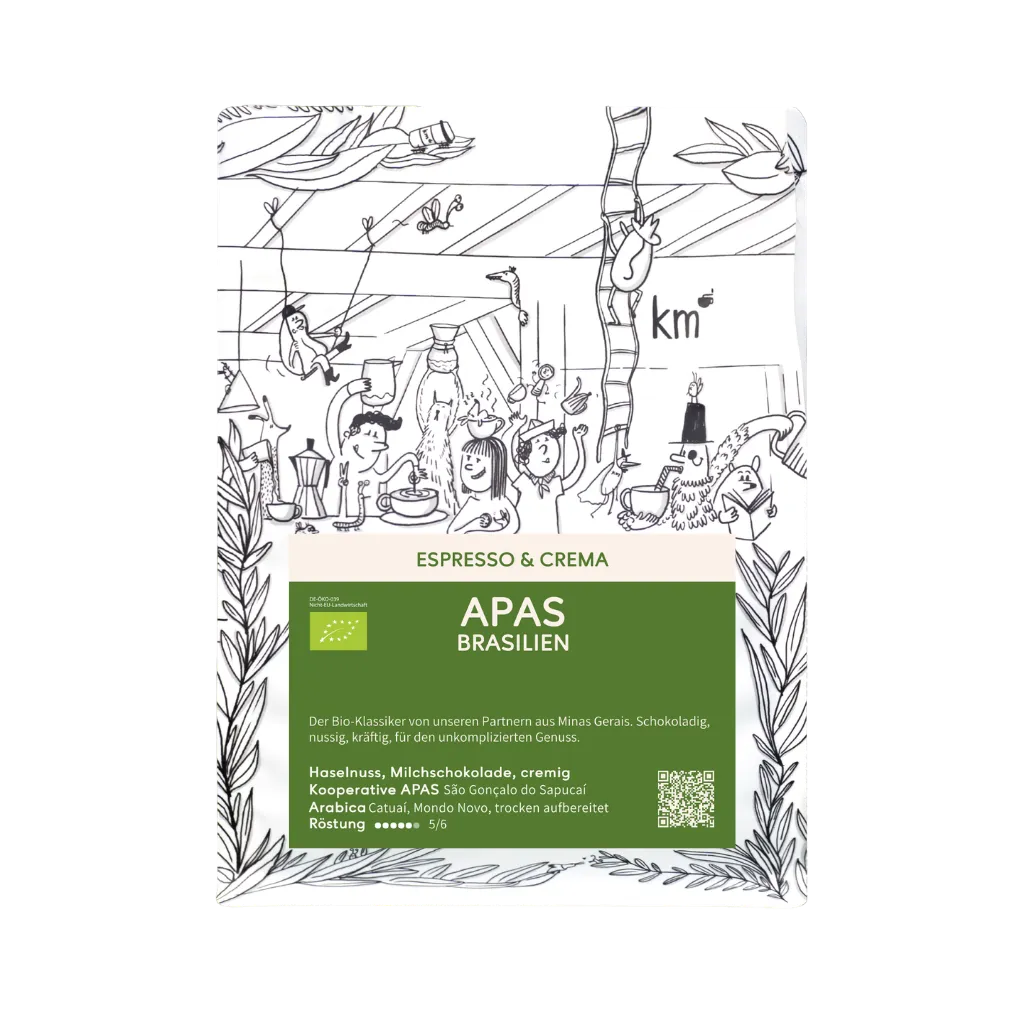
In the cup, the E64 WS delivers on what its particle size profile promises: structured, clean espresso shots with pronounced sweetness and pleasant crema. The versatility of the 64 mm flat burrs shines across a broad spectrum of roasts—from traditional profiles like our Apas Espresso to medium-light specialty roasts, yielding consistently enjoyable results.
Dialing in espresso with the Guided Dial-In feature is surprisingly quick: two to three shots, and your recipe is locked in. That is faster than most home baristas manage manually. Anyone who typically wastes six to eight shots dialing in a new bag of coffee will appreciate this feature immensely.
Conclusion
The Mahlkönig E64 WS is the most feature-packed grinder we have ever tested—and simultaneously one that feels like a work in progress on the software side.
Strengths:
- Motorized electronic grind adjustment in micron steps: precision unmatched in this price class
- Guided Dial-In with an intelligent algorithm that anticipates grind exchange
- Portafilter detection with automatic recipe selection
- Outstanding dosing consistency (0.067 g std. dev.)
- Versatile particle profile suited for medium-dark to medium-light roasts
Weaknesses:
- Software still buggy: input latency, occasionally ignored settings, slow 30-second boot time
- 3.8 g temporary retention—noticeable at home, especially for the first shot after idle periods
- Software-imposed recipe limits (minimum 40 g yield, maximum 19 g dose)
- Inadequate flapper on early production batches (must be retrofitted; now included standard on new units)
- Cumbersome Wi-Fi setup process
Who is it for? For home baristas who want a true Grind-by-Weight workflow and have no interest in manually adjusting dials. It is particularly great for beginners who feel uncertain when dialing in—here, the grinder genuinely takes over the heavy lifting. And for anyone fascinated by Mahlkönig’s vision of a connected setup linking grinder, scale, and espresso machine (Xenia).
Who is it not for? If you want a dedicated single-dosing grinder to switch beans daily, you are far better served by the SD64 or other single-dosing alternatives. If you expect a product that feels 100% polished on day one, you may find the software quirks frustrating. And if you expect flawless tactile refinement down to every last button at €999, the plastic controls reveal where manufacturing costs were trimmed.
Value for Money: At €999, you receive commercial-grade technology scaled down for home use: GbW, motorized micron adjustments, portafilter detection, and OTA updates. No competitor offers this feature set at this price point. The question is how much patience you have for a software platform that is still evolving. We rate its current state at 85%—and would still buy it today.
This grinder will certainly be back on our testing bench. We plan to evaluate its direct integration with the Mahlkönig Xenia and monitor future OTA firmware releases. The underlying hardware potential is undeniably there.
If Mahlkönig delivers on everything it set out to accomplish here, the E64 WS represents an almost unbelievably compelling proposition at this price point. The core promise is assisted brewing: a grinder that guides you step-by-step toward the perfect espresso.
Manufacturers like Maro have pioneered this at the espresso machine level. Mahlkönig is now pushing the same frontier on the grinder side. In terms of overall vision, it is a bold statement that is already very close to where it needs to be.
To see how the E64 WS compares head-to-head with other scale-equipped grinders, check out our Grind-by-Weight comparison featuring seven top models.
Test Results: Mahlkönig E64 WS
Technical Specifications Overview
| Price | €999 (RRP, as of February 2026) |
|---|---|
| Burr Size | 64 mm |
| Burr Type | Flat (parallel) |
| Operating Mode | Hopper (Grind-by-Weight) |
| Grind Speed | 27.3 g / 10 sec (Hopper) / 7.5 sec for 18 g |
| Noise Level | 85.1 dB(A) |
| Grind Temperature | 32.52 °C (Mean, 5 × 18 g) |
| Absolute Retention | 4.1 g (including 3.8 g temporary, 0.3 g permanent) |
| Single Dosing Deviation | 3.8 g (Not a single-dosing grinder) |
| Consistency (Std Dev) | 0.067 g |
| x50 (Espresso T4) | 289.8 µm |
| Fines Fraction Qf <100 µm | 32.2 % |
| 60% Peak Width | 265.4 µm |
| RPM Control | No (fixed ~1,950 RPM idle) |
| Weight | 5.8 kg |
| Dimensions | 39 × 21.8 × 15.4 cm (H × D × W) |
| Bean Hopper Capacity | 250 g |
| Special Features | GbW, Grind-by-Sync (Xenia connection planned), motorized electronic micron grind adjustment, portafilter recognition, Guided Dial-In, OTA updates, Wi-Fi |