



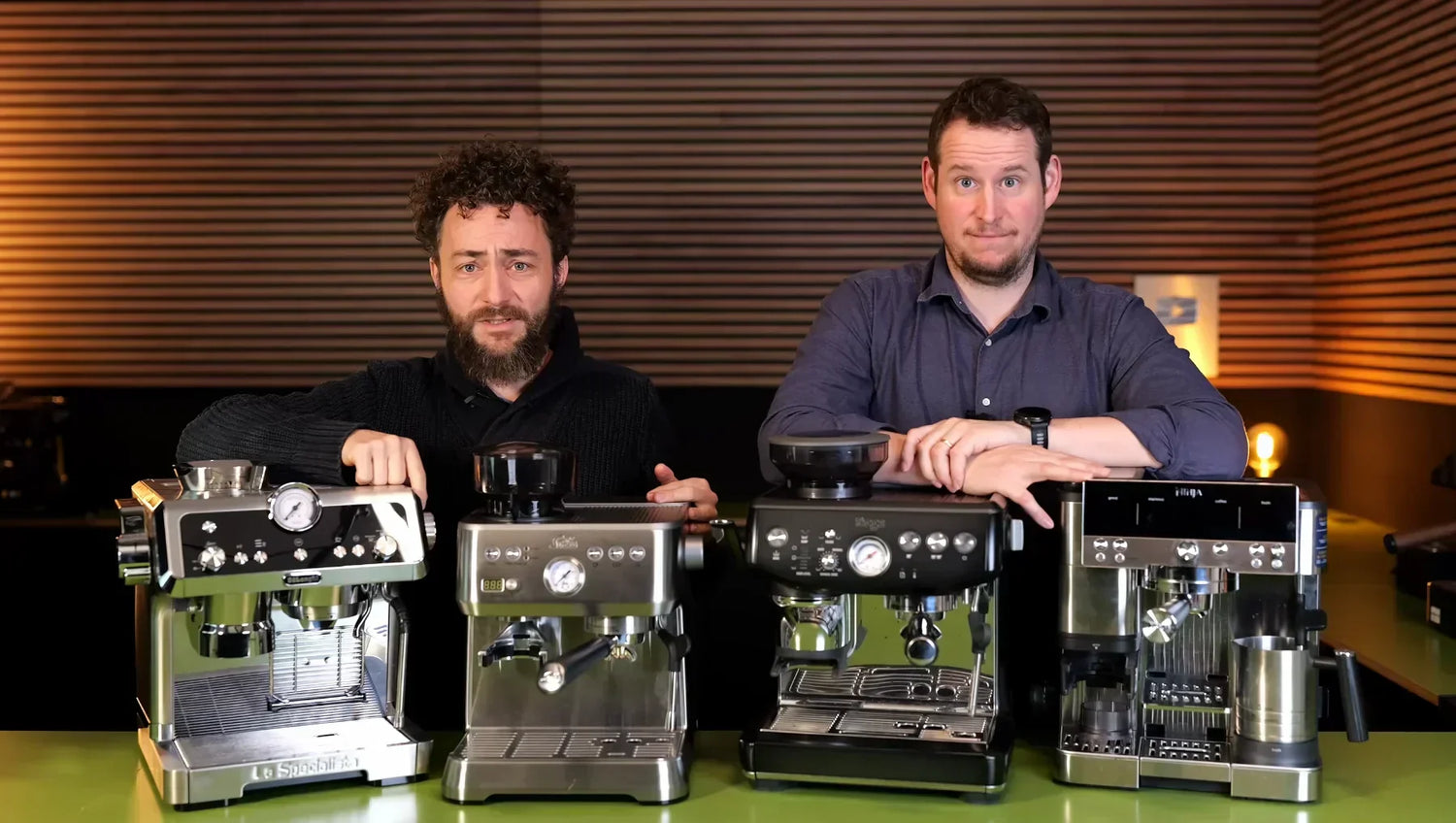

Do not buy an espresso machine with a built-in grinder. At least not without reading this article first.
We call these devices compact machines. A more fitting term would be: compromise machines. And why that is the case is something we have analyzed over years of testing and machine comparisons. Whenever an espresso machine with an integrated grinder lands on our test bench, either the espresso machine or the grinder proves to be a compromise in terms of quality.
What is an espresso machine with a grinder?
The idea sounds good: espresso grinder and espresso machine in one device. Beans in the top, espresso out the bottom, little space taken up on the countertop. Manufacturers like Sage, DeLonghi, Breville, or Lelit offer such combination devices, often for 500 to 1,000 euros.
The problem: Building a grinder and building an espresso machine are two completely different engineering tasks. Espresso machine manufacturers have their expertise in brew groups, boilers, and temperature control. Constructing a grinder that grinds consistently and finely enough for espresso is an entirely different story. And even if manufacturers bring the expertise to the table, there is still the price constraint. If the device is to be brought to market as cheaply as possible, savings are often made somewhere.
The quality compromise: grinder or temperature
In our tests, a pattern has emerged that appears in every one of these machines: Either the temperature is good—i.e., constant at a specified brewing temperature—or the grinder is good. We have not found both together in any compact machine.
Usually, the grinder suffers. Sometimes both the grinder and the temperature suffer. Even when well-known manufacturers have installed a supplier grinder, as with the Meraki Espresso: integrating it into a compact housing brings its own problems.
Why the grinder is almost always the victim
There is a historical reason for this. For decades, the coffee industry said: the machine is the most important thing. Grinders were structurally neglected; there was less research, less development. That has changed in recent years. Today, there are excellent grinders starting at 250 euros. But this progress is often not found in compact machines.
Added to this is a physical problem: a grinder has completely different requirements for humidity and heat than a brew group. If the grinder is located directly next to or above the brew group—and it has to be in a compact device—it works under conditions that harm the coffee. Heat and humidity in the grinding mechanism are the last things you want for consistent espresso.
The repair problem
Compactness has its price, and it shows after three to five years at the latest. In an espresso machine with a grinder, the grinding mechanism, brew group, heating element, and piping are packed into a very tight space. Access to individual components is limited. If the grinder is defective, the entire machine often has to be repaired because the two are interconnected.
With a classic E61 brew group, you can reach every screw. In a compact machine, screws are glued from above, lines are tangled, and components are stacked inside one another. Even if a technician can repair it, the hourly rate is often higher than the remaining value of the device.
That is why compact machines are not 15-year devices. They last for three to five, maybe eight years. A solid, classic espresso machine with replaceable components lasts significantly longer.

The workflow argument doesn't hold up
We often hear: "But the workflow is easier, everything in one device!" Is that true?
Not really. You still need a grinder, a portafilter, and a brew group. The path from the ground coffee into the portafilter and from there into the brew group is the same, regardless of whether the grinder is inside the machine or standing next to it. You still have to distribute the coffee, tamp, and lock it in.
And the cleaning effort? Not any less. The dirt is just in one place instead of two. In return, you have moisture and coffee grounds as combined dirt, which will clog the drip tray faster.
The price argument has become obsolete
500 to 800 euros for a compact machine sounds cheap at first—machine and grinder in one. But the market has changed. Today, you can get very solid single-dosing grinders starting at 250 euros. Add to that a good single-boiler or thermoblock for 300 to 500 euros. The individual components cost about the same together, and each component is better than its counterpart in the compact machine.
A concrete example: A DeLonghi Dedica or a Gaggia Classic as a machine, plus a DF54 or a Varia VS3 as a grinder, barely takes up more space together than a Sage Barista Pro.

When a compact machine still makes sense
We wouldn't be the Kaffeemacher if we didn't also examine the other side.
An honest argument: If you are not yet sure whether portafilter espresso is your path, a compact machine can be an entry point. To try it out, with the option of returning to a fully automatic machine later. But even then, we would say: buy an inexpensive machine and a good grinder. If the portafilter isn't for you, you at least have a grinder that works for mocha, filter coffee, or other preparations.
The only argument we cannot refute: pure compactness. For someone who has exactly 30 centimeters of countertop space and not a millimeter more, an all-in-one device might be the only option. Although a DeLonghi Dedica plus a hand grinder isn't any wider.
Our advice
Individual tests: compact machines
- Review Sage Barista Pro
- Review Sage Barista Touch
- Review Sage Barista Express Impress
- Review Sage Oracle Dual Boiler
- Review Sage Dual Boiler
- Sage Barista Guide: Tips & Questions
- Review Meraki