





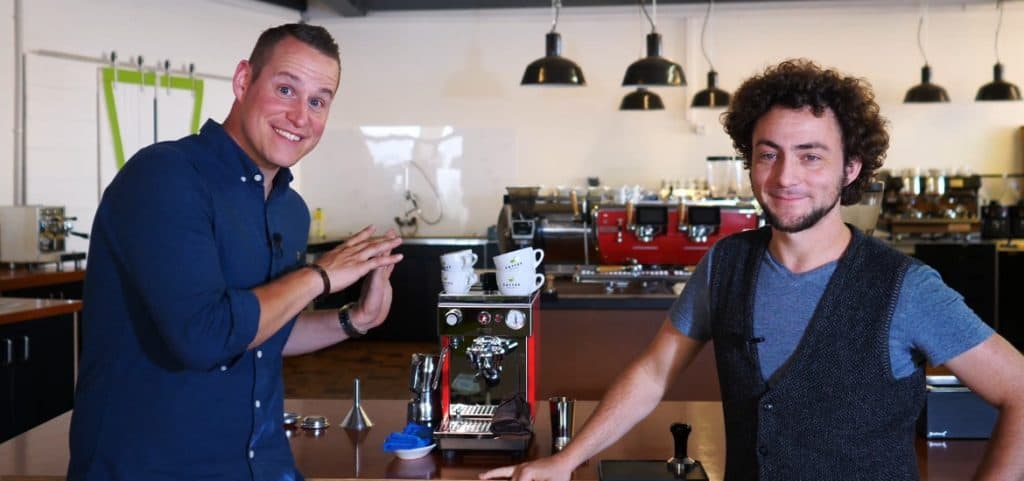
What could be more appealing than a home espresso machine whose 150 components are predominantly produced and assembled "locally"!? We are talking about Olympia Express – a company that has been a pioneer in espresso machine manufacturing in Switzerland for over 80 years.
The company and the brand are cult. The durability is legendary. In fact, there are still machines available that have been dispensing espresso for 30 years. The espresso machine manufacturer, which was acquired by Schätti Metallwarenfabrik AG in Schwanden in 2011, communicates heavily through tradition, materiality, coffee quality, and experience.
We want to focus particularly on these factors in this review. A price comparison is difficult because all other tested heat exchanger espresso machines are produced "differently" and are in a different price range (1200 – 2500 CHF). The Olympia Express Maximatic is available for around 4000 Swiss Francs and is listed in the Euro zone at 3690 Euros, e.g. at Manufactum. This makes the machine the most expensive heat exchanger espresso machine we know of.
In addition to cult status, longevity, and coffee quality, we have some expectations.
Materiality par excellence
How we have cursed un-deburred metal edges and thin "semi-metal" in our heat exchanger reviews over the last few weeks and months! The Olympia Express Maximatic is different! The small heat exchanger is simultaneously one of the heaviest, most robust, and, above all, best-crafted espresso machines. Its dead weight of around 18 kilograms is a statement. Nothing wobbles when locking in the portafilter.
The polished stainless steel of the front and the top section feels twice as thick as the outer skin of the BZ10 from Bezzera. By contrast, the Lelit Mara X feels as soft as a pillow. And the edges are butter-smooth, even on the drip tray, whose punched-out holes would work as a potato grater on almost all other machines we know. The powder-coated side panels also make a good impression. That is a joy!
The stainless steel water tank with a capacity of 1.5 liters is also a joy. These are usually plastic, and of the cheap variety at that. You could probably drive carpenter nails in with the Olympia's water tank.

The Olympia Express Maximatic
The machine is very compact and, at 19.5 cm wide, narrower than an A4 sheet of paper. A depth of 34 cm and a height of 37 cm ensure that the machine fits well into any niche, but also makes a statement when standing alone.
What we really like: the boiler can also be opened from the top. Theoretically, this allows direct access and easier descaling. With classic heat exchangers, we advise against doing this yourself because residues can remain in the boiler and clog the valves. With the Olympia Express Maximatic, this is less of a problem (but be careful, never open it while hot).
Functionality of the Olympia Express Maximatic – Reduced to the essentials
In terms of functionality, the Olympia Express Maximatic is completely reduced to the essentials. Making espresso and steaming milk.
The machine heats up to operating temperature in about 20 minutes. The machine's own brew group heats up well via a thermal bridge to the boiler. This is important so that the brewing temperature in the portafilter does not drop due to a cool ambient temperature. The machine's brewing temperature is constant for individual shots. We measured an average brewing temperature of 93 degrees, with fluctuations of only half a degree up or down. That is exemplary!

The drip tray of the Olympia Express Maximatic is very small.
However, the machine's small boiler (0.75 l) is not made for continuous use. The machine's temperature drops after the fifth consecutive shot at the latest. Since the Olympia Express Maximatic cannot be connected to a permanent water supply, it is not designed for continuous use anyway.
Steaming milk with the Maximatic also works well. Initially, the small boiler built up quite strong pressure, but this dropped significantly during the rolling phase. We therefore recommend only frothing with 0.35l pitchers.
The water draw is started and stopped with a button. Steaming is started via a plastic dial. Unlike most other espresso machines, the Maximatic cannot draw tea water. We didn't really miss this, as we don't recommend the water from the boilers for sensory reasons anyway. However, for quickly preparing an Americano (diluted espresso), a draw option is, of course, practical.
Missed opportunities and what we don't like
Unfortunately, the precision in terms of material selection and workmanship does not extend through all facets of the machine. The fact that the drip tray is small is less significant. But it is impractical that it feels like it makes sense to empty the tray after every 5th espresso. This is because when the extraction ends, the excess water from the lines empties into the tray.

Tamper included with the Olympia Express Maximatic is too small
Olympia describes the steam wand itself as "extra long." We find it "rather short" and, above all, fixed in its angle. This makes steaming and proper positioning difficult. The plastic dial for starting the steaming process also pales in comparison to the rest of the material.
We were genuinely surprised that Olympia Express does not provide a rubber coating over the steam wand. While not beautiful, it allows you to touch the wand. All other machines on the market either have a rubber coating, a plastic handle, or a "cool touch" tube that does not get hot on the outside.
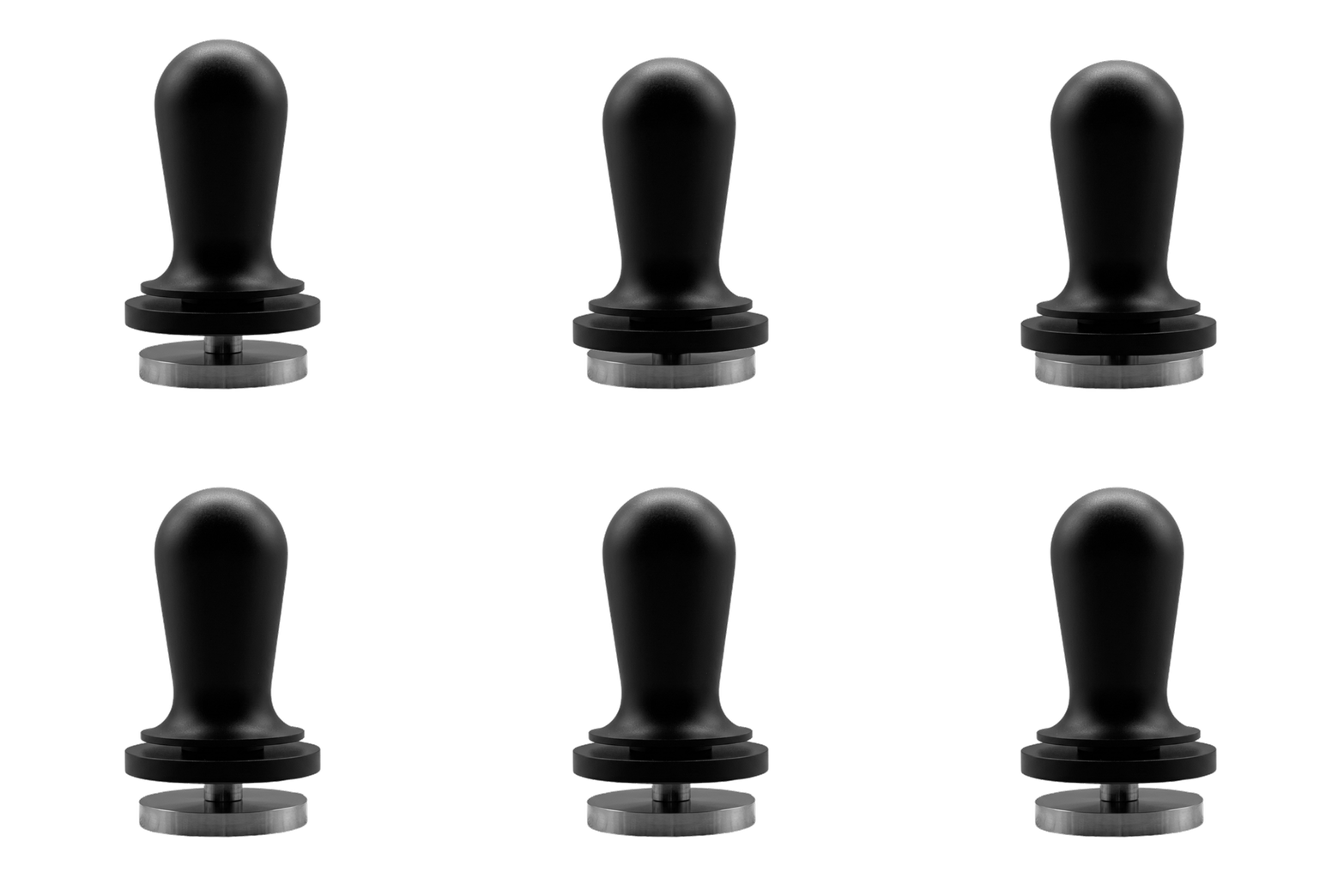
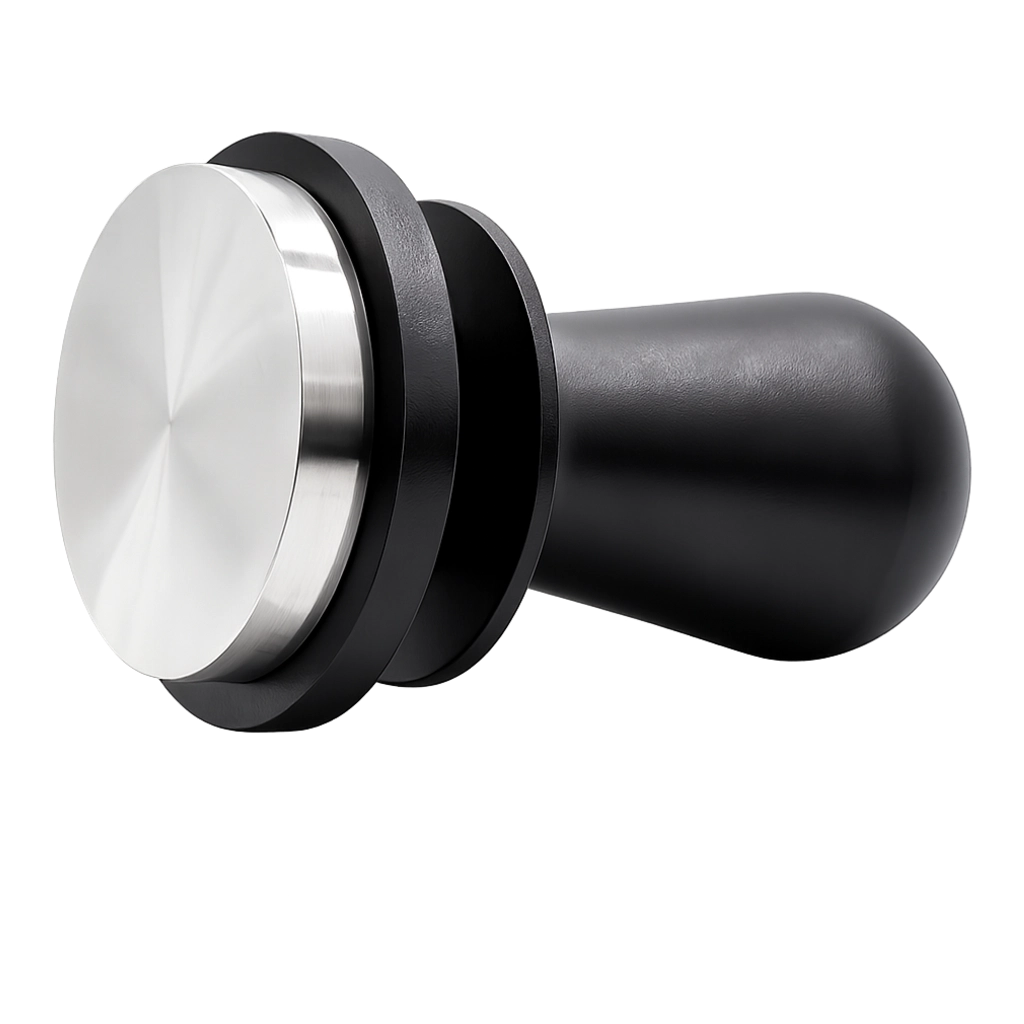
An absolute no-go is the size of the tamper in relation to the diameter of the basket. A good tamper closes off at the edge of the basket and therefore "tamps" the entire coffee puck. The included tamper leaves a gap of a good 2 mm. This invites channeling, and we indeed struggled with channeling in our extractions.
Conclusion and thoughts on the Olympia Express Maximatic
First off: we drank very good espresso and also prepared decent cappuccinos with the Olympia Express Maximatic. The material language and choice are truly outstanding. The fact that the machine is built in Switzerland, the components are not just haphazardly bought, and the machine has the ambition of being built for eternity – this puts the price of 4000 CHF in a proportional light.
Put differently: if an espresso machine for 500 CHF lasts 3 years and the Olympia Express lasts 30 years, then the Olympia is cheaper and easily amortized. And especially in a throwaway production society, we find this long-term perspective very, very valuable, and "local" production even more so. And we also find tradition to be invaluable, but also demanding.
Experience and tradition can be used to further develop an already high-quality machine and pick up on market impulses. A good example is the steam wands. Cool-touch wands are now installed as standard in espresso machines across all price ranges. You save yourself the ugly rubber cover and can still touch the wand. Olympia Express needs to work on that!
That a machine that prioritizes precision comes with a tamper that doesn't even fit the portafilter is incomprehensible. Tamper development has progressed continuously in recent years, and with a 58mm basket, 58.4 or 58.5mm tampers are used today that close off perfectly with the rim. This makes preparing a good espresso easier, especially for inexperienced users.
The Olympia Express Maximatic has not seen any further development for a long time, yet the product could easily be made better and upgraded. Since the machine is button-operated, a programmable water volume for all inexperienced home baristas would be a great relief to ensure a good brew ratio.
We think it's right that the machine dispenses with digital bells and whistles. But a shot timer would be an immense gain for the machine. This could even be equipped with a hand – how brilliant would that be!
The portafilter itself also does not feel as high-quality in terms of material as the rest of the machine. Another easily doable upgrade would be a replacement for the plastic dial for the steam wand.
A difficult review, this. Difficult for us to make a statement as to who this machine is the right one for. In a pure price-performance test, we have to say: you can get more for less. In terms of value retention, the Olympia Express Maximatic sets standards, but also leaves some things on the table that would be possible.
The machine is a collector's item. And learning to love the quirks and edges is, after all, part of every love affair.
Update: We received a tip from a machine user that the value retention of the machine is perhaps not that good after all. We have repair invoices totaling over 1400 euros, incurred by three repairs in less than four years.
Have others of you had similar experiences? Please let us know in the comments.