







Reading time: 3 minutes. This article is a short blog post. You can find the detailed blog article here.
The Brewing Ratio
How much coffee powder goes into the coffee? A frequently asked question! Measuring spoons are not standardized and not much help. So what does the perfect brewing ratio look like?
The Coffee Recipe
Brewing coffee is like baking – you should follow a recipe for consistent results. Only if enough coffee powder is used in relation to the water can the result taste good. Because the delicious particles need to be extracted from the coffee.
This is complemented by the grind size – grind size and quantity = delicious coffee!
Over-extraction
Too much water with too little coffee powder leads to a long brewing time and thus to over-extraction. Not everything in coffee is delicious, and some things we don't want to extract, otherwise the coffee becomes thin, bitter, and puckers the mouth (astringent) – nobody likes that!
Under-extraction
Too little water with too much coffee powder leads to the exact opposite result – we don't extract enough, and the coffee becomes sour/salty. The beverage is concentrated, and so are the unpleasant flavors.
Both phenomena result in an unbalanced outcome. Only the harmonious interplay of sweetness, acidity, and bitterness makes coffee a symphony of the senses.
But don't worry. Each of you can learn to conduct with a few simple steps!
The Search for the Sweet Spot
The brewing ratio helps us choose the right parameters in advance. The brewing ratio is the amount of coffee powder used and the water added.
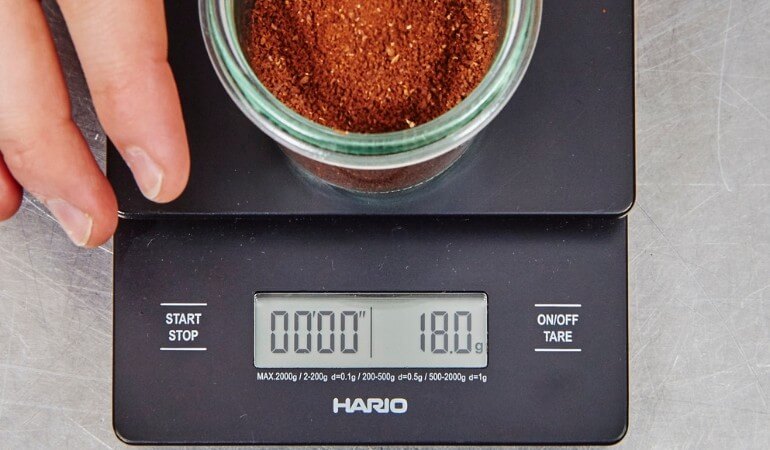
Through many experiments, the ideal brewing ratio is approximately 60g of coffee powder per liter of water, or a ratio of 1:16.66 (18g/300ml) – this is the starting point from which experimentation can be done in both directions and applies to all filter coffee brewing methods.
The "happy place" for filter coffee is between 1:14 (72g) and 1:20 (50g) – about 1.10% - 1.50% dissolved solids in the water taste delicious; almost all filter coffee fans agree on this.
Of course, there are other recipes like bypass, but more on that elsewhere.
The Brewing Ratio of Espresso
Small, concentrated, and strong, and extracted under pressure – the espresso!
While filter coffee has 1.1-1.5% dissolved solids, espresso proudly boasts 7-11%. Mathematically, this results in a maximum brewing ratio of 1:3.5 or 9g of coffee powder to 27g of extracted espresso to achieve 7% dissolved solids.
Since we cannot precisely dose the water from the machine, we must weigh the extracted result and, if possible, program the machine's volumetric settings.
The classic espresso brewing ratio is in the range of 1:2 or 1:2.5 – 9g of coffee powder to 18g of espresso or 9g of coffee powder to 22.5g of espresso.
The capsule craze has literally watered down the espresso and shaped the consumer's taste perception. Often, one now hears that espresso is "too strong."
The Basis for a Successful Brew
In this video, we explain the correlations between strength and extraction (we have also dedicated a separate blog post to this topic - to the article).
In a nutshell:
Strength, the concentration of dissolved solids (measured in TDS %) in relation to extraction, is the prerequisite for delicious coffee.
Each brewing method has its typical strength. As mentioned, we don't want to extract everything, but just enough for it to taste good – this is about 18-22% of the coffee.
Under-extractions tend to be acidic, and over-extractions tend to be bitter – in the middle, the coffee is sweet and balanced!
Extraction is the same for all brewing methods, in contrast to strength.
The Superfluous Measuring Spoon
Since there's no standard coffee spoon, the volume of coffee varies depending on the grind size, dark roasts are lighter than lighter ones, and it's quite difficult to use the exact same amount every time, coffee spoons are about as useful as a freezer in the Arctic.
Just 1-2g deviation per 100ml and the coffee is over- or under-extracted.
How much fits in the cup?
About 150-200ml – the required amount should be calculated based on this. If the coffee tastes good, guests will gladly have 2-3 cups.
If we take 6g/100ml, we need 48g/800ml for 4 cups, minus 2x48ml (tribute to the coffee cake), which results in 725ml, or 175ml per cup.
With espresso and Aeropress, different amounts of water remain in the puck.
The French Press
For multiple guests, the French Press (plunger pot) has proven its worth – a so-called "full immersion" brewing method where water and coffee extract together.
At a ratio of 7g to 100ml of water, a delicious beverage extracts here in 3-5 minutes!
Conclusion
Here you have the guidelines; deviations and special recipes will certainly cross your path on your coffee journey, and experience will show you how to interpret everything. This article serves as your starting point, because what matters is in the cup!
Here you will find the right scales and measuring cups for your preferred brewing method.