





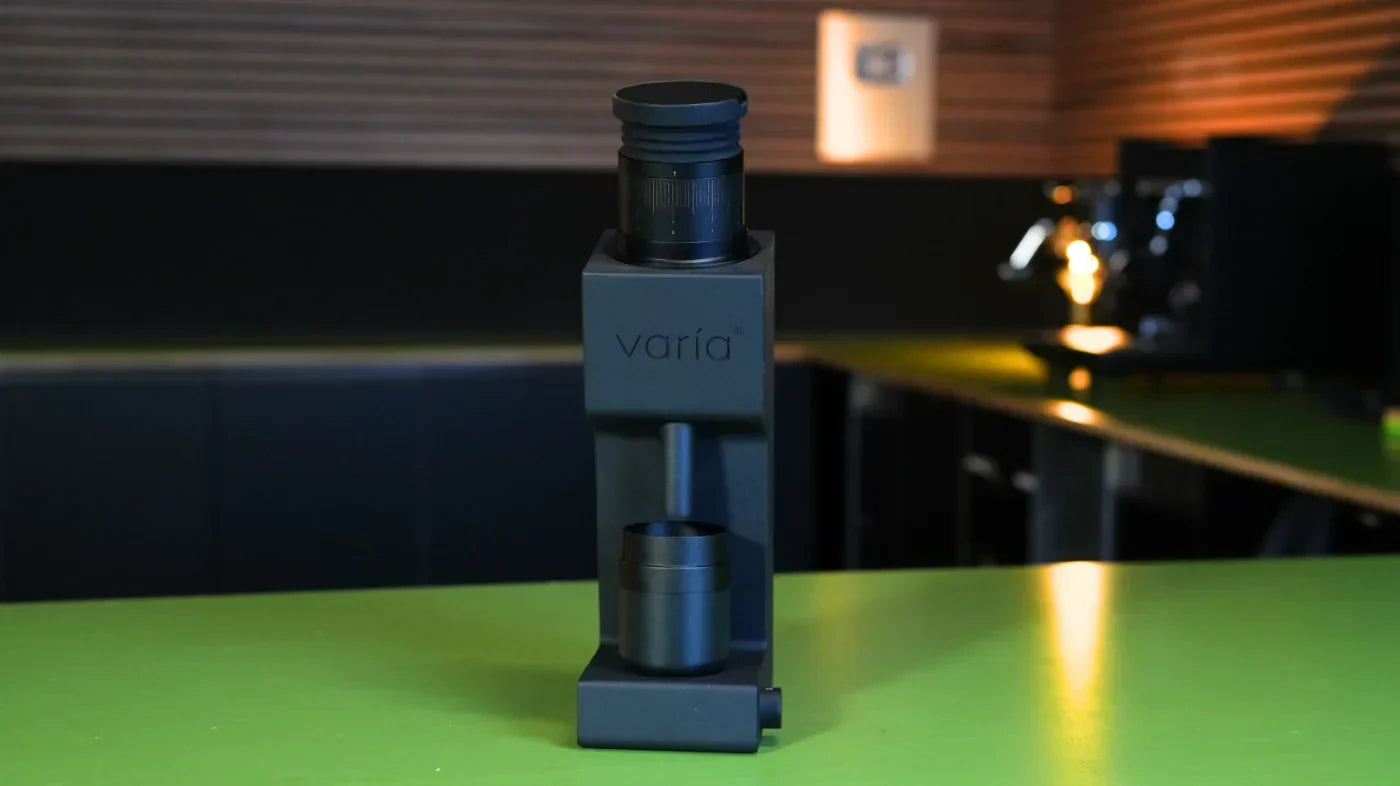

The Varia VS4 was one of the most anticipated grinders of the past few months. When we first got our hands on it at a coffee trade show, we were genuinely excited about it. Now the full test is behind us: we took almost half a year to run two Varia VS4 units through a complete test, because we wanted to avoid mistakes and confirm our findings on a second unit. It costs 499 US dollars direct from Varia's online shop, and just under 500 euros here, sitting between the smaller VS3 and the larger VS6 in size. A 53 mm conical burr, a brushless motor, and once again a genuine single-dosing grinder. The question we've been chasing for months: does the VS4 live up to the hype, and what's going on with its particle distribution?
An Aluminium Block With Two Genuine Innovations
The VS4 sits on the counter as a compact aluminium block, a good 5 kilos, just under 10 cm wide, 33 cm tall, 16 cm deep. It feels solid and sits firmly on the test bench. The box now includes a 58 mm dosing cup; on the VS3, that was a small cup nobody was ever really happy with. The new cup is well made, but it has a quirk: if you leave it in place while grinding, it sinks down and its rim pushes into the portafilter basket. We're not fans of a rim that intrudes into the basket. In practice, though, we barely saw any channeling at the edge, because that rim is very narrow. Anyone distributing with a needle tool (WDT) on top of that has the issue completely off the table.
Two things about the VS4 genuinely impress us. The first is the grind adjustment. It's now decoupled from the body of the grinder and, more importantly, from the bellows. On the VS6, the adjustment was fine and precise, but puffing the bellows would often nudge the grind setting by accident. That simply doesn't happen here anymore, because no pressure lands directly on the adjustment ring. On top of that, there's a scale whose indicator line lines up precisely with each marking. One line equals roughly one to one and a half seconds of extraction time, worst case two. It's hard to get finer than that in a home setting.
The second big strength of the design is that the grinder opens and cleans with one hand. You pull the grinding chamber out in a few seconds, brush it out, put it back in, done. We don't need to discuss grinder cleaning tablets for this one; you simply won't need them. Why being able to open the grinder this fast matters more than you'd think comes up again, somewhat involuntarily, when we get to retention.

The Burr Set: 53 mm Conical, Low RPM
Inside sits a 53 mm conical burr set, driven by a 200-watt brushless motor with a planetary gearbox. You set the speed via a dial on the side, adjustable between 150 and 300 RPM in steps of 50, which is deliberately slow for an espresso grinder. Grind adjustment runs stepless through an internal thread with 10-micron resolution. There's active ionisation built in against static buildup, though an RDT spray bottle is still included.
Faster and More Pleasant Than the VS3
Varia has clearly made progress here. The VS4 grinds 18 grams in around 13 seconds. The VS3 took about 30 seconds, roughly double. That makes a real difference in the morning.
Noise level is where it gets interesting, because the number alone is misleading. We measured around 80 to 81 decibels (81.5 dB at 150 RPM, 82.5 dB at 300 RPM, to be exact). The VS3 measured lower on paper at 73 decibels, but it sounded shrill and aggressive, a high-pitched whine for 30 seconds straight, somewhere between a bee and a circular saw. The VS4 has a deeper hum, more like a fast bumblebee, and sounds powerful rather than like a motor in its last stand. Subjectively, it's more pleasant even though the meter shows more decibels.
Grind temperature stays unremarkable. On the first unit, we measured an average of 26.9 °C, close to room temperature; the second ran slightly warmer at 30.4 °C. Both are well within acceptable range. Consistency across doses is excellent, with a standard deviation of 0.08 grams.
Retention: the Sore Spot
Retention is where we struggle a bit. On a single-dosing grinder, we want to get the coffee we put in at the top back out at the bottom. More than 0.7 grams of temporary retention already strikes us as a lot for this type of build. The VS4 sits at around 1.8 grams of temporary retention, plus about 0.2 grams of permanent retention, adding up to roughly 2 grams total. For a single-dosing grinder, that's a poor result.
That's surprising at first, since conical burrs usually have low retention, because very little clings to the cone itself. The problem sits elsewhere: in the drivers that spin underneath the cone. Coffee sticks there, breaks off, and falls back in with the next grind. We measured this the same way we do for every grinder: grind, weigh, vacuum out, brush clean, five times in a row. After the first grind with a clean chamber, more than 0.4 to 0.8 grams got left behind each time.
The catch is in how it builds up. The more permanent retention settles into the drivers, the more fresh coffee it holds back next time, and the larger the temporary portion becomes too. Ignore this and you'll quickly end up with well over a gram of old coffee sitting in the chamber, in a worst case several weeks old, mixing into the fresh grounds. But you can open the grinder faster than you can refill it with coffee, and that's exactly what takes the edge off this high number.
The VS4 only works well as a single-dosing grinder if you open and brush it out regularly. That takes less than a minute. Skip it, and the temporary retention just keeps growing, and the first espresso after a longer break will taste flat.
In terms of raw throughput, single dosing works reliably here: 18 grams in, roughly 18 grams out. Sometimes it's 17.7 or 17.8 grams, which tells you a bit more got left behind that time, and of course part of the current dose is still coffee from the previous grind. So the coffee does get reliably swapped out, just with this residue riding along.
Handling and Grind-Setting Repeatability
Handling is very good. The RPM dial sits on the right, switch it on, the grinder runs until you stop it.
Grind-setting repeatability is genuinely fun to test. We adjusted from espresso to ristretto, then to lungo, and back to espresso, and the VS4 lands right back on its starting point every time. Peak width comes back at 279.4 versus 277.1 microns, virtually identical. Together with the fine, decoupled adjustment, this is one of the grinder's real strengths.
Particle Distribution: a Story in Two Measurements
This is where it gets interesting, and unfortunately the outcome isn't good news for everyone. Early in the year, we measured our first unit and got a very wide particle distribution, with a main peak of 308 to 316 microns. That was noticeably higher than we expected. So we decided to run a second measurement and ordered a second VS4 unit.
The second measurement shows a solid particle distribution. At the lowest RPM setting, the main peak sits at 279 microns, with the median (x50) around 254. At 300 RPM, the main peak climbs to 299. That still puts the VS4 on the wider side overall, but at low RPM it moves a bit further away from values we'd describe as sensorially unbalanced and occasionally scattered. It's a classic, solid figure we've seen on the market for a long time. Clarity-focused grinders for light specialty coffees tend to sit below 240, with the best ones at 160 to 170 microns. That's a different grind profile from what the VS4 delivers.
Fines content sits relatively high at around 36 percent. That brings a certain dustiness, but it also supports body. Altogether, this distribution is a close relative of the VS3's. Both grinders run a conical burr, and both show their strength with full-bodied, classic coffees. For fruity coffees you want to brew for maximum clarity, they're the wrong pick, and within the Varia family we'd reach for the VS6 instead.
Stick with 150 RPM. The coffee turns out more balanced, the main peak narrower, the fines content lower. There's barely an argument for 300 RPM, unless you want to shave a few seconds off the grind time and knowingly accept the quality trade-off.
In the Cup
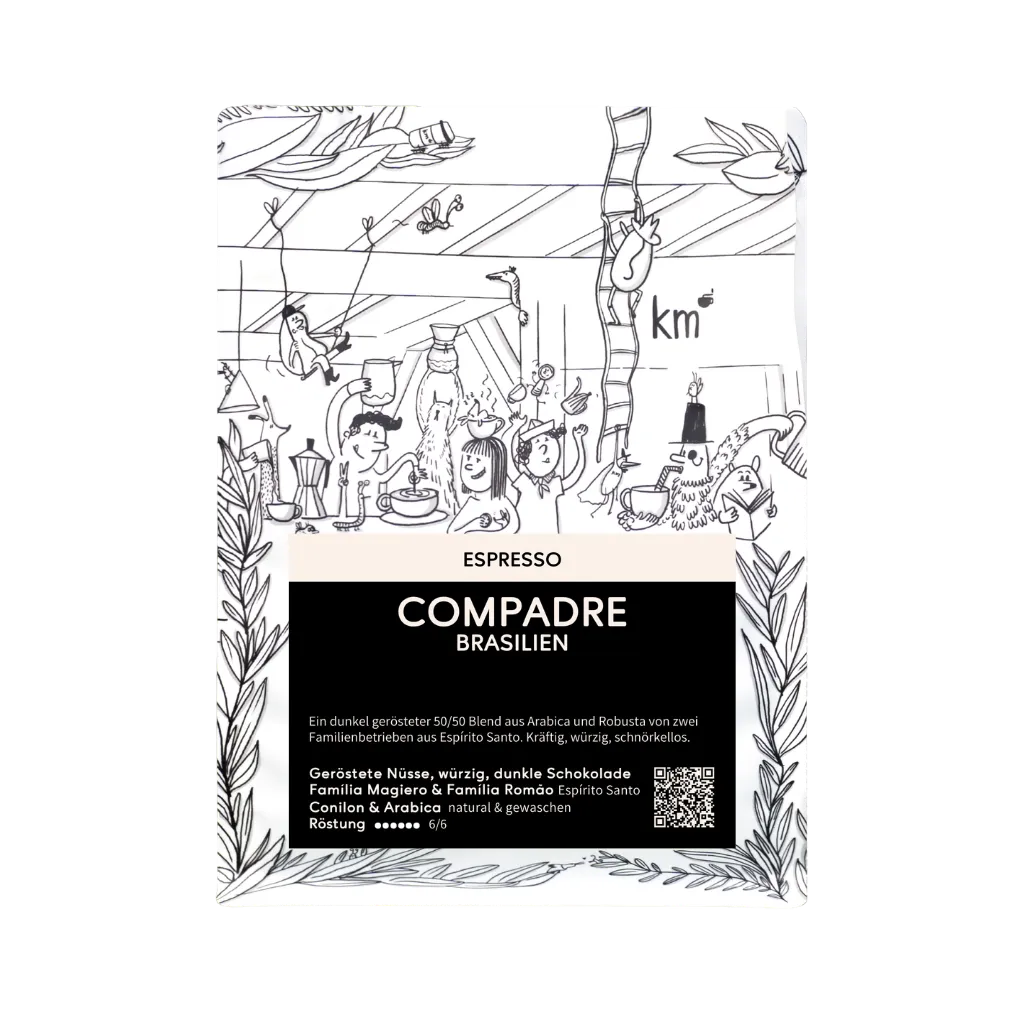
We cupped it blind against our reference coffee, and in the video also against our Compadre, an Italian-style espresso focused on body. That's exactly what the VS4 delivers: a dense, creamy espresso that sits heavy on the palate and fills the cup. A bit dusty, sure, but it fits this style of coffee, which wants to be exactly that rich in the cup. With classic and medium roasts, the grinder feels right at home. With light, highly complex coffees, the result is satisfying, but it's not this grinder's specialty.
Verdict
The Varia VS4 is a very good grinder for a clear use case, and it's genuinely fun to use day to day. The grind adjustment and the easy-open design are real innovations, handling and repeatability are among the best in this class, and it's noticeably faster and more pleasant than the VS3. For around 500 euros, you get a lot of grinder and a lot of quality.
The catch is retention. At around 2 grams total, it's too high for a single-dosing grinder, and it builds up if you ignore it. Being able to open and brush out the grinder in seconds softens that, but doesn't cancel it out: this is a grinder you need to actually want to clean regularly.
Who is it for? Anyone pulling solid, body-forward espresso from classic to medium roasts and willing to clean it regularly will be very happy here. If you switch between one or two medium or darker roasts, this is exactly right for you. It's less of a fit if you swap beans very often and want to brew a lot of light, complex specialty coffees for maximum clarity. In that case, the high retention and the somewhat wide distribution work against you, and you'd be better served by the larger VS6 or a clarity-focused grinder.
As always, we bought the grinder ourselves and tested it independently.
Test Results: Varia VS4
| Price | 499 USD (Varia online shop), just under 500 euros |
|---|---|
| Burr size | 53 mm |
| Burr type | Conical, stainless steel |
| Operating mode | Single dosing |
| Grind speed | 13 sec. for 18 g (unit 2: 12 sec.) |
| Noise level | 81.5 dB (150 RPM) / 82.5 dB (300 RPM) |
| Grind temperature | 26.9 °C (unit 1) / 30.4 °C (unit 2) |
| Absolute retention | ~2 g (of which ~1.8 g temporary, ~0.2 g permanent) |
| Single-dosing deviation | ~1.8 g (retention) |
| Consistency (std. dev.) | 0.08 g (unit 1) / 0.05 g (unit 2) |
| x50 (espresso) | 254 µm (150 RPM) / 235 µm (300 RPM) |
| Main peak (peak width) | 279 µm (150 RPM) / 299 µm (300 RPM) |
| Fines Qf <100 µm | around 36% (150 RPM) / around 39% (300 RPM) |
| RPM control | Yes, 150–300 RPM in steps of 50 |
| Motor | 200 W brushless with planetary gearbox |
| Weight | a good 5 kg |
| Dimensions (W × H × D) | ~10 × 33 × 16 cm |
| Highlights | tool-free opening grinding chamber, decoupled grind adjustment, active ionisation, stepless 10-µm adjustment |
You'll find all our espresso grinder tests in the espresso grinder overview.