





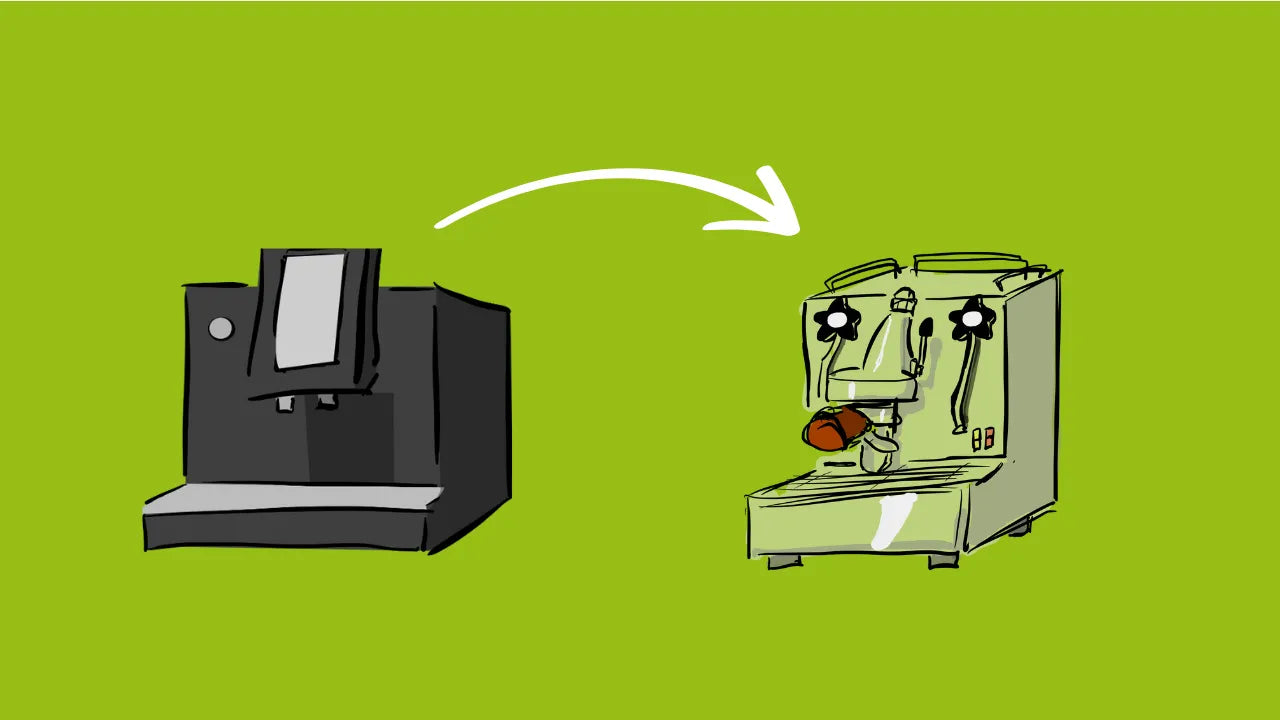
Switching from a fully automatic coffee machine to an espresso machine - tips and reasons

Fully automatic coffee machines make coffee that tastes reasonably good. However, it is very, very rarely good or even excellent. With an espresso machine – often also called a portafilter machine – it's a different story. The espresso, in particular, tastes significantly better. Anyone who uses good beans and a suitable grinder with the machine simply plays in a different league when it comes to coffee quality.
Of course, a portafilter machine also has disadvantages: Preparation is more complex, and in addition to the machine itself, a grinder is needed. Above all, there is no button that does everything for you. But that is also its advantage: Portafilter machines don't pretend – they serve exactly what you brewed yourself.
If something doesn't go well, you are primarily responsible. And us! Because with this video, we'll guide you – and with many more videos and articles too.
But what actually speaks for a portafilter machine? What should you know? Is preparation really that much more complex? And how does cleaning work – how much time does that really take?
Table of Contents
- Why does espresso from a portafilter taste better?
- Old coffee in the machine – the problem with "dead space"
- Dirty fully automatic machines
- How to make espresso with a portafilter?
- Portafilters taste different: brewing ratio and strength
- Lungo or Americano?
- The grinder determines the quality
- Cleaning the espresso machine
- The smart portafilter machine
- You can make espresso!
Why does espresso from a portafilter taste better?
When we prepare coffee, we extract from ground coffee everything that, together with the brewing water, makes up our espresso. This process is called extraction. The more uniformly the coffee grounds are ground and the more evenly the brewing water flows through the coffee, the better the espresso tastes.
A good grinder and an even distribution of the coffee in the brewing chamber are the basic prerequisites for this. Fully automatic coffee machines, technically correctly called piston coffee machines, do not do either particularly well. Often, inferior conical grinders are installed. And perhaps you know this: Does your fully automatic coffee machine's grinder really struggle against the beans? Does the motor groan, does the grinding process sound anything but smooth? The reason for this is a poor grinder!
The freshly ground coffee then either falls directly into the brewing chamber or pushes old, pre-ground coffee into it. This collects in the machine's empty spaces – a chapter all its own!
Once in the brewing chamber, the coffee in the fully automatic machine is not evenly distributed. Instead, it forms a wild landscape of hills with trapped air pockets and craters. The piston of the fully automatic machine simply compresses the coffee and guides the brewing water through it.
While we carefully ensure that the coffee creates an even resistance to the brewing water when making espresso with a portafilter machine, the exact opposite happens in a fully automatic machine. The water shoots through the gaps, over-extracting in some places, while in other places the water barely gets through.
The result? Over-extracted coffee tastes bitter, under-extracted coffee tastes sour. We call this over- and under-extraction – and yes, it doesn't taste good! Above all, the coffee lacks density and smoothness, what we call texture and body. And this is particularly noticeable when comparing an espresso from a fully automatic machine with one from a portafilter.
Old coffee in the machine – the problem with "dead space"
In almost all inexpensive fully automatic coffee machines, the freshly ground coffee does not fall directly into the brewing chamber, but partially remains on the way there. The moist climate in the machine also causes coffee particles to accumulate in these intermediate spaces. Some of it is pushed into the brewing chamber with the next grinding – we call this temporary dead space. Other residues remain permanently – this is the permanent dead space.
Ground coffee rapidly loses aroma and complexity from the moment it is ground. Researchers have found that a large portion of volatile aromas are gone after just 30 minutes. In addition, the coffee reacts with the moisture in the machine.
All of this does not taste good. The old coffee contributes to an unclean, bitter taste. The coffee oils begin to oxidize, which in some cases can even lead to a rancid taste.
Of course, there is also dead space in grinders for portafilter machines. However, the grinder industry has done a lot in recent years to significantly reduce it. You can find out how much dead space a grinder has in our grinder tests.
Dirty fully automatic machines
Coffee in the so-called dead space. Moisture in the machine. That sounds like a lot of cleaning effort – and that's precisely why the fully automatic machine regularly prompts us to clean and descale. But a large part of the stubborn dirt is not in the brewing group itself, but on the way there and around it.
The fully automatic machine is a closed system in which coffee is ground, transported, and moistened. And yes, it is exactly as dirty as that sounds. No automatic cleaning of a fully automatic machine truly removes the stubborn oil traces and coffee residues from the brewing group. Hardly any machine even asks us to regularly remove and clean the group. And very few regularly clean the coffee that has fallen next to the group or the residues distributed deeper inside.
Moisture and coffee residues – the perfect breeding ground for mold. Plus everything else that makes coffee increasingly unappetizing over time. Only a thorough machine service truly frees the fully automatic machine from these residues.
Fully automatic machines are simply not designed to be easy to clean – and some manufacturers even deliberately make it difficult for users. Jura, for example, uses a special screw that can only be removed with a Jura screwdriver. Perhaps the manufacturer doesn't want people to see what goes on inside their machines?
While the fully automatic machine hides its brewing group and operating paths inside, everything is open and accessible on an espresso machine. So you can see the dirt. This can give the impression that you constantly have to clean. And yes, that is indeed the case – but it would be no different in a fully automatic machine. It's just that the gunk is simply hidden there.
However, the daily "cat wash" of the portafilter machine takes less than a minute, and even the deep cleaning is done in a few minutes. More on that below.
How to make espresso with a portafilter?
Let's go through the espresso preparation process step by step. If you want more details, our blog post "Espresso Preparation" with the corresponding videos will help.
1. Choose the right beans
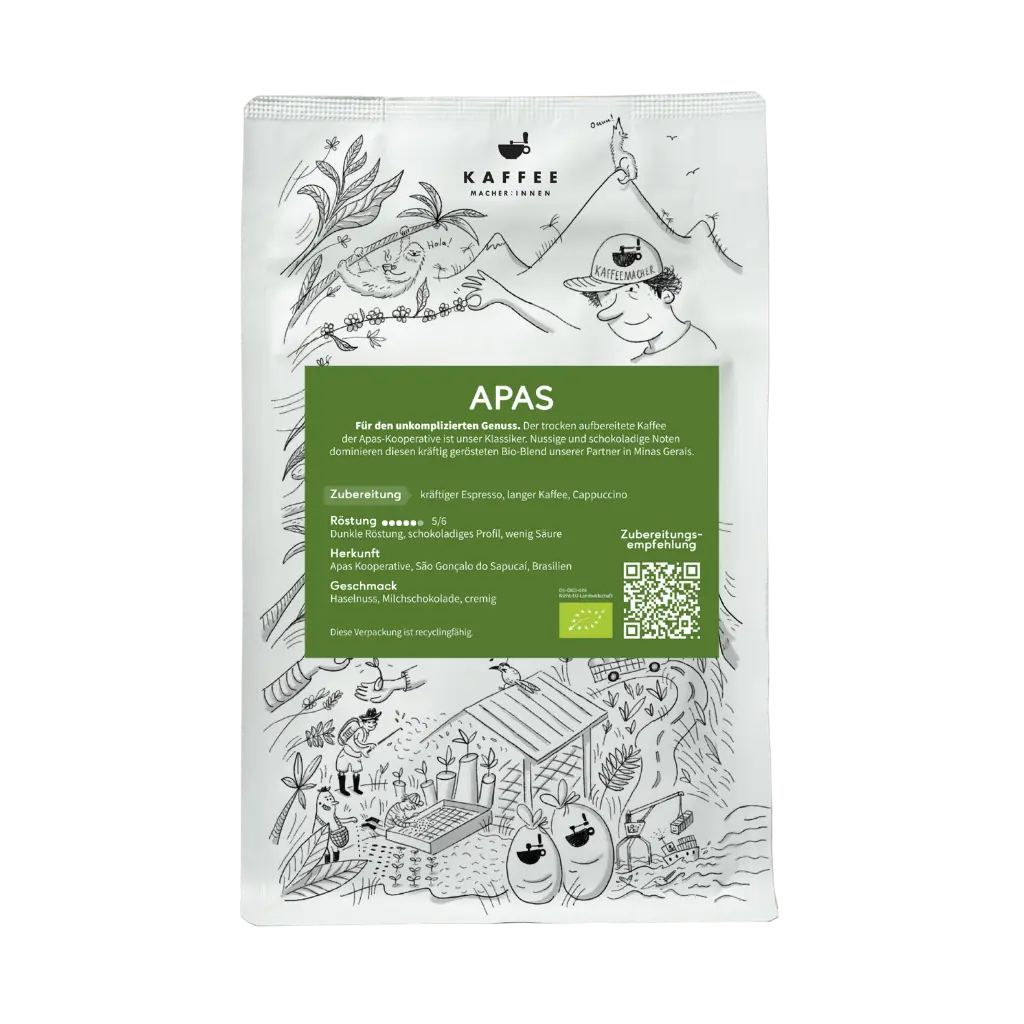
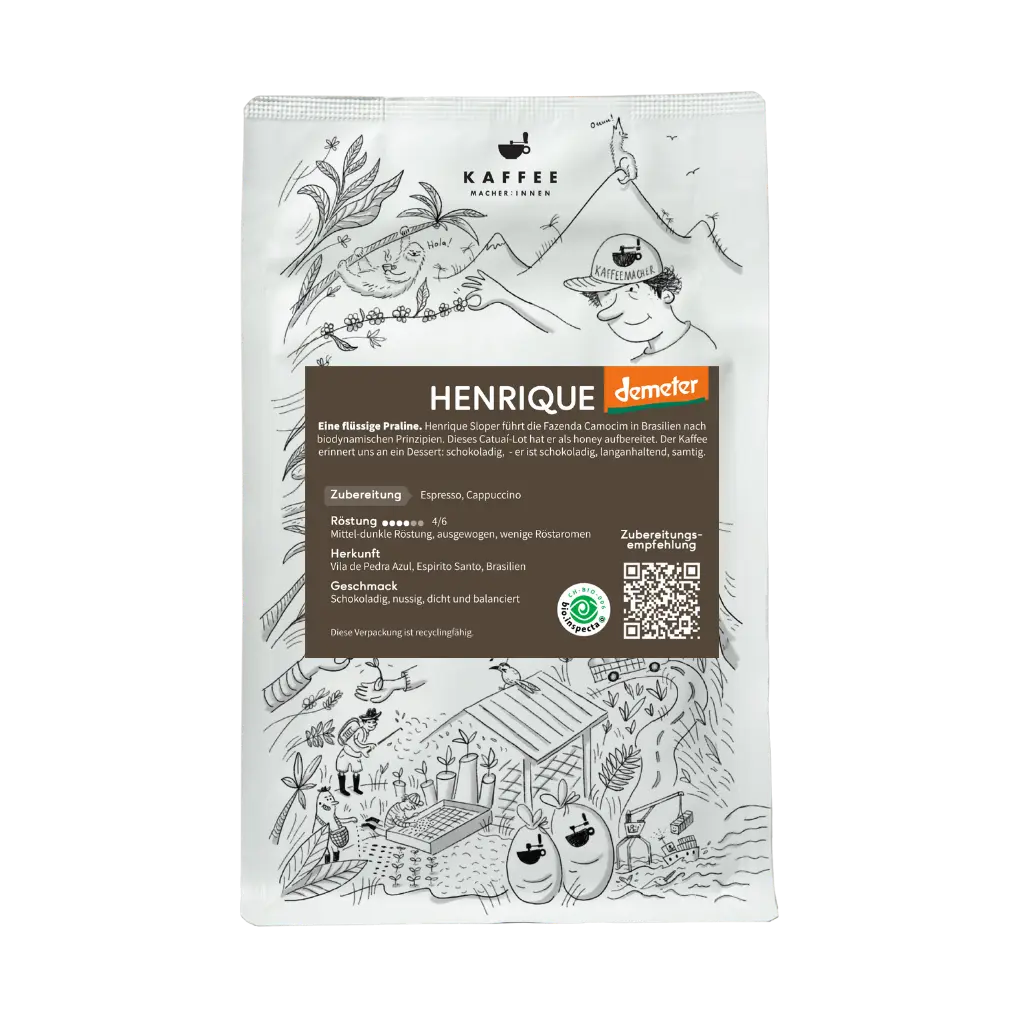
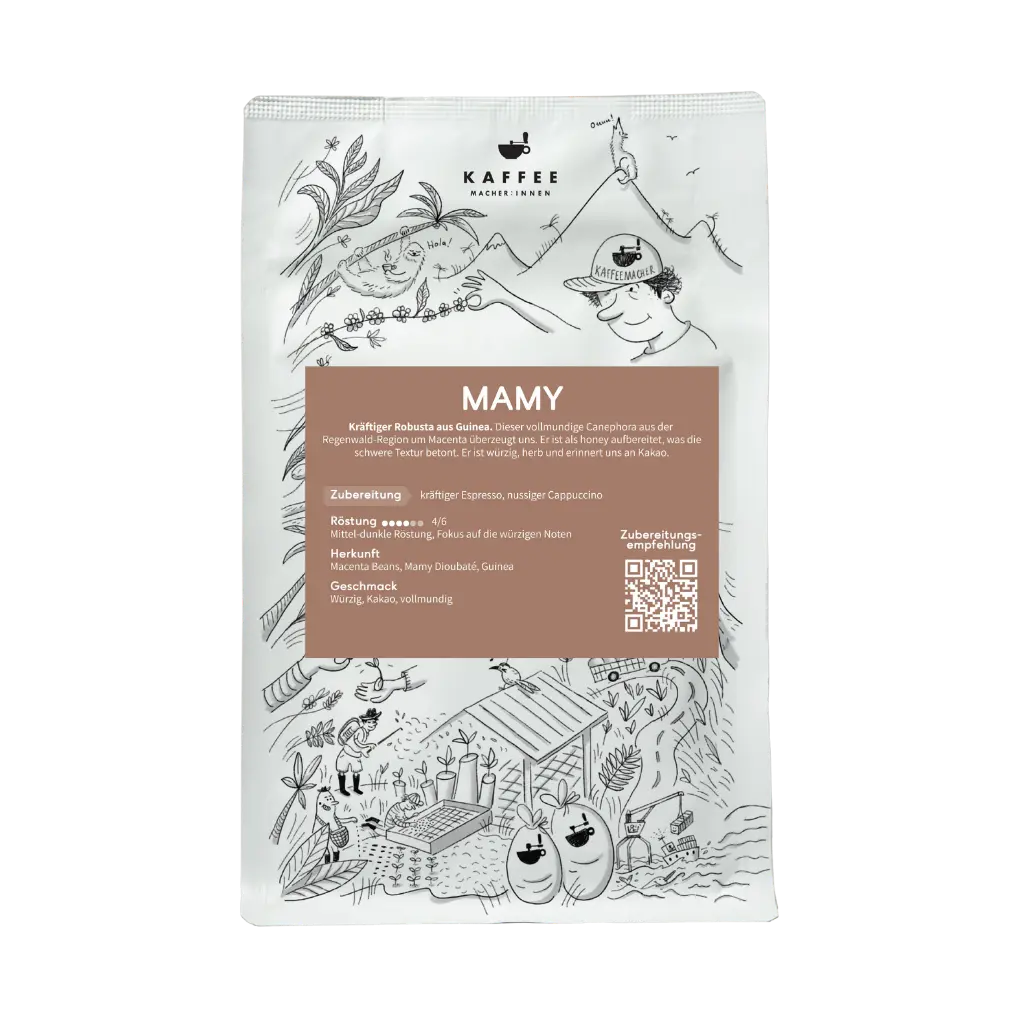
Use an easy-to-extract coffee with an accessible flavor profile. From our range, these would be Apas, Mamy, and Henrique, for example.
2. Grind coffee
We grind the amount of coffee suitable for our sieve. For a double sieve, this is usually 14 to 19 grams. For many machines, you can find the exact specifications in our articles or in the manufacturer's instructions.
When you set your grinder for the first time, you should weigh the amount of coffee powder. This gives you confidence to later brew the right amount of espresso in the correct time.
The grind for espresso is very fine – so fine that many inexpensive grinders reach their limits. You can see if your grind is correct during the extraction.
3. Distribute coffee
Distribute the coffee in the portafilter by gently tapping it sideways with your hand. You can carefully level larger mounds with your finger. Finish distributing with a light tap on the tamping mat so that the powder settles evenly.
There are simple tools called WDT (Weiss Distribution Technique) that improve powder distribution.
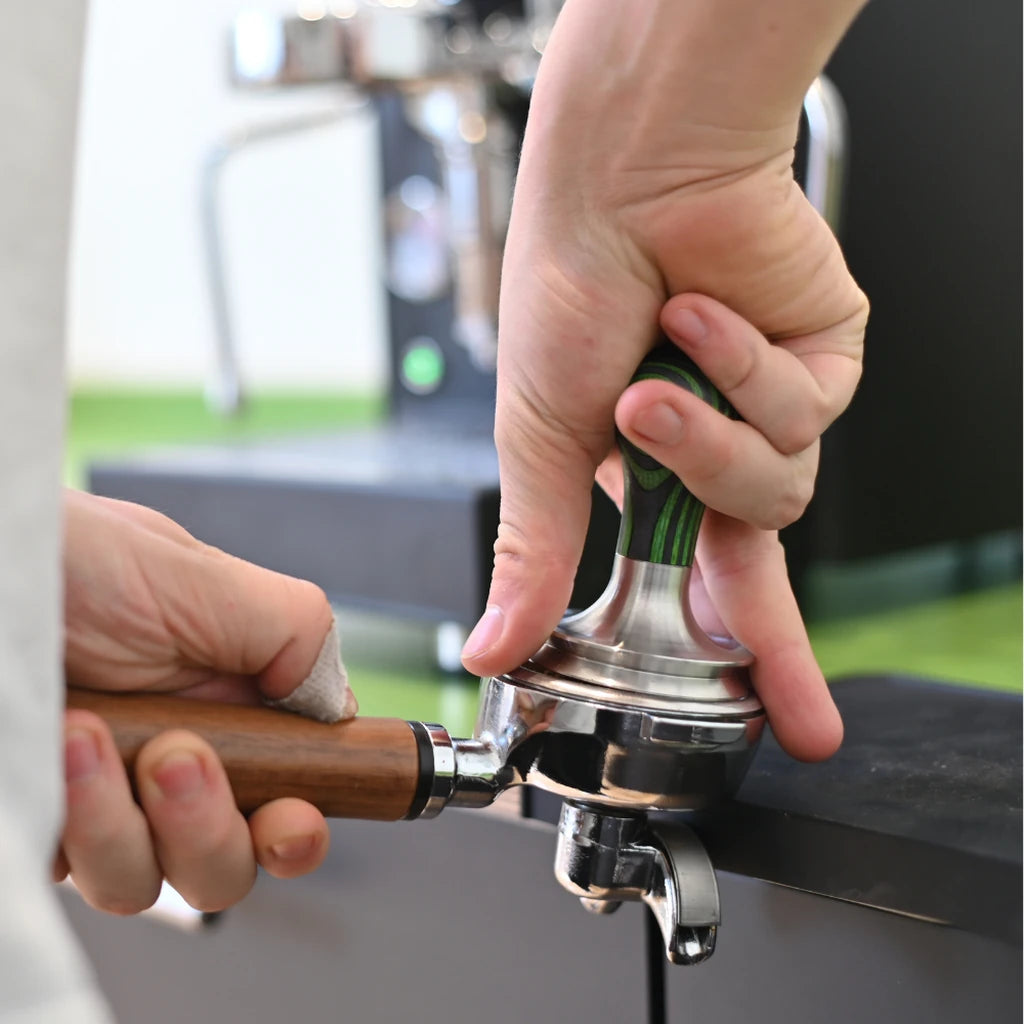
4. Tamp
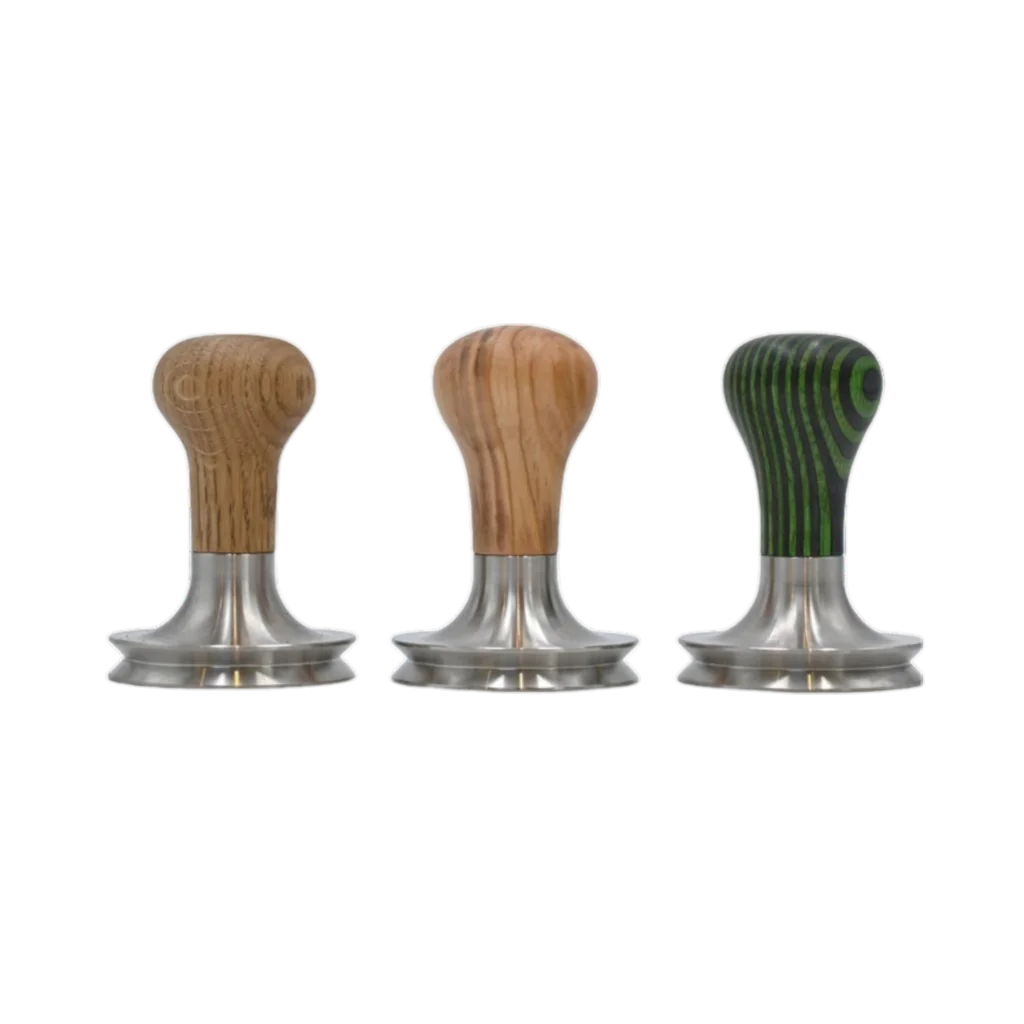
Place the portafilter on the tamping mat, place the tamper straight on the coffee grounds and press the coffee powder evenly. A force of 5 to 10 kilograms is a good guide.
Tip: If you are unsure how much pressure you are applying, press your tamper on a bathroom scale once – this will give you a feel for the force.
5. Flush
With many espresso machines, it makes sense to run hot water through for 2-3 seconds before clamping the portafilter. This rinses coffee residue from the brew group and stabilizes the temperature.
6. Insert portafilter and start brewing
Carefully insert the portafilter so that the pressed coffee powder does not loosen at the sides. After inserting, you should start brewing quickly so that the coffee is not exposed to the warm and humid atmosphere under the brew group for too long.
Tip: Place your cup on a small scale to see how much coffee is brewed in what time.
7. The right brewing ratio
Follow these recipes (more on this in the Brewing Recipes chapter):
- If you have previously drunk coffee from a fully automatic machine, I recommend a brewing ratio of 1:2.5 or 1:3.
- Example: 10 g coffee powder → 25–30 g espresso
- Double espresso: 18 g coffee powder → 45–54 g espresso
- The coffee should run through in approximately 20 to 30 seconds. A good target range is 25 to 28 seconds.
8. Adjust grind size
- Is the coffee flowing too slowly? → Make grind coarser.
- Is the coffee flowing too fast? → Make grind finer.
Always adjust the grind size in small increments. Also, grind out a few grams before the next extraction, as there will still be remnants of the previous grind in the grinder.
Important: Never change several parameters at once. Keep the brewing recipe consistent while you adjust the grinder.
9. Enjoy espresso
Congratulations! You have found the right starting position for your coffee and your recipe.
You will always have to gently readjust your grinder – and adjust it again for a different coffee. But now you know all the important steps. Have fun experimenting!
Want more details? Here we explain how to succeed in preparing espresso.
Portafilters taste different: brewing ratio and strength
Taste is a matter of habit – especially with intense aromas. Anyone who has been drinking coffee or espresso from a fully automatic coffee machine for a long time will probably stumble when trying their first and second espresso from a portafilter espresso machine.
This is partly due to the brewing ratio and partly to the more uniform extraction. Espresso from a portafilter usually contains 7–9% dissolved coffee particles, while espresso from a private fully automatic coffee machine usually only reaches 3–5%.
By the way: Even most commercial fully automatic machines rarely exceed these values. For context:
- 3–5% coffee particles mean 95–97% water
- 7–9% coffee particles mean 91–93% water
Yes, you read that right: coffee mainly consists of water!
Why is the brewing ratio crucial?
The brewing ratio determines the concentration of the espresso. While with a portafilter we usually use 1 part coffee to 2 to 3 parts water, with a fully automatic machine it is often 1:3 or even 1:4.
In addition, many fully automatic machines are standardly set to a high water volume: 8g of coffee often result in 35g of espresso. For comparison: In a portafilter machine, 8g of coffee is typically extracted into 16-20g of espresso – which is significantly more concentrated.
Additionally, the fully automatic machine extracts the coffee less evenly and less efficiently, resulting in less intense flavor and body.
How does espresso from a portafilter taste?
It is denser, more concentrated, creamier. A big difference is the mouthfeel, which we call texture in technical terms and perceive tactilely.
Taste literally explodes – that's how concentrated this coffee feels. That's exactly what makes the appeal and fascination of a good espresso when the extraction is right.
Our tip: Approach espresso more gently
If a 1:2 or 1:2.5 brewing ratio is too concentrated for you, work your way up with a more open ratio. For example, you can brew 1:4.
Even with more water, you will notice the altered body and more even extraction – but the result will taste more familiar to you.
Lungo or Americano?
Those who enjoy long coffees can prepare a Café Crema, a Lungo or an Americano with a portafilter machine. We have dedicated a separate article to long coffee.
For Lungo and Café Crema, the brewing ratio is extended to 1:6 to 1:10. This means: 10 g of coffee results in 60 to 100 g of coffee.
With an Americano, the process is slightly different:
- First, you pour 70 to 80 g of hot water into the cup.
- Then, you brew a double espresso directly over it.
The result? A perfectly balanced long coffee. The consistent, controlled espresso extraction ensures that your Americano tastes dense, well-structured, and creamy.
The grinder determines the quality
The grinder is at least as important as the espresso machine. Especially inexpensive fully automatic machines often have inferior grinders, which negatively affects the taste...
We talk a lot about portafilters here – but this article could just as well be about the grinder.
Because when preparing a perfect espresso, the grinder is at least as important as the espresso machine itself. In fact, it is one of the biggest differences between portafilters and the often inferior grinders in fully automatic coffee machines.
By choosing a portafilter machine, you enable yourself to choose a really good grinder. Especially in the lower price segment, it makes sense to spend as much on the grinder as on the machine.
A good beginner setup could look like this:
- Delonghi Dedica with a Sage Smart Grinder
- Even better: a Varia VS3 or Eureka Specialita
⚠️ Our tip:
Don't buy a compact system with an integrated grinder! Otherwise, you'll be tied to a built-in grinder again – just like with a fully automatic coffee machine. And unfortunately, the same often applies here: the grinder quality leaves something to be desired.
More about espresso grinders? We have written numerous test reports and videos about them!
Cleaning the espresso machine
Influenced by the regular cleaning prompts of the fully automatic coffee machine, you might ask yourself: And how is the cleaning of the espresso machine?
I can put all your fears to rest. It's done quickly, fits into daily life, and best of all: the machine is truly clean afterwards.
What should you do daily?
After brewing espresso:
- Unclip the portafilter
- Knock out the coffee puck into the knock box
- Briefly run hot water through the shower screen – this cleans the brew group
- Hold the portafilter under the water stream and then wipe it clean with a cloth
This leaves the machine clean and ready for immediate use.
Weekly cleaning: removing residue
Once a week, you can replace the portafilter basket with a blind filter and briefly build up pressure against it. This cleans the brew group even more thoroughly.
More thorough cleaning with cleaning powder:
- Add some cleaning powder to the blind filter
- Insert the portafilter
- Start the brewing cycle and build up pressure for about five seconds
- Stop the brewing cycle and repeat this five times
- Rinse the blind filter thoroughly with water
This cleaning is completely sufficient every two to three weeks if you briefly flush water through the group after use and do not leave coffee grounds in the portafilter.
We have also recorded a detailed article and videos on cleaning.
The Smart Portafilter Machine
Perhaps all this still seems too complicated when you read it. Maybe you want the quality of an espresso machine, but you don't want to get too involved in the preparation. In that case, there are now machines that were developed precisely for this purpose – and they are constantly improving.
There are espresso machines that are highly intelligent and help you brew the described espresso experience with less effort and guided by the machine. Currently, these machines are still expensive, but it is foreseeable that they will become increasingly affordable and powerful.
Maro: Step by Step to the Perfect Espresso
One example is the Maro espresso machine. In beginner mode, it guides you step by step through the extraction process. You simply select whether you want to brew espresso, cappuccino, or flat white – the system takes care of the rest. Every step is explained on the display.
After brewing, you and the machine evaluate the extraction, and it tells you how to adjust the grinder.
The special feature: If the espresso runs too fast, the machine automatically reduces pressure and flow rate – thus correcting the shot. The result is still a good espresso.
Ligre: Smart Brewing with a Precise Grinder
The Ligre espresso machine also follows this path. Its display and menu navigation are kept simple, but it also offers intelligent support during the brewing process.
Particularly exciting is the Ligre grinder, a grind-by-weight grinder that weighs out exactly the right amount of coffee grounds every time. However, you still have to set the grind size yourself.
Nunc: Fully Automatic Adjustment of Grind Size and Extraction
The Nunc espresso machine and grinder are not yet on the market, but their concept promises even further automated guidance.
With Nunc, the grinder communicates directly with the espresso machine.
- If the espresso runs too fast, the grind size automatically adjusts.
- At the same time, the machine reduces the flow rate during the shot if it detects too high a flow.
If everything works as planned, Nunc could significantly simplify the preparation process even further.
You Can Make Espresso!
Smart machines make the transition from a fully automatic coffee machine to an espresso machine easier. But they are not necessary to master good espresso at home.
What seems complicated at first will quickly become easy and natural for you once you have taken the first steps with your espresso machine.
We will guide you:
- Our videos will help you with the most important basics.
- Our Online Home Barista Course will guide you concisely through all the steps.
- Or visit us directly with your espresso machine in one of our courses in Dinslaken (Ruhr area) or Basel (Switzerland).
In recent years, we have helped thousands of people brew perfect espresso at home – we would be happy to guide you too!