



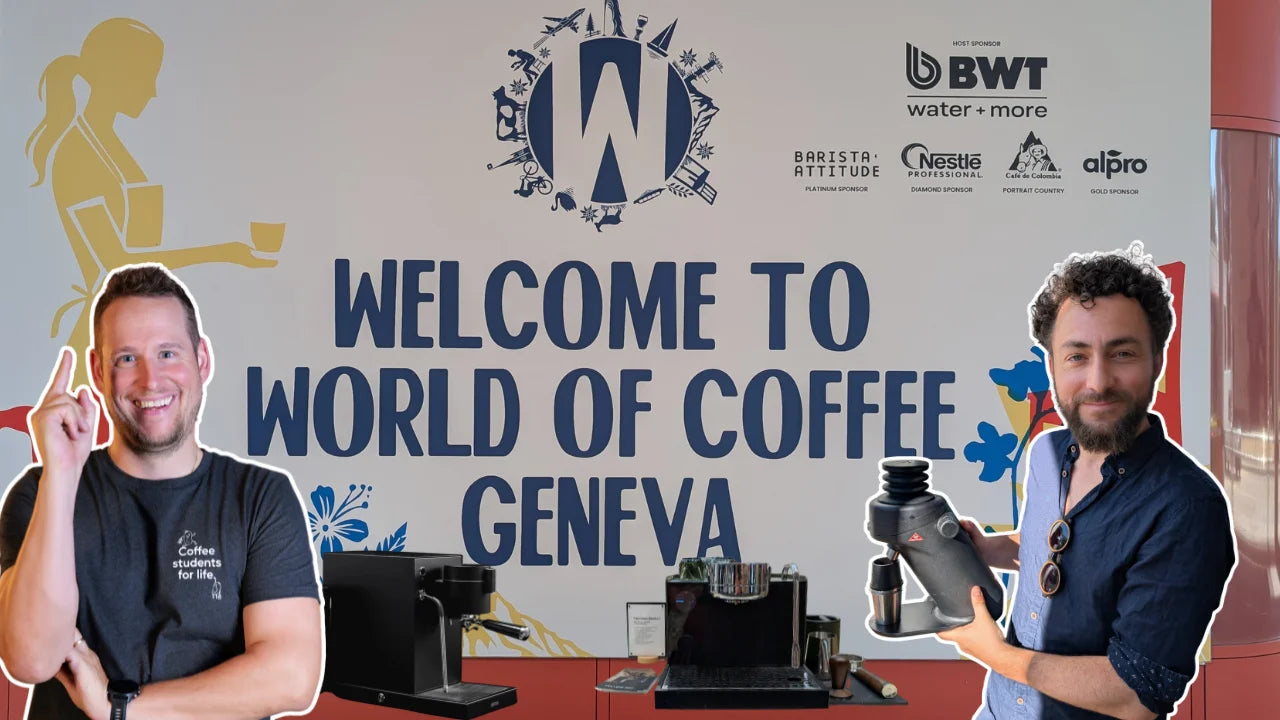

The World of Coffee 2025 in Geneva offered coffee aficionados a colorful display of innovations. We took a critical and curious look around on-site – and here we present all the important new developments in espresso machines and grinders for home use.
There are indeed novelties and innovations. At the same time, many manufacturers, in their usual manner, sell old wine in new bottles and present a new color variant of an espresso machine as a quantum leap. We will skip such descriptions and focus on the essentials. From smart grinders to motorized lever espresso machines and portable devices – here you'll find out what's moving the industry and where it's headed.
As always for this trade fair report: we have not tested all the devices mentioned and can only give a first impression. How well the announced features actually work in practice, we will only be able to report after an extensive test in our coffee academy.
Varia VS4 – Single Dosing Made Easy
First up is a grinder that made our espresso grinder tester, Michel Indelicato, positively beam at the fair: the Varia VS4, the latest offspring of the well-known Varia grinder series. This single-dose grinder closes the gap between the compact VS3 and the larger VS6. What makes it special?
- Conical Burr Set: The VS4 works with newly developed conical burrs (53 mm diameter) – not identical to those of the VS3, but its own design.
- Adjustable RPM: For the first time, Varia also offers RPM adjustment (revolutions per minute) on a smaller model to further optimize grinding speed and grind quality.
- Lightning-fast Cleaning: The highlight is its ease of cleaning. The grinder can be opened in a few simple steps without adjusting the grind size. Michel was thrilled: Finally, you can clean the burrs without having to readjust afterwards!
- Anti-Static: The spout contains a kind of ionizer or anti-static technology, which is supposed to prevent coffee grounds from sticking to the housing.
- Price and Availability: The VS4 is expected to hit the market at the end of 2025, with a target price of around €450 – a strong offer for such a grinder.
Classification: Even the smaller VS3 was a price-performance hit, and the VS4 goes one step further. For single-doser fans on a limited budget, this grinder should be very interesting. Innovative features such as RPM control and effortless cleaning show the trend: ease of use and maintenance are highly valued.

Zero:Hero – Portable Espresso Machine with Power
On my outdoor trips, I enjoy testing portable espresso makers. One such device is the Zero:Hero hand-held espresso maker, which has received a Red Dot Award.
At the trade fair stand, we tried out the small, mobile espresso maker, which looks suspiciously similar to a competitor's product – but makes a crucial promise: it gets hot enough!
This handy device is conceptually similar to well-known portable espresso machines, but is supposed to be able to heat water up to 92 °C. This was precisely my point of criticism with a competitor – the brewing temperature. The Zero:Hero is supposed to put an end to that. I will make a comparison and test as soon as possible.
Key Facts Zero:Hero:
- Operation: Battery-powered, usable with hot or cold water. With already hot water, up to 200 shots are said to be possible; from cold water, approx. 4–5 espressos per charge.
- Brew Group & Handling: Fill coffee, twist together, tamp – the ritual remains manual. The design is based on familiar models, which immediately provides a sense of familiarity.
- Temperature: According to the manufacturer, the device reaches approx. 92 °C brewing water temperature. If this really works, it would be a game-changer in this segment. Personally, I would even go higher.
- Fun Factor: Should Zero:Hero meet expectations, it will be the ideal companion for espresso on the go and will soon accompany my kayak and road bike tours.
Classification: There are many portable devices, but they often fail due to temperature or the number of possible brews. Zero:Hero promises to solve both. We remain (cautiously) optimistic. If the little hero is indeed hot enough and durable, it could become the benchmark among travel espresso makers. Price-wise, we expect it to be in the range of similar devices (there was no concrete information on this at the fair yet).

Source: meticulous
Meticulous Espresso – The Robotic Lever for Home Use
Next up was the Meticulous stand – and here, espresso tech dreams came true. Meticulous is a unique espresso machine that executes a classic manual lever shot completely mechanically - but with much more dynamic control. We pre-ordered this fine piece a while ago via crowdfunding; according to the manufacturer, the first units are expected to be delivered in summer 2025.
What makes Meticulous special? Basically, you get an electronically controlled lever machine, but without a visible lever. An internal piston takes over the pressing, and numerous sensors monitor the extraction process in real time:
- Plenty of Sensors: Built-in sensors measure flow, pressure, and temperature during extraction. Nothing is left to chance – every parameter is recorded.
- Single-Dose Water System: Before each shot, a defined amount of water is filled into a front chamber directly above the portafilter, which is then precisely brought to temperature. Only the necessary water is heated.
- Integrated Scale: A scale is built into the drip tray – ingenious for accurate output measurement. Simply place the cup, press the button, and the weight of the espresso appears on the display. Dosing and even manual single-dosing for filter coffee are also possible.
- Digital Profile Control: Pressure curves can be freely programmed and controlled. The machine can theoretically automate everything from pre-infusion, flow to pressure profiling. Profiles can be saved and recalled at any time.
- Brewing Process: One press of a button, and the piston in the brew head lifts, so that the water wets the entire surface of the puck. Then, the pressure or flow is gradually built up according to the program. Flow, pressure, temperature – everything is regulated to the second. There are no limits for the espresso tinkerer here.
Planned Price: Kickstarter backers invested around $1,200; officially, the Meticulous Espresso is expected to cost about $2,000 (without the optional milk frother). If everything works as Meticulous announces, this is more than competitive.
Classification: Meticulous could become the link between professional levers and smart machines. At the same time, the Meticulous brews instantly! No hoses, no path between the brewing element and the brew chamber. The heating and pressure generation moment takes place at the brew chamber or portafilter. There are many other strengths and few weaknesses that the Meticulous is likely to offer. We are certainly looking forward to our model like hardly any other machine before.
Muvna Switch-Grinder – Two Grinders in One
You see a lot at trade fairs – but this novelty even amazed us: A manufacturer showed an espresso grinder where you can change the entire burr set within seconds. Yes, you read that right: Conical or flat? You no longer have to choose, you simply swap them out!
The grinder – announced in Europe under the name Muvna – features two interchangeable burr sets: a huge 98 mm conical burr set and a flat set with 83 mm burrs. With a lever, you remove the entire front section, which attaches to the main body of the grinder via metal pins. The other burr set is then attached in the same way. The "burr swap" is completed in 3–4 seconds.
Further facts about Muvna:
- Retention minimized: Due to the design of the interchangeable system, almost no coffee grounds seem to remain in the grinder. Less dead space = less old coffee in the next shot.
- Target group: High-end home users and laboratory technicians? Joking aside – Muvna is aimed at hardcore geeks who want to choose the optimal burr type depending on the bean (conical for more traditional espressos, flat for light roasts, for example). Or for the undecided who simply want both or want to experiment.
- Performance: Concrete technical data (motor, RPM, etc.) were not mentioned on site. But the burr sizes alone show: We are playing in the top league here.
- Price & Availability: The Muvna grinder is expected to be ready for market around August 2025. A price of around $3,000 was indicated – so certainly not a bargain.
Classification: Muvna pursues a radically innovative approach. Whether you actually switch between conical and flat constantly in everyday life remains to be seen – but it's impressive as a technology demo alone. For well-heeled espresso nerds, Muvna could be the all-in-one solution. Retention, flexibility, and engineering were clearly at the forefront here. We are genuinely excited to see how this grinder performs in tests and whether the changing mechanism is permanently robust. Definitely one of the most exotic highlights of WOC in Geneva 2025.

WPM Primus – Pro Features in a Compact Format
WPM has long ceased to be an insider tip when it comes to affordable espresso equipment. In Geneva, the Hong Kong-based company delivered a double punch: with the new Primus espresso machine and exciting updates to their grinders.
Primus: Dual Boiler, Thermoblock & Pressure Profiling
The WPM Primus looks like a typical 1-group home machine at first glance, but inside it's packed with high-tech. It's aimed at ambitious home baristas and small cafés. What makes it special?
- Innovative Heating System: The Primus combines a classic 0.8l boiler with PID control for espresso with two thermoblocks – one for hot water and one ("Supersteam-Thermoblock") for steam. Result: rapid heat-up time and strong temperature stability despite its compact design. In fact, according to the manufacturer, the machine is ready for operation in approx. 2 minutes – impressive if that works. However, many have claimed this and few have delivered. We shall see.
- Gear Pump with Profiling: Instead of the usual vibratory or rotary pump, WPM uses a quiet gear pump. This allows precise pressure profile control: You can adjust the pressure curve during extraction or even (in the future) control it by flow. Multi-stage profiles with programmable phases are already possible – from pre-infusion to pressure ramp-down.
- Built-in Sensors: The machine also has a flowmeter and, according to the manufacturer, in the hot water area. This is actually more than just exceptional in this price range. In addition, there is a fairly intuitive LED display that shows all parameters.
- Plenty of Steam: The dedicated steam thermoblock delivers dry steam with plenty of power – fine microfoam for latte art is possible. How well it's possible was shown to us by the developer directly on the machine. It was the most beautiful latte art I have ever seen from a technician. The steam boiler only runs when needed, which saves energy.
- Tank & Fixed Water Connection: WPM supplies both a water tank and a fixed water connection as standard – at no extra charge, with a target price of approx. €2,000. Many other manufacturers charge dearly for the fixed water option; here, it's standard.
Classification: The Primus combines many trends in one machine: rapid heating technology, pressure profiles or stage control, and energy efficiency. The fact that WPM offers this for ~€2,000 is a statement. Of course, we need to check how the mixed approach (boiler + thermoblock) performs in practice and whether the machine can achieve the heat-up time and temperature stability. But what WPM is showing here is very, very promising.
WPM ZP-1 and KONOS: Single-Dosers in a Double Pack
In addition to the machine, WPM also showed new developments in grinders. The WPM ZP-1, a compact single-dosing grinder that debuted at the last Frankfurt Coffee Fair, is already known. In Geneva, now the surprise: KONOS, a new conical grinder based on the ZP-1.
WPM ZP-1 – the Flat Burr Single-Doser:
64 mm flat burrs, adjustable RPM, and very low retention. Praised for its solid construction. (We haven't tested it ourselves yet, but an order has been placed to catch up.)
- Single Dose Conical: KONOS uses a conical 71 mm burr set.
- Adjustable RPM: Like the ZP-1, KONOS also offers adjustable burr RPM to control grind quality and speed.
- Easy-Clean Mechanism: Inspired by the ZP-1, KONOS features a mechanism for quick cleaning of the grinding unit. Removing coffee grounds should thus become child's play – important for single-dosing.
- Design & Quality: Aluminum housing, modern look.
Classification: With ZP-1 and KONOS, WPM has two arrows in its quiver to shake up the single-dose market. The strategy is somewhat reminiscent of Niche (which also offers flat vs. conical options with Zero and Duo). The combination of RPM control and ease of cleaning is exciting. In short: WPM is stepping on the gas to appeal to ambitious home users. We are already looking forward to examining both grinders in detail!

Fellow Espresso Series 1 – High-Tech in a Plastic Shell
The manufacturer Fellow, known for stylish kettles and accessories, is now entering the espresso stage. At the Fellow stand, the brand new Espresso Series 1, Fellow's first portafilter machine, was presented. Here are the most important impressions:
Technology & Features:
- Three Heating Elements: The Series 1 uses a thick-film heater + mini-boiler + brew group heating in combination. Specifically: A pre-connected flow heater heats water lightning fast and feeds it into a small boiler, which in turn supplies the brew group, which also has a heating element. This results in triple temperature control of the water along the path. This is intended to allow the machine to reach temperature quickly and maintain it very stably – ambitious!
- Full Profile Control: Remarkable for a machine in this class: you can program pressure profiles. Pre-infusion and pressure ramping – all of this should be possible and intuitively adjustable via a rotary knob/display. There is also a memory function for profiles, so you can save recipes for different beans (including temperature, pressure, and flow throughout the extraction).
- Fast Steamer with a Catch: The Series 1 is dual-use (espresso & milk), but technically behaves more like a single-boiler when switching to steam. For frothing, the mini-boiler has to be heated up, which takes some time, and then cooled down again for espresso. However, Fellow emphasizes that they have implemented smart solutions for this – how well this works (and how quickly it lowers the temperature again) remains to be seen in tests. Additionally, there is an Assisted Steaming function: The machine offers pre-selected steam temperatures for different types of milk (e.g., less heat for oat milk).
- Operation & Aesthetics: The device has a modern, sleek design (available in black, red, brown) and reminded us of some existing machines in terms of form factor – although aesthetics are in the eye of the beholder. Operation is via a rotary-push knob and a display. Everything is supposed to be very intuitive. In practice, we sometimes had difficulty getting out of certain menus – but one will get used to that.
- Price & Material: This is where it gets interesting: A price of approx. €1,500–€1,600 has been announced (Fellow USA states $1,499 MSRP, early birds paid $1,399). This is extremely competitive, considering the features – but it is only made possible by the generous use of plastic for the housing. The machine is almost entirely made of robust plastic; metal is only found in a few places. This reduces costs but raises questions about value and durability.
Classification: Fellow has taken a bold step with the Espresso Series 1. On paper, it combines features typically found in more expensive machines into a sleek, compact device at a mid-range price. If this concept takes off, Fellow could achieve a real price-performance hit and challenge established brands like the Lelit Bianca. However, skepticism is warranted: How well does the temperature control work with the small boiler? How long will the plastic housing withstand daily use? We are critical, yet eager, for a test unit. Because if the Series 1 lives up to its promises, many home baristas could soon be pulling "profile-saved, unpacked shots" – without spending a fortune. Innovative, but also solid – that will be the key.
ECM & Profitec News – Exacto Grinder and more
At the joint booth of ECM / Profitec, we found two highlights: a new single-dosing grinder called Profitec Twist SD54 (already tested by us) and the prototype of the ECM Exacto, a Grind-by-Weight grinder.
ECM Exacto – Grind-by-Weight with Brains
The ECM Exacto is expected to be released at the end of 2025 and marks ECM's entry into grind-by-weight grinding. Its name says it all. Here are the key facts we learned:
- Direct dosing via scale: The Exacto has an integrated scale that weighs the dispensed grounds in real time and automatically stops the grinding process as soon as the target dose is reached.
- 64 mm burrs are used.
- Stepless adjustment with digital display: The grind adjustment is stepless via a rotary knob, but with a digital scale on the display. This means that as you change the grind, a display shows the numerical value with very high resolution.
- Portion recognition: The grinder automatically detects whether a 1-shot or 2-shot portafilter is inserted. Accordingly, it could, for example, suggest different standard doses. This gives it an advantage over all other weighing grinders under 1500 euros.
- Development status: The prototype at the fair already felt good, but still needed refinement. ECM wants to show an improved version by the HOST fair in autumn and then quickly bring it to market. Visually, the grinder is slightly larger than previous ECM grinders – not surprising, as it has significantly more technology inside.
Classification: With the Exacto, ECM is joining a trend that has already been embraced by brands like Baratza and Eureka: smart grinders with weighing technology. For ECM fans who appreciate German engineering and stylish design, the Exacto could be a great addition to their ECM espresso machine.
No price information has been provided yet, but the grinder is expected to cost more than 1000 euros. If the accuracy and reliability are right, the Exacto is sure to find customers – Michel already attested to a "beautifully powdery grind" during the fair's shot. We will stay tuned and hope to report more soon and test the particle distribution.

The DACH-Arkel Connection was also at the fair. Lukas Brenneis from Brewspire, Markus Berger from Vitudurum (Switzerland) and Wolfgang Köppl from Die Röster (Austria) closely accompanied Fernando Moreira from Arkel in the development of the new Arkel Coast Dualboiler. The machine was not at the fair. However, a unit has arrived with us today and will be tested in the near future.
Sage/Breville Oracle Dual Boiler – When the machine adjusts the grind size
Sage Appliances (known as " Sage" in Germany, globally as Breville) made another step towards integration in its compact machines at WOC 2025: espresso machine and grinder merge into an intelligent system. Specifically, at the Sage booth, we got a preview of the next generation of the Oracle range and the Dual Boiler machines. And they were impressive.
What's new with Sage? In short: the Sage Oracle Dualboiler with more control for the user and automatic readjustment by the machine. In detail:
- Fine-tuning all parameters: The new model offers many more setting options than before. Grind mode selectable (by time or quantity) – even with an integrated grinder. Pre-infusion can be set to be time-controlled (with constant low pressure, ~1–2 bar), similar to a "blooming" phase. Overall, the machines seem much more open to the user, where previously much was predefined and limited.
- Integrated grinder with Auto-Adjust: The Sage Oracle Dualboiler combination machine monitors the extraction and automatically adjusts the grind size. If the shot runs too fast, the machine adjusts the grinder finer; if it runs too slow, it adjusts coarser – all by itself. This feature was previously only known from gastronomy, for example from self-regulating grinders in large automatic machines or the Mahlkönig Grind-by-Weight plus Sync System in a networked form. Sage is now bringing this to the home.
- Connectivity: The machines feature smart functions such as remote power-on. Via app, you can preheat the machine, for example, from bed. Cozy!
- No turbo heater, but parallel operation: Sage deliberately opted against a pure thick-film heater/thermojet to enable simultaneous espresso brewing and milk frothing. The new Dualboilers heat up in about 10–15 minutes, which is somewhat mitigated by remote start.
Classification: Sage/Breville is taking a big step towards "Machine Learning" in the espresso kitchen. The grinder reacts if the espresso runs too fast or too slow. Since the Sage Oracle Dualboiler also relies on its own automatic tamping, the machine now masters the entire process.
For entry into the world of espresso, this could be gold: fewer failed attempts, more consistency. Experienced users may turn up their noses ("I'll adjust it myself!"), but they also benefit from the extended controllability (pre-infusion, etc.). The question is what all this will cost.
The topic of networking (keyword: machine "talks" to grinder) is striking here. Sage has set an example – and as we heard, other manufacturers are also working on it (Rocket, for example, is experimenting with a Bentwood grinder in conjunction at the commercial level). Conclusion: the path from automatic coffee machine to portafilter is getting shorter and shorter, as more and more smart mechanisms facilitate the preparation of espresso and co.

Baratza Encore ESP Pro – Espresso Entry 2.0
Among the grinders, one of the most exciting new developments was the Baratza Encore ESP Pro. Baratza is known for home grinders (Encore, Virtuoso, Sette…), but now they have significantly upgraded their entry-level Encore model. The Encore ESP Pro was introduced at the Houston Expo and was also prominently featured at the Geneva stand.
What does the Encore ESP Pro offer?
- Stepless & fine: Unlike the classic Encore with coarse clicks, the Pro version has a stepless burr set with an ultra-fine resolution of 2.2 micrometers per step in the espresso range. This allows for precise dial-in for portafilters, but it also continues to cover a wide range up to filter coffee (the burr set has two zones: espresso and brew).
- Digital display & timer: For the first time, Baratza has installed a proper display. This not only shows the grinding time in 0.1-second increments but also the grind size as a number! Turning the hopper switches the display from timer mode to numerical grind setting – a great help for reproducing settings. We were impressed by how precise and repeatable it seems.
- Auto-Off for Single Dosing: The grinder has two operating modes: Timer mode (classic for hopper operation) and Single-Dose mode with auto-stop. In SD mode, the grinder detects, based on resistance, when there are no more beans in the burr set and then shuts off. No more running empty – practical! For single-dosers, a small bellows can also be attached to blow out every last crumb – although Baratza has another innovation here...
- Integrated Ionizer: Yes, you read that right – Baratza has equipped the Encore ESP Pro with a static remover via ionization. A small plasma generator module creates ions that neutralize the static charge of the grounds. Result: Hardly any more static charge and sticking in the chute. Baratza has thus brought serious anti-static technology to the entry-level segment. Hats off!
- Further details: LED lighting in the discharge chute (so you can see what you're doing), improved material quality inside (more metal parts for stabilization), and an easily replaceable bean hopper (you can switch between a single-dose hopper and a small attachment for continuous operation). Oh, and best of all: according to Baratza, practically no retention – we will see and measure it ourselves.
- Price & Market Launch: The Encore ESP Pro will be surprisingly affordable at $300 (approx. €299). It will eventually replace the old Virtuoso series and, with the existing Encore ESP (non-Pro), form Baratza's new entry-level duo. Market launch is expected in autumn 2025.
Classification: Here comes perhaps the new benchmark for under €300. The Baratza Encore ESP Pro combines many features previously only seen in more expensive grinders: stepless fine adjustment, timer & display, anti-static. Especially for espresso beginners, the new Baratza should be extremely attractive.
Eureka Mignon Specialità Smart – When the Grinder Thinks Along
The Italian grinder manufacturer Eureka has given its bestseller, the Mignon Specialità, a brain upgrade. The new model is called Specialità Smart and features patented "Smart Technology" designed primarily to guide beginners.
What can the Smart-Specialità do?
- Burr-Distance-Display: The grinder has a digital screen that shows the burr distance in real-time. As you adjust the grind, you immediately see the change in micrometers on the display while the burrs move. No more guessing where you stand – it couldn't be more precise.
- Extraction time assistant: It gets really clever with the new assistant function: You can enter your target extraction time into the grinder (e.g., 25 seconds for an espresso) and then the actual extraction time of the last shot. The grinder then calculates a grind setting suggestion – specifically, it might say: "Go from setting 195 to 200, i.e., coarser, to reach your goal." This also works with stored recipes (dose, output, time): you can save recipes (multiple profiles, e.g., for different beans) and then, depending on the selected recipe, receive a grind setting hint to get back to where you were.
- Recipes & Storage: Up to 12 recipes can be stored, including desired input weight, output volume, and extraction time. If you change the beans and load a saved recipe, the grinder will show: "For 18g in, 36g out in 30 seconds, adjust from 201 to 175." Something like that – very helpful for quickly finding the right point that you had determined at some point.
- High-precision construction: Eureka has apparently also mechanically optimized to ensure repeatability. They also announced that they are extending the motor warranty to 10 years – a testament to their confidence in durability.
- Price: The Specialità Smart costs approximately €600 and will be available from June/July 2025.
Classification: Eureka is taking a similar path to Sage and Co., but from the grinder's perspective. The grinder "coaches" the user to the correct grind size – something we haven't seen in grinders before.
Exactly what smart machines (e.g., the new Sage) already do – give the user tips ("adjust finer/coarser") – Eureka is now doing standalone in the grinder. The industry trend is clear: devices should support beginners and flatten the learning curve. For professionals, it may be a nice gimmick, but for beginners, such a digital helper can save frustration.
The conclusion is obvious that Eureka is also thinking about connectivity: Today, the grinder reads the time from the user – tomorrow perhaps directly from the machine? It's only a small step until the machine and grinder directly exchange data and react automatically. This is not happening yet, but we can well imagine that a future Eureka will retrieve information from an espresso machine with an open interface and readjust itself.
Conclusion: The Mignon Specialità Smart is an exciting link between a classic grinder and the smart era. And even without networking, it is simply a top grinder with a modern operating concept – innovative and user-friendly for beginners.
Gilda Dualboiler – Swiss Turbo Machine with Volumetric Doser
Shortly before the end of the fair, we met Bruno Trepp from Kaffeewelt GmbH, a Swiss barista and entrepreneurial veteran. Bruno stood on stage with us at barista championships more than ten years ago. The busy "Kafimaa," as he has called himself for years, took over the Swiss espresso machine manufacturer Gilda last winter. This company was founded by Marco and Dorothea Tschümperlin in 2012.
Bruno and his team want to help the already innovative machine achieve wider distribution. Here is some information about the Dualboiler machine:
- 2 minutes heat-up time: Yes, Dualboiler, but thanks to a tiny coffee boiler (120 ml) and four heating cartridges with a total of 1600 watts, the machine is ready in 2:00 minutes! (The portafilter, however, still needs about 6 minutes to heat up further, or should be flushed through.) This is a record time in the Dualboiler segment, but still requires extensive testing in our lab before confirmation.
- Eco-Steaming on Demand: The steam boiler remains off until needed – then it heats up to steaming readiness in 40 seconds. This saves an enormous amount of electricity.
- Matching the Gilde espresso machine, there is also a grinder, with unique volumetric dosing: The bean hopper has two chambers (for 1-shot and 2-shot portions); you fill the beans into it, turn it over, and the volume corresponds quite precisely to the required dose.
- A built-in flow meter in the machine ensures that the appropriate amount of water is used for brewing.
Classification: This project shows what is possible in terms of energy saving and speed, without sacrificing Dualboiler comfort (simultaneous operation). However, the price of the machine, manufactured in Switzerland, is considerable at 3,995 Swiss francs.

Mahlkönig X64 SD – Big Player Embraces Single Dose
A real treat at the end: Mahlkönig – the epitome of Made in Germany coffee grinder quality – is now also jumping on the single-dosing bandwagon. The X64 SD looks interesting and presents itself with a very competitive market price of 499 Euros. This is only possible because Mahlkönig is, for the first time, also relying on production in China for its core brand. Of course, almost all other grinders in the same price range also come from there. The most important question will be: can Mahlkönig quality be ensured in a long-distance relationship? The first impressions of the grinder I gathered in Geneva are promising, in any case:
- Flat 64 mm burrs
- Flexible use: The X64 SD can be used classically as a single-dosing grinder with bellows or with a small bean hopper. However, since it doesn't have a timer, this makes less sense. Three different attachments are included. This is nicely versatile.
- Magnetic dosing cup: The included dosing cup locks magnetically into the holder. The cup itself can be extended upwards and thus reliably catches coarser grounds with a tendency to static charge.
- Easy cleaning: The entire dispensing unit can be removed and brushed out with a single movement. To access the burr set, three screws must be loosened.
- Price & Availability: Mahlkönig is targeting a price under €499, which sounds quite attractive for a premium brand. The market launch is expected very soon.
Classification: Mahlkönig officially enters the single-dosing game for home espresso machines. Unofficially, they started it. The EK43, with Matt Perger, paved the way for this trend. However, for the EK43, one still has to pay more than 2300 Euros today.
Between the rise of the EK43 as the favorite grinder of many baristas and the year 2025, more than three dozen single-dosing grinders from other manufacturers were brought to the market. For the home segment, the Niche paved the way.
10 years later, Mahlkönig is now reacting with its own variant, and it's directly very competitive. The first impression of the Mahlkönig x64 Single Dose is positive. The offer is tempting in terms of price. We are already looking forward to extensively testing our model in the coming weeks and months.
The Mahlkönig X64 SD will be available from recommended specialist dealers such as Stoll Espresso
Industry Trends: Intelligence, Connectivity, and Comfort
After this tour of new products, it's worth taking a brief look at the bigger picture. What trends are emerging in the home espresso industry for 2025?
- Smart Assistants & Automation: Whether it's Sage's self-adjusting grinder in the Sage Oracle Dual Boiler or Eureka's grind-size advising Specialità – devices are becoming increasingly intelligent. The goal is to support users, prevent errors, and simplify the perfection process. Espresso machines and grinders synchronize or at least provide clear guidance. Beginners, in particular, benefit from a shorter learning curve. The barista isn't replaced, but guided.
- Connectivity and Communication: The first steps towards Machine-to-Machine communication are visible. Today, a combination machine self-corrects its grind size; tomorrow, perhaps the espresso machine will signal the external grinder: "Shot was too fast – grind finer!" Rocket Espresso presented something similar at the professional level (machine ↔ Bentwood grinder connection). Hemro (Mahlkönig) recently acquired the German machine brand Xenia – likely also to drive such integrations. In the coming years, we will see more and more networked ecosystems where machine and grinder work together harmoniously. This brings the systems we know from Dalla Corte and Mahlkönig in the commercial sector to the home segment.
- Sensor Technology and Data Logging: The Meticulous impressively demonstrates how sensors (pressure, flow, temperature, weight) allow us to translate every shot into data. Such data will be used even more in the future to create profiles, make auto-corrections, or simply provide feedback to the user. Scales in machines (see Meticulous) or IoT modules will become more common. Tomorrow's home barista might have more diagrams on their tablet than yesterday's roaster. 😉
- Speed and Energy Efficiency: Nobody wants to wait 30 minutes for preheating anymore. Thick E61 group heads are under pressure from new technologies. Whether it's Fellow's triple heating system, WPM's boiler + thermoblock combination, or Gilda's 2-minute boiler – heating up quickly is the motto. At the same time, manufacturers are focusing on energy saving: only turning on thermoblocks when needed; insulating small boilers; standby modes and app-controlled power-on. The ecological footprint of the home espresso oasis should shrink without sacrificing convenience.
- Single Dosing and Low Retention: For grinders, the trend clearly continues towards single-dose concepts. Reasons: less retention, easier bean changes, more flexible grind size. At the same time, we see innovation in anti-static (ionizers, coatings) and cleaning (tool-free opening, interchangeable burrs). Manufacturers have understood that high-quality coffees can only show their complexity if home baristas can easily clean their grinders.
Finally, it should be mentioned: The World of Coffee 2025 in Geneva was an intense ride. For three days, we spoke with many manufacturers and gathered information for you.
The industry is becoming increasingly diverse, intelligent, and user-oriented. Of course, we coffee lovers also enjoy the analog, the manual – but who says a few clever chips and motors can't make our lives easier? As long as the coffee ultimately tastes better, innovations are welcome. And there were quite a few of them this year. Many manufacturers, however, have saved their novelties for Host in Milan, which will take place at the end of October. We will, of course, visit and report.
With that in mind: We look forward to numerous in-depth tests as soon as all these exciting machines and grinders arrive. As always, we will keep you updated with videos and articles. The home barista world remains in motion – and we will stay on top of it for you, critically, curiously, and with a lot of enthusiasm. Until then: Take care and drink good coffee!